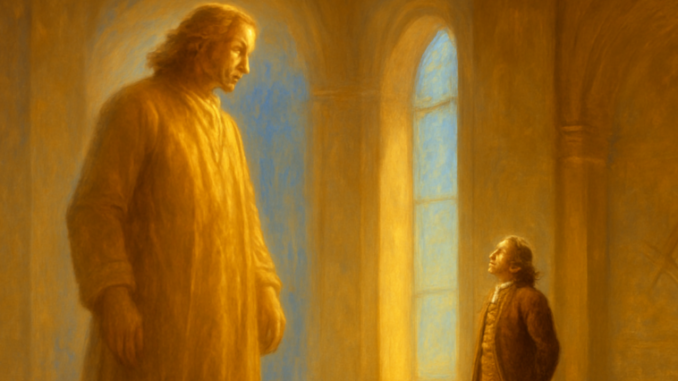
What if a being eight miles tall, hailing from a star in the constellation of Sirius, looked down upon the Earth and discovered its inhabitants? In 1752, Voltaire wrote a philosophical tale that brings this thought experiment to vivid life. Micromégas is no children’s story — it is a razor-sharp satire on human arrogance. And the question Voltaire implicitly poses is the very same question every Freemason should ask himself: how significant am I really, and what justifies my judgment of others?
A Giant Discovers Tiny Creatures
Voltaire’s story opens with Micromégas, an inhabitant of a planet orbiting Sirius. He is so immense that our tallest mountains would barely reach his ankles. Accompanied by a companion from Saturn — himself a giant by earthly standards at roughly a thousand meters tall — he embarks on a journey across the cosmos. When the two travelers finally reach our planet, they initially see nothing remarkable. Only through a magnifying glass do they spot ships, and within those ships, minuscule creatures that apparently think, speak, and philosophize.
The scene is comic, but the underlying message cuts deep. These microscopically small beings — humans — turn out to be utterly convinced that the universe was created for them. They debate metaphysics, quote Aristotle and Thomas Aquinas, and declare with absolute certainty how the cosmos is structured. Micromégas and his companion listen in astonishment at the self-assurance of creatures who seem so insignificant in the grand scheme of things.
The Paradox of Human Knowledge
What Voltaire exposes here is a fundamental contradiction. The human mind is capable of remarkable insights in mathematics, physics, and logic. Yet that same mind regularly lapses into absurd certainties about matters it cannot possibly fathom. The little philosophers aboard the ship can calculate the distance to the moon, yet they claim with equal confidence to know the nature of the soul and how God thinks.
True greatness lies not in the breadth of what you know, but in the honesty with which you acknowledge what you do not know.
This paradox strikes at a core value within Freemasonry: the search for truth demands intellectual humility. The initiation ritual reminds the candidate that he begins as a rough stone — not because he is worthless, but because perfection is a process, not a starting point. The Mason who believes he already knows everything has missed the very essence of the Craft.
Perspective as a Virtue
Voltaire was not a Freemason in the formal sense, though he moved in Enlightenment circles where many lodge brothers could be found. His thinking, however, aligns seamlessly with the philosophy that flourished in eighteenth-century lodges. The Enlightenment brought a new kind of humility — not the subservience to dogma, but the insight that human knowledge has limits, and that progress requires us to constantly revise our assumptions.
The Freemason learns this in the lodge through his encounter with symbols that never carry a single, fixed meaning. The square and compasses are not unambiguous instructions — they are invitations to reflect. They ask: how do you measure your actions? What limits do you set on your desires? In this way, they function exactly like Voltaire’s cosmic giants. They offer a perspective from the outside, through which what once felt certain suddenly becomes relative.
Brotherhood Beyond the Boundaries of the Known
One of the most striking moments in Micromégas comes when the giants discover that these tiny creatures, despite their insignificance, are capable of reason and compassion. Something like wonder arises — perhaps even respect. The chasm between Sirius and Earth proves not unbridgeable when both sides are willing to listen.
This resonates powerfully with the Masonic ideal of universal brotherhood. The lodge brings together people who in the outside world might never have spoken to one another. Different backgrounds, different convictions, yet united in the recognition that no one holds a monopoly on truth. That recognition is not a weakness — it is the very precondition for genuine connection.
The Blank Book as a Gift
At the end of Voltaire’s story, Micromégas presents the scholars with a book that, he promises, contains all the answers to their philosophical questions. When they open it at the Academy of Sciences in Paris, every page is blank. The satire is merciless. There is no ready-made answer, no ultimate revelation. The search itself is the answer.
For the Freemason, this image feels deeply familiar. The lodge does not promise secret knowledge to be handed over in a single evening. The work on the rough stone takes a lifetime. Anyone who expects that initiation will suddenly reveal everything will find the pages empty. But anyone who understands that the emptiness is an invitation to write his own story discovers in that very blankness the deepest wisdom.
Relativity as Liberation
Voltaire did not set out to discourage his readers — he wanted to liberate them. Acknowledging that we are tiny specks in the cosmic whole need not be a source of despair. On the contrary, it releases us from the burden of having to know and control everything. It makes room for wonder, for humor, for the willingness to learn from others.
The Freemason who reads Micromégas recognizes in it the spirit of the lodge. Not dogma, but the question stands at the center. Not rank, but the willingness to engage in self-reflection determines the worth of a brother. And not the scale of what you have achieved, but the sincerity of your search defines your greatness.
The question Voltaire leaves us with endures: if we could look at ourselves through the eyes of a cosmic traveler, what would we see? A being stubbornly clinging to supposed certainties, or someone who continues to search with an open mind and a humble heart? The answer is not found in a book — not even in this essay. The answer writes itself, one day at a time, in the way we choose to live.
Copyright text & image: devrijmetselaar.nl
Texts are based on the ideas and content of the author of devrijmetselaar.nl, reviewed, corrected, and supplemented with the assistance of OpenAI. Images are created based on the ideas of the author of devrijmetselaar.nl using OpenAI/DALL-E.

Be the first to comment