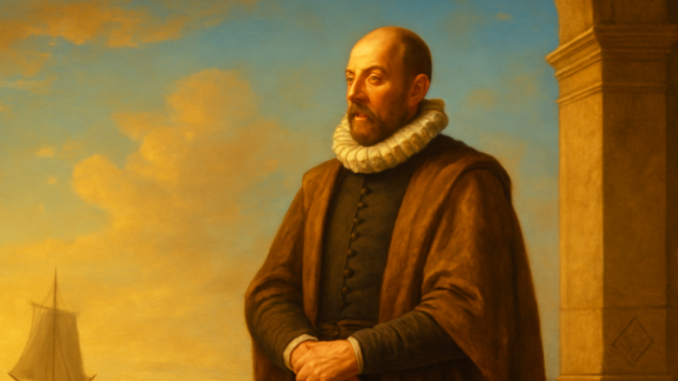
It is late in the evening. A Freemason sits alone in his study, a yellowed book open before him. He reads a passage by a sixteenth-century French thinker and feels the words reaching across the centuries, as though they were written for him personally. The question that surfaces is at once simple and unsettling: not what he has done, but why he did it. In that moment, two traditions touch — separated by four hundred years, yet united in the same search for sincerity.
The Heart of Montaigne‘s Essay
In one of his brief but penetrating essays, Montaigne argues that our actions cannot be separated from the intentions behind them. The results of what we do may shine in the eyes of the world, but the true value lies in what moved us when we began. A good deed performed out of vanity carries a very different weight than the same act born of genuine compassion. Montaigne invites us to look beyond the surface — past the praise and criticism of others — into the quiet chamber of our own conscience.
This is no idle thought experiment. Montaigne warns that we are remarkably skilled at deceiving ourselves. We construct noble narratives around our motivations while the actual driving forces behind our actions are sometimes far less flattering. This is precisely why self-reflection is not a luxury but a necessity. Anyone who refuses to examine his own intentions is building his life upon a foundation he has never inspected.
The Lodge as a Mirror for Intentions
Within Freemasonry, this question of motivation plays a central role. When someone enters the lodge, he is not asked about his worldly achievements. The question is subtler: Why are you here? What are you truly seeking? These questions are not designed to judge, but to invite the candidate toward honesty with himself. The ritual creates a space where superficial answers simply will not suffice.
The working tools used as symbols in Freemasonry — the square and compasses among them — point toward the construction of an inner edifice. But what kind of temple can you build if the foundation is crooked? Montaigne’s insight connects seamlessly here: it is not the magnificent façade that matters, but the integrity of the builder. The question is not whether your walls are straight, but whether your hands were clean when you raised them.
Brotherhood Beyond Outward Appearances
Montaigne writes about human relationships with a remarkable clarity. He knew that people tend to judge one another by outcomes — success, status, visible results. But true connection, he suggests, arises when we recognize each other in our vulnerability and in our honesty about what truly drives us. Freemasonry shares this vision. Brotherhood is not an alliance of perfect people. It is a community of seekers willing to face their own imperfections.
The real value of our deeds lies not in what the world sees, but in what we knew about ourselves when we performed them.
In the lodge, no one is asked to keep his mask in place. On the contrary, the work invites us to peel away layer after layer, searching for what lies beneath. This is no easy task. It takes courage to acknowledge that some good deeds sprang from less-than-noble motives, and that some failures were undertaken with the purest of intentions. Montaigne would recognize this as the beginning of genuine wisdom.
The Search for Inner Truth
Both Montaigne and Freemasonry place the pursuit of truth at the center of their concerns, but it is a particular kind of truth — not the truth of facts and figures, but the truth about ourselves. Who am I, really? What drives me? Where do I hide behind fine words? These questions are uncomfortable, yet they are also liberating. Whoever learns to understand his own motives becomes less dependent on the judgment of others.
Montaigne wrote that he made himself the subject of his own study — not out of narcissism, but because the human being is at once the most accessible and the most enigmatic subject in existence. The Freemason recognizes this instinctively. The work in the lodge is not aimed at changing the world out there. It is aimed at transforming one’s own rough stone into something useful, something authentic.
Intention as a Living Practice
None of this remains merely theoretical. Both Montaigne and Freemasonry emphasize that insight must be translated into practice. It is not enough to know that intentions matter — you must live by that knowledge every day. This means questioning yourself before you act, not only in hindsight. It also means accepting that you will sometimes fail, and that even failure can hold value when the intention behind it was sincere.
Consider these guiding principles as touchstones for daily life: Examine your motives before making a decision. Be honest about the gap between your words and your deeds. Seek out brothers and sisters who help you stay sharp and self-aware. Accept that perfection is impossible, but sincerity is always within reach.
It is in this living practice that the thought of Montaigne and the traditions of Freemasonry meet at their deepest point. Both acknowledge that the human being is a work in progress — never finished, always on the way. And both insist that the direction of that journey is determined by something invisible from the outside: the intention with which we take each step.
Four hundred years after Montaigne set down his pen, his question remains as urgent as ever. It is not what we do that defines us, but why we do it. For the Freemason, this is no abstract philosophical principle — it is a living invitation that sounds anew every time the lodge is opened. In that shared pursuit of honesty about our intentions, two traditions find each other, bound by the same conviction: that inner work is the measure by which everything else is weighed.
Copyright text & image: devrijmetselaar.nl
Texts are based on the ideas and content of the author of devrijmetselaar.nl, reviewed, corrected, and supplemented with the assistance of OpenAI. Images are created based on the ideas of the author of devrijmetselaar.nl using OpenAI/DALL-E.
Frequently Asked Questions
What does Montaigne's philosophy have to do with Freemasonry?
Montaigne believed that true value lies in our intentions and inner motivations rather than outward appearances, a principle that aligns perfectly with Freemasonry's emphasis on self-examination and integrity. Both traditions encourage members to look beyond surface achievements and examine what truly drives their actions, creating a path toward genuine personal development. This connection demonstrates how Freemasonry draws from timeless philosophical wisdom to guide its members toward sincerity and self-awareness.
Does Freemasonry judge candidates based on their accomplishments?
No — Freemasonry is not concerned with worldly status or achievements when someone petitions to join. Instead, the fraternity asks deeper questions about the candidate's true motivations and what they are genuinely seeking through membership. This approach ensures that the lodge becomes a space for authentic seekers rather than those pursuing external validation or status.
How does Freemasonry help members examine their own intentions?
The ritual, symbolism, and community of the lodge create a structured environment specifically designed for honest self-reflection. Working tools like the square and compasses serve as reminders that the quality of inner work matters far more than outward appearance, encouraging members to build their inner temple with integrity. The fraternal bonds formed in the lodge support members in facing their imperfections and motivations with courage and honesty.
Is Freemasonry only for people who are already perfect or enlightened?
Absolutely not — Freemasonry is explicitly a community of seekers and imperfect people committed to honest self-improvement. The fraternity welcomes men willing to examine themselves, acknowledge their flaws, and work toward greater integrity, regardless of where they begin their journey. This inclusive approach means that vulnerability and a genuine desire for growth are far more valuable than any pretense of perfection.


Be the first to comment