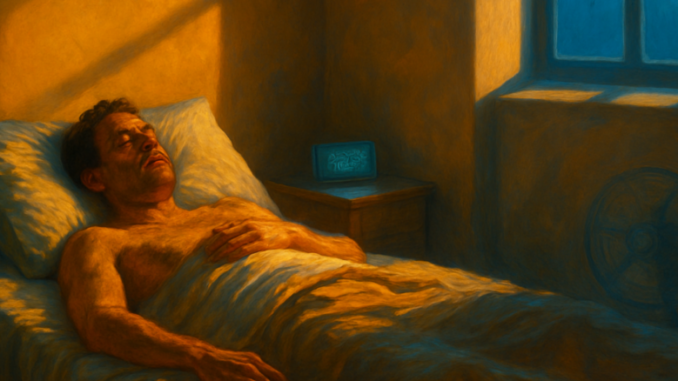
Last night, temperatures in parts of the country refused to drop below comfortable levels — what meteorologists call a tropical night. While many tossed and turned in sweat-soaked sheets, searching desperately for relief, a hidden question lay buried in the oppressive stillness. Not a question about the weather, but about ourselves. How do we behave when things become uncomfortable? As it turns out, the heat of a summer night can be an unexpected teacher in the art of ethical living.
The Boiling Point of Character
A thermometer measures temperature, but what measures our inner compass when the heat rises? In Freemasonry, we speak of working the rough ashlar into a perfect cube. This is not a one-time act but a lifelong process — one that becomes most visible in moments of discomfort. The tropical night serves as a kind of crucible in which our everyday patience, kindness, and self-control are put to the test.
When the night brings no relief, small irritations bubble to the surface. The neighbor who opens his window and plays music. The child who cannot sleep. The partner who claims the only fan. In these seemingly trivial moments, something ancient reveals itself — what the Greeks called sophrosyne: the art of moderation and self-mastery. It is easy to be virtuous when everything is going your way. The true test comes when sweat is beading on your forehead.
Heat as a Symbolic Trial by Fire
Across countless wisdom traditions, fire and heat symbolize a process of purification. Gold is refined in the furnace; steel is forged in the flame. The Freemason recognizes in these images the inner transformation necessary to become a better person. Viewed through this lens, the tropical night is not an enemy but an invitation. It asks us plainly: who are you, really, when your comfort zone is stripped away?
The person who masters themselves in the hour of trial builds more solidly than those who erect palaces in times of prosperity.
This ancient wisdom resonates powerfully in the context of a sleepless, sweltering night. The point is not about heroic deeds or grand sacrifices — it is about the small, invisible choices. Do you get up to bring a glass of water to someone in your household? Do you respond with understanding when a loved one is irritable from lack of sleep? These micro-moments form the very fabric of our ethical existence.
Seeing the Struggle of Others
A tropical night also reminds us that not everyone has equal means to cope with extremes. While one person switches on the air conditioning, another lies in a poorly insulated apartment with no way to cool down. Freemasonry teaches that true brotherhood extends beyond the walls of the lodge. Ethics is never merely a private affair — it reaches outward into the community.
In the heat of summer, the question of social responsibility becomes tangible. Who thinks of the elderly neighbor living alone? Who looks out for the homeless person who cannot find shade? The temperature makes no distinctions, but society does. Here, the personal touches the collective, and the inner work of self-improvement connects to outward action in the world.
Patience as a Building Block
One of the most underestimated virtues in our age of instant gratification is patience. The tropical night forces us to wait. To wait for sunrise and the hope of cooler air. To wait for sleep that may never come. This waiting is not a passive state — it is an active exercise in acceptance. The Freemason knows that growth takes time, that the rough ashlar is not polished in a single night.
Consider the layers of patience a single uncomfortable night demands: patience with yourself when sleep refuses to come; patience with others who are also struggling; patience with nature, which follows its own rhythm; and patience as the foundation upon which all other virtues are built.
Within this patience lies a deeper wisdom. It teaches us that we do not always have control, but we always have a choice in how we respond to what happens to us. This is the core of every ethical tradition, whether Stoic, religious, or humanist in nature. The tropical night becomes, in effect, a nocturnal lecture in the philosophy of living.
The Morning After the Trial
When the sun rises after a tropical night, many feel exhausted. And yet, something has also been gained. Every trial endured, no matter how small, adds something to our inner edifice. Freemasons speak of degrees and steps, of a gradual refinement of character. In this sense, the tropical night is a rung on the ladder, a station on the journey toward a more mature self.
It is tempting to regard the first hot night of the year as nothing more than a meteorological event. But those who look with different eyes see in it an invitation to self-reflection. How did I behave? Was I patient? Was I kind? Did I think of others? These questions are not meant as self-punishment — they are tools for growth.
The first tropical night of the year has already passed, but the questions it raised linger like morning dew. In the symbolic language of Freemasonry, every trial is an opportunity to work on ourselves. The heat tests our character; the night reveals our true nature. Perhaps that is the greatest gift of a sleepless summer night — not the memory of discomfort, but the insight into who we might become when we keep working the rough ashlar, even as sweat drips from our brow.
Copyright text & image: devrijmetselaar.nl
Texts are based on the ideas and content of the author of devrijmetselaar.nl, reviewed, corrected, and supplemented with the assistance of OpenAI. Images are created based on the ideas of the author of devrijmetselaar.nl using OpenAI/DALL-E.
Frequently Asked Questions
What does Freemasonry teach about character development during difficult times?
Freemasonry teaches that character is built through a lifelong process of refining oneself, much like working rough stone into a perfect cube. This inner transformation becomes most visible during moments of discomfort and trial, where our patience, kindness, and self-control are genuinely tested. The organization recognizes that true virtue is demonstrated not when life is easy, but when we face adversity with integrity and self-mastery.
How does Freemasonry use symbolism like fire and heat to teach ethical lessons?
Freemasonry employs ancient symbols of fire and heat to represent purification and inner transformation, much as gold is refined in a furnace and steel is forged in flame. These symbolic trials remind us that discomfort can be an invitation for personal growth and self-discovery. By viewing challenges through this lens, Freemasons learn that difficult moments are opportunities to strengthen their character and ethical foundation.
Does Freemasonry emphasize individual ethics or community responsibility?
Freemasonry teaches that true brotherhood extends beyond the lodge walls and encompasses community responsibility. The organization emphasizes that ethics is never merely a private affair but reaches outward to serve others, particularly those in vulnerable circumstances. Freemasons are encouraged to recognize the struggles of all people and to take action in supporting their communities during times of hardship.
What is the significance of small, everyday choices in Masonic ethics?
In Freemasonry, ethical living is not about grand gestures but about the small, invisible choices made in daily life—such as showing kindness to someone in distress or responding with patience to others' frustrations. These micro-moments of virtue form the very fabric of a person's ethical existence and moral character. Freemasonry teaches that consistent integrity in small matters builds a person far more solidly than any outward achievement.

Be the first to comment