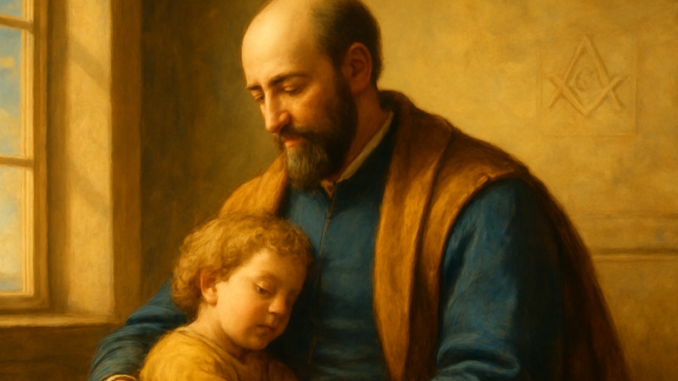
In 1580, the first edition of Michel de Montaigne’s Essays appeared in Bordeaux — a work that would permanently reshape Western philosophy. Among the personal reflections and sharp observations lies an essay that, at first glance, seems like an intimate family narrative: the eighth essay of the second book, on the affection of fathers for their children. But look deeper, and you discover a text rooted in ancient philosophical traditions, from Stoicism to Renaissance humanism, with surprising connections to the fraternal ideals that Freemasonry would embrace centuries later.
The Tower Library: Where Ancient Wisdom Converged
To understand which thinkers influenced Montaigne when he composed his essay on fatherly affection, we must first return to his famous tower library at his château in the Dordogne. On the ceiling beams, he had Latin and Greek maxims engraved — borrowed from the likes of Sextus Empiricus, Lucretius, and Seneca. This was no mere decoration. It was a daily confrontation with the wisdom of antiquity, a form of intellectual exercise that allowed him to test his own thoughts against those of his predecessors. When Montaigne writes about the relationship between father and child in Essay II,8, he is not simply a man recording his feelings. He is engaging in a dialogue with the dead.
Seneca and the Stoic Duty of Detachment
The influence of Lucius Annaeus Seneca is particularly palpable in this essay. Seneca, the great Stoic philosopher of the first century, wrote extensively about the art of letting go. In his Letters to Lucilius, he emphasizes that true love must not be possessive — that a father should raise his children as future free beings rather than as extensions of himself.
Montaigne adopts this Stoic principle and pushes it even further. He criticizes fathers who treat their children as property, who wield inheritance as a tool of power, and who refuse to give their offspring the space to become independent. The Stoic ethics of virtue — centered on self-mastery and detachment — thus form the moral skeleton of the entire essay.
Stoicism taught that a person must align his inner disposition with the natural order. A father who smothers his children with possessive love acts against nature. Montaigne translates this into a concrete plea: give your children responsibility early, share your possessions while you are still alive, and trust that the upbringing you have provided is enough.
Plutarch as Mirror and Guide
Alongside Seneca, Plutarch is the author Montaigne cites and admires most. The Greek biographer and moralist from Chaeronea wrote extensively in his Moralia about education, family bonds, and the formation of character. His treatise on the education of children circulated widely during the Renaissance and served as a guidebook for humanist educators.
Montaigne treated Plutarch as a conversation partner, not as an authority to be followed unquestioningly. In Essay II,8, this method is on full display: he adopts Plutarch’s idea that education is a matter for the entire community — not solely the biological father — but adds his own skeptical qualifications.
It was Plutarch who gave Montaigne the model of comparison. Just as Plutarch in his Parallel Lives set two great men side by side to illuminate their virtues and flaws, Montaigne places biological parenthood next to intellectual creation. Is fathering a book not as valuable as fathering a child? It is a bold question that springs directly from the Plutarchian method of moral comparison.
Skepticism as the Foundation of Honesty
Montaigne is often associated with Pyrrhonian skepticism — the philosophical tradition going back to Pyrrho of Elis, rediscovered during the Renaissance through the work of Sextus Empiricus. This skepticism holds that we must continually suspend judgment because certain knowledge is unattainable.
In Essay II,8, this attitude is unmistakable in the way Montaigne discusses his own fatherhood. He does not write as an authority who knows how things should be done, but as a searching mind who honestly admits that he has not always had the right feelings. That intellectual honesty — the ability to doubt yourself without being paralyzed by it — is one of skepticism’s greatest gifts to Western culture.
From the Stoics, Montaigne learned to let go. From Plutarch, he learned to compare. From the skeptics, he learned to doubt. Together, these traditions form the philosophical foundation of an essay that redefined parenthood as an act of trust rather than possession.
Renaissance Humanism and the Revaluation of the Individual
The broader intellectual climate in which Montaigne wrote was that of Renaissance humanism. Thinkers like Erasmus of Rotterdam and Giovanni Pico della Mirandola had placed human dignity back at the center of philosophical inquiry. The human being was no longer merely a subject of God or prince, but a creature with the capacity for self-realization.
Montaigne applies this humanist ideal to the father-child relationship. A child is not an extension of the father but an autonomous individual in the making. The father’s task is not to rule, but to guide. This idea, revolutionary in the sixteenth century, resonates deeply with the way Freemasonry would later shape the relationship between Master and Apprentice — as one of guidance, not subjugation.
From Aristotle to the Lodge: Spiritual Fatherhood as a Universal Ideal
There is a still deeper philosophical layer in Essay II,8 that deserves attention. Montaigne indirectly references Aristotle, who wrote in the Nicomachean Ethics that the creator loves his creation more than the creation loves its creator — just as a parent’s love for a child naturally exceeds the child’s love in return. This asymmetry, far from being a source of bitterness, is presented as the natural order of generative love.
Montaigne extends this Aristotelian insight into the realm of intellectual creation. The author who brings forth a book, the philosopher who nurtures an idea — these are acts of spiritual fatherhood that mirror biological parenthood. The implication is profound: fatherhood is not confined to biology. It is a universal principle of creation, care, and eventual release.
This concept finds a striking parallel in Masonic tradition. The relationship between a more experienced Brother and a newer member of the Lodge is, in many ways, a form of spiritual fatherhood. It is not about authority or control, but about transmitting knowledge, modeling virtue, and trusting the younger Brother to find his own path toward the Light. Montaigne could not have known about Freemasonry, yet the philosophical impulses that shaped his essay — Stoic detachment, Plutarchian comparison, skeptical humility, humanistic respect for the individual — are the very same impulses that would later animate the Craft.
The lesson Montaigne draws from his ancient sources is ultimately a Masonic one, even if he never wore an apron: the greatest act of love is to prepare someone to stand on their own, to shape a rough stone not in your own image, but in its own best possible form.
Montaigne’s essay on fatherly affection is far more than a personal meditation on family life. It is a philosophical tapestry woven from Stoic ethics, Plutarchian method, Pyrrhonian skepticism, and Renaissance humanism — traditions that together redefine parenthood as guidance rather than ownership. For Freemasons, the resonance is unmistakable. The same principles that led Montaigne to argue for letting go, for trusting in what has been built, and for honoring the autonomy of the next generation are the principles that underpin the fraternal bonds of the Lodge. In reading Montaigne, we do not merely encounter a sixteenth-century father wrestling with his feelings. We encounter a timeless call to build, to teach, and — when the time is right — to step aside.
Copyright text & image: devrijmetselaar.nl
Texts are based on the ideas and content of the author of devrijmetselaar.nl, reviewed, corrected, and supplemented with the assistance of OpenAI. Images are created based on the ideas of the author of devrijmetselaar.nl using OpenAI/DALL-E.
Frequently Asked Questions
What is the main topic of Montaigne's Essay II,8?
Essay II,8 focuses on the affection of fathers for their children. While it appears to be an intimate family narrative, it is actually rooted in ancient philosophical traditions and explores how fathers should raise their children as independent beings rather than possessions.
How did Montaigne's tower library influence his philosophical writing?
Montaigne's tower library at his château in the Dordogne had Latin and Greek maxims from philosophers like Sextus Empiricus, Lucretius, and Seneca engraved on the ceiling beams. This served as a daily intellectual exercise that allowed him to test his own thoughts against ancient wisdom and engage in a dialogue with historical thinkers.
What Stoic principle from Seneca influenced Montaigne's views on fatherhood?
Seneca emphasized that true love must not be possessive and that fathers should raise children as future free beings rather than extensions of themselves. Montaigne adopted this Stoic principle of detachment and used it to criticize fathers who treat children as property, wield inheritance as a tool of power, or refuse to grant their offspring independence.

Be the first to comment