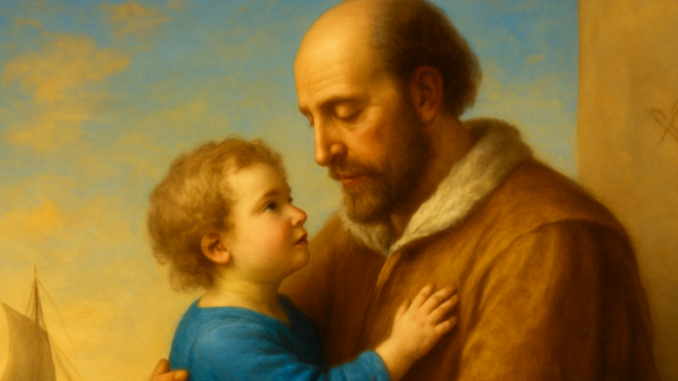
In 1580, Michel de Montaigne published an essay that appears at first glance to be a personal reflection on parenthood. Look closer, however, and it reveals itself as a profound meditation on human connection. His thoughts on the affection of fathers for their children touch on questions that would become central to Freemasonry centuries later: What does it truly mean to be connected to another human being? How does love relate to duty? Where does possession end and genuine affection begin? The parallels between Montaigne’s thinking and the Masonic tradition are remarkably sharp — and deserve to be explored through the lens of both.
A Sixteenth-Century Thinker and an Ancient Brotherhood
When Montaigne retreated to his estate in the Dordogne around 1578 to write his famous essays, organized Freemasonry as we know it did not yet exist. The first Grand Lodge was not founded until 1717 in London, under the guidance of figures such as James Anderson and Jean-Théophile Desaguliers. Yet Montaigne and the later Masonic tradition share a striking starting point: the belief that honest self-examination is the key to a virtuous life.
In his essay on fatherly affection, Montaigne dissects the bonds between parent and child with a precision that calls to mind the work done within a lodge, where brethren invite one another to reflect openly on their own behavior and motives. He wrote during a time of religious wars, political turmoil, and deep social division in France. In that very context, he chose not to preach but to question. He examined his own feelings as a father and openly admitted that paternal love is not always natural or pure. Sometimes what we call affection is in reality a form of self-interest — a projection of our own desires onto the child.
That honesty, that willingness to turn the mirror on yourself, is precisely what Freemasonry refers to as the rough ashlar: the unworked material of one’s own character that must be refined with patience and courage.
Connection Beyond Possession
One of Montaigne’s most striking arguments in this essay is that true affection only arises when a father no longer views his child as an extension of himself. He compares the relationship to creating a work of art: at some point, the creator must let go and allow the work to find its own way. This idea touches on a fundamental Masonic principle. In the lodge, brethren learn that connection is not about control or hierarchy, but about mutual respect and the willingness to recognize the other as a free and independent being.
Brotherhood in the Masonic sense is never possessive. It demands the ability to set aside the ego in order to make space for genuine encounter. True connection — whether between father and child or between brethren in a lodge — only emerges when affection is free from the need to possess or control.
The Mirror of Self-Reflection
Montaigne emphasizes in his essay that fathers who treat their children harshly are in truth reflecting their own insecurities. He writes about fathers who deny their sons freedom out of fear of becoming irrelevant, and about patriarchs who wield their inheritance as an instrument of power. These observations are not only psychologically acute — they also resonate with Freemasonry’s quest for truth.
In the Masonic tradition, the mirror is a powerful symbol: whoever seeks the light must first be willing to acknowledge the shadow within. Montaigne does exactly that. He analyzes the darker sides of parental authority without condemnation, but with a gentleness that leaves room for growth.
It is no coincidence that later Enlightenment thinkers closely associated with Freemasonry — such as Voltaire and Johann Wolfgang von Goethe — regarded Montaigne as one of their great predecessors. Voltaire called him the first man who wrote honestly, and Goethe admired his ability to find universal truths in everyday experience. Both saw in Montaigne a spirit worthy of the lodge: someone who used the personal as a gateway to the universal, and who never shied away from self-examination.
Intellectual Creation as the Highest Bond
Remarkably, Montaigne places the bond with intellectual creations — such as his own essays — above the biological bond with children. He writes that what the mind produces is more intimately connected to ourselves than what the body brings forth. This idea resonates deeply with the Masonic tradition, in which building the inner temple — the spiritual work on character and wisdom — is regarded as the highest purpose.
The Freemason does not merely build structures of stone; he builds ideas, virtues, and a legacy that transcends the material world. Montaigne would have recognized this principle immediately.
Where Montaigne and the Lodge Meet
The overlap between Montaigne’s essay and Masonic values can be distilled into several core principles that are essential to both traditions:
Self-reflection as a moral duty: Both Montaigne and Freemasonry regard honest self-examination as the first step toward a virtuous life.
Connection without possession: Genuine affection — whether in parenthood or brotherhood — requires letting go of control.
Spiritual growth over material gain: The inner temple is more valuable than the outer façade.
Gentleness as strength: Acknowledging your own shortcomings without self-condemnation opens the door to real improvement.
What Montaigne wrote in the quiet of his study about the relationship between fathers and children carries a universality that effortlessly transcends the boundaries of time and tradition. The Freemason who enters the lodge today recognizes in Montaigne’s words the same invitation that echoes through every Masonic ritual: look inward with courage, connect with others in freedom, and build something that outlasts the self. Four centuries may separate the essayist from the modern lodge, but the lesson endures — true connection begins where possession ends, and the greatest work we can do is the work we do upon ourselves.
Copyright text & image: devrijmetselaar.nl
Texts are based on the ideas and content of the author of devrijmetselaar.nl, reviewed, corrected, and supplemented with the assistance of OpenAI. Images are created based on the ideas of the author of devrijmetselaar.nl using OpenAI/DALL-E.
Frequently Asked Questions
What is the connection between Michel de Montaigne's essay on fatherly affection and Freemasonry?
Although Montaigne wrote his essay in 1580, centuries before organized Freemasonry was established in 1717, his ideas on honest self-examination and genuine human connection align remarkably with Masonic principles. Both traditions emphasize the importance of introspection and virtue, with Montaigne's willingness to honestly examine his own motivations paralleling what Freemasonry calls the 'rough ashlar'—the unworked material of one's character that must be refined through self-reflection and courage.
What does Montaigne mean by suggesting that true affection requires letting go of possession?
Montaigne argues that fathers who view their children as extensions of themselves cannot experience genuine affection, only self-interest. He compares this to creating a work of art—at some point, the creator must release control and allow the work its independence. This principle reflects a fundamental Masonic ideal: that true connection is based on mutual respect and freedom, not control or hierarchy.
Why is Montaigne's approach to examining fatherly love considered radical for his time?
During a period of religious wars, political turmoil, and deep social division in sixteenth-century France, Montaigne chose not to preach moral lessons about paternal love. Instead, he questioned and honestly examined his own feelings, openly admitting that paternal love is not always natural or pure, and that it can sometimes be a projection of self-interest. This willingness to engage in honest self-examination rather than accept conventional wisdom was both courageous and philosophically innovative for his era.



Be the first to comment