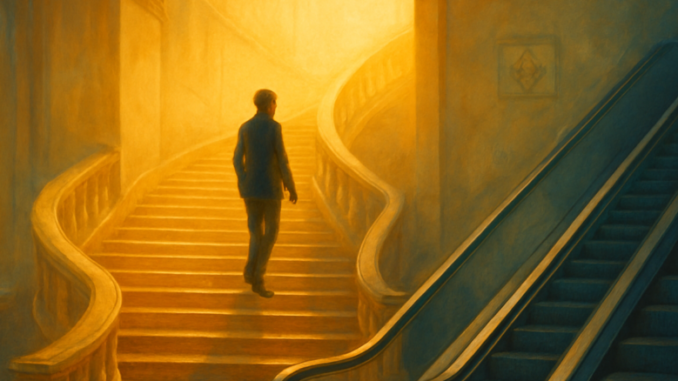
On November 22, 2026, eight people were injured when an escalator at Amsterdam’s Bijlmer ArenA station suddenly accelerated out of control. A mechanism designed to move people effortlessly became a source of chaos and danger. The incident raises uncomfortable questions about our blind trust in automation — but it also touches on something far older and deeper: the meaning of the staircase itself, and the difference between being moved without thought and consciously taking a step.
The Staircase as Archetype in Architecture and Ritual
Staircases are among the oldest architectural elements known to humankind. The ziggurats of Mesopotamia, more than four thousand years old, were essentially enormous stepped constructions connecting earth to heaven. The pyramids of Egypt, the temples of the Maya, the Acropolis of Athens — wherever civilizations erected their most sacred structures, the staircase played a central role. It was never merely a practical tool for bridging differences in height. The staircase was a ritual route, a path of transformation.
In the Temple of Solomon, which holds a special place in Freemasonry, the biblical Book of Kings describes a winding staircase leading to the upper chambers of the sanctuary. This staircase was not simply climbed. Priests prepared themselves, purified themselves, and ascended the steps with deliberate purpose. Each step marked a transition from the profane to the sacred. The legendary master builder Hiram Abiff, whose story plays such a vital role in Masonic tradition, is said to have overseen the orderly construction of this sanctuary — including the stairs that functioned as thresholds between worlds.
The Winding Staircase in Freemasonry
Within Masonic ritual, the winding staircase occupies a prominent place, particularly in the Fellow Craft degree. The candidate is invited to ascend a staircase consisting of a specific number of steps. This is not a physical staircase within the lodge but an imagined journey, accompanied by words and symbolic actions. Each step represents a form of knowledge or virtue: the liberal arts and sciences, the human senses, the orders of architecture. The Fellow Craft learns that ascent does not happen by itself. It requires effort, attention, and the willingness to pause and reflect on what each step means.
James Anderson, who compiled the first constitutions of modern Freemasonry in 1723, emphasized the importance of order and gradation within the Masonic system. The staircase was more than a metaphor — it was a structuring principle. Just as an Entered Apprentice must first master the fundamentals before becoming a Fellow Craft, so each step must be consciously taken before the next one becomes accessible. Jean Théophile Désaguliers, co-founder of the Grand Lodge of England and a natural philosopher, might well have expressed it this way: the laws of mechanics apply to the mind as well. Skip a step, and you lose your balance.
When the Staircase Loses Its Ritual
What happened at Bijlmer ArenA station? An escalator — a mechanical staircase that relieves humans of all effort — began moving faster than intended. People standing passively on it lost their footing. The automation that was supposed to carry them became their adversary. It is a striking illustration of what happens when movement is severed from consciousness. No one on that escalator was prepared for the moment the machine went its own way. No one had reason to be alert, because the entire construction is designed to make alertness unnecessary.
A staircase you do not climb yourself is not a path of growth but a mechanism of trust without awareness.
This stands in sharp contrast to the way the staircase functions in ritual traditions. In a Masonic ritual, the staircase is never passive. The candidate is not transported upward — he ascends of his own accord. Each step demands an action, a response, a moment of reflection. The ritual compels presence. And it is precisely that presence, that conscious engagement with the act, that makes the journey valuable. The Greek philosopher Plato described a comparable ascent in his Allegory of the Cave: the path toward the light is arduous, even painful, but only those who walk it themselves achieve genuine insight.
Conscious Movement in an Automated World
The incident at Bijlmer ArenA is, first and foremost, a technical failure with human consequences. The injured deserve care, and the mechanism deserves thorough investigation. But if we consider the event more broadly, it touches on a theme of increasing urgency: the relationship between humans and automation, between acting with intention and being passively transported.
Johann Wolfgang von Goethe, himself a Freemason and author of a body of work steeped in initiation motifs, repeatedly warned in his writings against the person who surrenders control over his own fate. In Wilhelm Meister’s Journeyman Years, he sketches a world in which craft and conscious effort are the keys to a meaningful existence. The Sorcerer’s Apprentice, one of his best-known ballads, tells of a young man who unleashes magical forces without understanding them — with disastrous consequences. It is tempting to hear in a runaway escalator a modern echo of that warning.
What Ritual Teaches Us About the Everyday Staircase
The lesson that Freemasonry embeds in its staircase ritual is not that we should avoid all escalators. It is more subtle than that. The ritual reminds us that every transition — every step upward or downward — is a moment of choice. Consciousness is what distinguishes a living, thinking person from a passenger on a conveyor belt. That lesson applies not only inside the lodge but at every station, in every stairwell, at every threshold we encounter in our lives.
The ritual of the winding staircase teaches us that ascent requires effort. Awareness at every step is not a luxury but a necessity. Automation without alertness makes us vulnerable. And across all cultures and centuries, the staircase remains a universal symbol of conscious transformation — a reminder that the most meaningful journeys are those we undertake step by deliberate step.
The next time you step onto an escalator, a staircase, or any kind of threshold in life, consider this: are you ascending, or are you merely being moved? Masonic ritual has preserved the ancient wisdom that every step matters — that growth demands our active participation, not our passive trust. In a world increasingly designed to carry us without our effort, the simple act of climbing a staircase with full awareness may be one of the most quietly radical things we can do.
Copyright text & image: devrijmetselaar.nl
Texts are based on the ideas and content of the author of devrijmetselaar.nl, reviewed, corrected, and supplemented with the assistance of OpenAI. Images are created based on the ideas of the author of devrijmetselaar.nl using OpenAI/DALL-E.
Frequently Asked Questions
What is the significance of the staircase in Freemasonry?
In Freemasonry, the winding staircase is a central symbol, particularly in the Fellow Craft degree. It represents a journey of ascent that requires deliberate effort, attention, and reflection. Each step symbolizes different forms of knowledge or virtue, such as the liberal arts and sciences, human senses, and architectural orders. Unlike an escalator that moves people passively, the Masonic staircase emphasizes conscious, purposeful progression from the profane to the sacred.
How does the Temple of Solomon connect to Masonic staircase symbolism?
The Temple of Solomon features prominently in Masonic tradition through its winding staircase, described in the biblical Book of Kings. This staircase was not simply climbed but served as a ritual route where priests prepared and purified themselves before ascending to the upper chambers. Each step marked a transition from the profane to the sacred, establishing the precedent for the staircase as a threshold between worlds—a concept that became central to Masonic ritual and the legend of Hiram Abiff.
Why are staircases considered sacred in ancient civilizations?
Staircases were never merely practical structures for bridging height differences in ancient civilizations. They were ritual routes designed to facilitate transformation and connection between the earthly and divine realms. This is evident in the ziggurats of Mesopotamia, Egyptian pyramids, Mayan temples, and the Greek Acropolis. The staircase functioned as an architectural and spiritual element that guided people through deliberate, meaningful ascent toward the sacred.

Be the first to comment