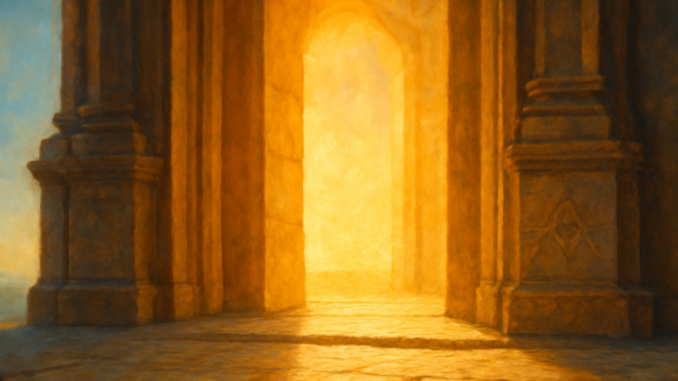
A threshold is never just a threshold. When someone returns after years of absence to a place they once left behind, something far greater than a geographical journey takes place. A ritual unfolds — an act laden with meaning that reaches well beyond what the eye can see. While the circumstances leading to such a return may capture public attention, the deeper question is this: what does it truly mean to cross a threshold a second time?
The Threshold as a Borderland
In Freemasonry, the threshold holds a place of profound significance. Entering a lodge is not merely a matter of stepping through a door — it is the crossing of an inner boundary. The threshold marks the transition from the profane to the sacred, from the everyday to the deeply meaningful. This is no arbitrary architectural feature. Since time immemorial, the threshold has served as a symbol of transformation.
The Romans even had a god of the threshold: Janus, the two-faced deity who gazed simultaneously toward the past and the future. His name lives on in our month of January — that collective moment when we all cross a threshold into a new year. What this symbolism tells us is that every transition demands a moment of awareness. You cannot simply step across a threshold. You must be ready for it.
The Ritual of Departure and Return
Symbolic journeys lie at the heart of Masonic ritual. The candidate is led in blindfolded, undergoes trials, and passes through stages of darkness into light. This pattern mirrors a universal human story: the departure, the transformation, and the return. The literary scholar Joseph Campbell called it the Hero’s Journey — a narrative structure found in mythologies across the world.
But returning is not the same as going back. The person who returns has been changed. The threshold you once crossed before may look the same, yet it is fundamentally different — because you are different. In Greek tragedy, this theme surfaces again and again. Odysseus returns to Ithaca, but he is no longer the man who left twenty years earlier. His return demands a new ritual — one of recognition, of reconciliation.
Reconciliation as Inner Work
Freemasonry speaks purposefully about building the inner temple. Those who work on themselves inevitably work on their relationships with others. Reconciliation never begins with the other person — it begins within one’s own heart. The rough ashlar that symbolizes the Entered Apprentice must be shaped and refined before it can take its place in the greater structure.
Returning is not about undoing a departure. It is about completing an inner journey that only becomes visible when the threshold is crossed once more. This does not mean reconciliation is easy, nor that it always succeeds. But the ritual of return provides a framework within which reconciliation becomes possible. By consciously marking the return — by turning it into a meaningful moment — space for transformation opens up.
This is why so many cultures have rituals surrounding homecoming: fathers waiting for lost sons, communities welcoming their travelers with ceremony. The act of return, when ritually acknowledged, becomes an invitation to heal.
The Symbolic Language of the Body
In Masonic ritual, great attention is paid to the posture and movement of the body. How you stand, how you walk, how you extend your hand — these are not empty forms but expressions of an inner state. When someone returns to a place marked by conflict, they speak not only with words but with their entire being.
The philosopher Maurice Merleau-Ponty wrote extensively about the body as a carrier of meaning. We communicate not only through what we say but through how we are present. A return is therefore always a bodily event. The tension in the shoulders, the hesitation before the door, the first step across the threshold — all of it tells a story that runs deeper than words can capture.
What Preceded and What Follows
The media tend to focus on backstory — the conflicts, the statements, the ruptures. But from a Masonic perspective, the question of what comes next is at least as important. A ritual is not merely a commemoration of the past; it is an opening toward the future. By consciously crossing the threshold, by ritualizing the return, a new chapter begins.
Johann Wolfgang von Goethe, himself a Freemason, wrote about the necessity of dying and becoming. Every transformation requires that something be released before something new can emerge. This is the deeper meaning of every ritual: it marks a transition, a small death that makes room for new life.
The Universal Lesson of the Threshold
What can we learn from the symbolism of return and thresholds? Perhaps this: that every transition in our lives offers a chance for reflection. You don’t need to be a member of a lodge to pause and consider the thresholds you cross. Every morning is a small return to life. Every conversation with someone from whom you’ve grown estranged is a ritual of reconnection.
Freemasonry does not offer answers — it offers methods. It teaches us to live consciously, to discover meaning in actions that might otherwise pass unnoticed. When someone returns to a place they once left, the outside observer sees only a journey. But those who have learned to see symbolically recognize the ritual unfolding before them: the threshold being crossed, the transformation reaching completion, the possibility of reconciliation opening wide.
The threshold remains a borderland — a place where past and future meet. Those who return carry their entire journey with them. And while we can never know how another person’s return will unfold, we can appreciate its symbolic depth. For in every return, in every ritual of reconciliation, something of the universal human quest is reflected: the search for connection, for meaning, and for inner peace.
Copyright text & image: devrijmetselaar.nl
Texts are based on the ideas and content of the author of devrijmetselaar.nl, reviewed, corrected, and supplemented with the assistance of OpenAI. Images are created based on the ideas of the author of devrijmetselaar.nl using OpenAI/DALL-E.
Frequently Asked Questions
What is the significance of the threshold in Freemasonry?
In Freemasonry, the threshold represents far more than a physical doorway. It marks the transition from the profane (everyday) to the sacred (deeply meaningful). It symbolizes transformation and inner boundary-crossing. The concept is so ancient that the Romans had Janus, a two-faced god of the threshold, who looked simultaneously toward the past and future. Every threshold crossing demands a moment of awareness and readiness for transformation.
How does the Masonic journey relate to the Hero's Journey described by Joseph Campbell?
Masonic ritual follows the Hero's Journey pattern: a candidate is led blindfolded through trials, passes through stages of darkness into light, and undergoes transformation. This mirrors the universal narrative structure found in mythologies worldwide—departure, transformation, and return. However, returning is not the same as going back; the person who returns has been fundamentally changed by their experiences.
Why does reconciliation begin within one's own heart according to Freemasonry?
Freemasonry teaches that reconciliation never begins with another person—it begins within one's own heart. This reflects the broader Masonic principle of building the inner temple through self-work. Those who work on refining themselves, like the rough ashlar (stone) of the Entered Apprentice being shaped and refined, inevitably improve their relationships with others. Inner transformation is the foundation for outward reconciliation.

Be the first to comment