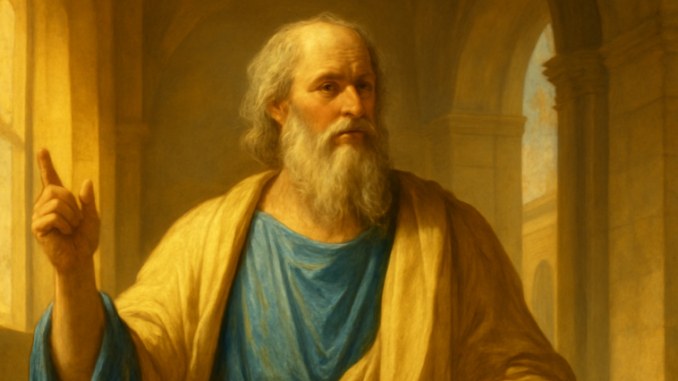
In 348 BC, Plato died in Athens while still working on his most extensive dialogue: The Laws. This final work contains no lofty abstractions — instead, it offers concrete prescriptions for governing a city. Where his celebrated Republic describes the perfect state through philosophical idealism, The Laws presents a workable alternative: a blueprint that accounts for human limitations. For anyone interested in the origins of Western legal philosophy, the design of communities, or the deeper principles behind Freemasonry, this ancient text remains an indispensable source.
The Historical Context of The Laws
Plato wrote The Laws in his old age, after twice attempting to realize his political ideals in Syracuse. Both attempts had failed. The philosopher had learned firsthand how difficult it was to translate philosophical principles into political reality. These disappointments profoundly shaped his final work: where the Republic placed the philosopher-king at the center of government, Plato now acknowledged that the law itself must hold supreme authority. No person, however wise, could stand above the law.
The dialogue takes place during a pilgrimage on Crete, between three elderly men: an unnamed Athenian (generally regarded as Plato’s mouthpiece), the Spartan Megillus, and the Cretan Cleinias. Together, they design a legal framework for a fictional colony called Magnesia. The setting is deliberate: in antiquity, Crete was considered the cradle of lawgiving, where the mythical King Minos was believed to have received his laws directly from Zeus.
The Central Idea: Law as Educator
The central theme of The Laws is that good legislation does not merely prohibit and punish — it educates. Plato compares the lawgiver to a physician who not only prescribes medicine but also explains why the treatment is necessary. Every law, he argues, should be accompanied by a preamble: an explanation that persuades the citizen of its purpose. This was a revolutionary idea. Laws were not commands imposed from above, but invitations to virtuous living.
“Good laws shape the character of citizens; they are not merely rules, but teachers of virtue.”
Plato addresses virtually every aspect of communal life in The Laws: from marriage and education to property rights and criminal justice. He advocates a mixed constitution that combines elements of monarchy and democracy, designed to prevent tyranny. Power is distributed across multiple institutions: a council of 360 members, nocturnal assemblies of wise elders, and appointed officials who oversee education and religion.
Striking Examples from the Work
One of the most remarkable proposals concerns land ownership. Plato suggests dividing the territory into 5,040 inalienable plots — a number chosen because it is divisible by an unusually large number of factors, making it practical for administrative purposes. Citizens may not sell or mortgage their plot. In this way, Plato prevents wealth from accumulating in the hands of a few while others fall into poverty. This economic equality forms the foundation for political stability.
Education receives equally detailed attention. Plato prescribes that all children — boys and girls alike — receive the same training in gymnastics, music, and arithmetic. Play and dance are not mere recreation; they shape character. Through shared rituals and festivals, the unity a community needs is created and sustained. The state determines which stories and songs are appropriate, placing art in the service of moral formation.
The Relevance of Plato’s Insights Today
What can we learn from a work that is nearly 2,400 years old? The idea that laws should not only punish but also persuade resonates strongly with contemporary debates about public support for policy. Plato understood that rules citizens neither understand nor consider fair will inevitably meet resistance. His emphasis on education as the foundation of society remains strikingly relevant at a time when the quality of education is under intense scrutiny worldwide.
The principle that laws must apply equally to all — and cannot be enforced at the whim of those in power — has roots in this ancient Greek text. Through Roman thinkers like Cicero and Church Fathers like Augustine, Plato’s ideas about law and society profoundly influenced the Western tradition. Much of what we now take for granted in jurisprudence owes a debt to The Laws.
Connections to Freemasonry
For Freemasons, The Laws offers particularly rich points of connection. Plato’s emphasis on communal rituals — on forming character through shared practices — mirrors what takes place in lodges on a regular basis. His conviction that a society must be built upon shared values and symbolic actions touches the very core of what Masonic brotherhoods aspire to achieve.
The building metaphor Plato occasionally employs is especially striking: the lawgiver acts as an architect who designs the city, shaping its structure so that its inhabitants may flourish. This image resonates deeply with Masonic symbolism, where the tools of the stonemason serve as allegories for moral self-improvement and the construction of a just society. The lodge itself is, in a sense, a Magnesia in miniature — a carefully designed space where shared ritual, education, and moral reflection combine to form better individuals and, by extension, a better world.
A Practical Idealism
The Laws is often described as Plato’s most realistic work. Where his earlier writings sought perfection, here he acknowledges that human beings are not perfect. The law compensates for our weaknesses; it provides structure where self-discipline falls short. This pragmatism makes the work more accessible than the more abstract Republic, though ironically, it is far less widely read.
The key principles Plato lays out can be summarized as follows:
Law as educator: rules accompanied by explanation and persuasion. Mixed constitution: a balance between authority and freedom. Equal land ownership: economic stability as the basis for harmony. Universal education: character formation through art and physical activity. Communal rituals: unity through shared practices.
Aristotle, Plato’s most famous student, would later criticize some of the proposals in The Laws, yet he acknowledged the work’s enduring value. The dialogue stands as a testament to a philosopher who had tempered his ideals after a lifetime of experience — and who, in doing so, produced something arguably more valuable than perfection: a vision grounded in reality.
Plato’s Laws is a fascinating final testament from a philosopher who refined his vision through decades of experience and disappointment. The work invites us to reflect on a question that remains as urgent now as it was in ancient Athens: how do we live together? What rules do we need, and how do we ensure those rules are experienced not as coercion, but as shared wisdom? For Freemasons, who devote themselves to building both character and community through ritual, symbol, and brotherhood, Plato’s answers continue to illuminate the path.
Copyright text & image: devrijmetselaar.nl
Texts are based on the ideas and content of the author of devrijmetselaar.nl, reviewed, corrected, and supplemented with the assistance of OpenAI. Images are created based on the ideas of the author of devrijmetselaar.nl using OpenAI/DALL-E.



Be the first to comment