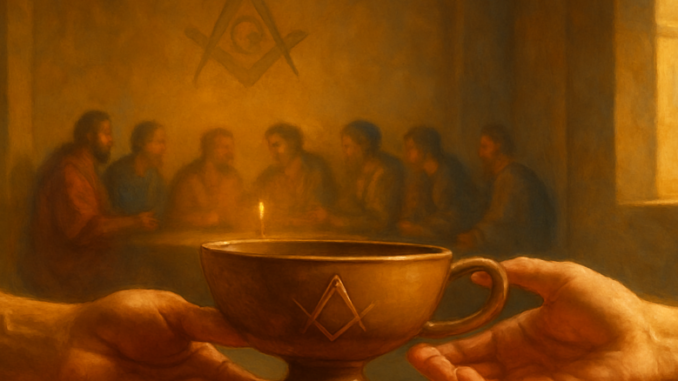
A drinking cup passed from hand to hand. A circle of men speaking about what truly moves them. In Plato’s Symposium, written around 385 BCE, guests gather to explore the nature of love. What initially appears to be a philosophical conversation about romance unfolds into a profound exploration of human connection, the longing for beauty, and the transformative power of community. For anyone familiar with both classical philosophy and Freemasonry, the parallels are striking — and deeply instructive.
The Drinking Cup as a Symbol of Shared Wisdom
The Symposium opens with an everyday ritual: the sharing of wine. The host, Agathon, receives his friends following his victory at a dramatic competition. The guests agree to drink moderately and instead deliver speeches in honor of Eros, the god of love. This seemingly simple scene carries deeper significance. The cup passed around the table symbolizes not mere conviviality, but the sharing of insight. Each speaker fills the evening with his own perspective, and from this multiplicity of voices a richer understanding slowly emerges.
In Freemasonry, we recognize similar moments where sharing stands at the center of the experience. The lodge is a space where brethren exchange their thoughts, where every viewpoint contributes to a greater whole. Just as Plato’s guests each illuminate a different facet of love, so each Freemason casts his own light on the questions that occupy the brotherhood. The goal is not to arrive at one definitive answer, but to seek together.
Diotima and the Ladder of Beauty
The climax of the Symposium is the speech Socrates attributes to Diotima, a wise woman from Mantinea. She describes love as an ascent: from the admiration of one beautiful body, through the appreciation of noble souls and virtuous deeds, toward the ultimate contemplation of Beauty itself. This ascending movement is not a flight from the earthly — it is a deepening of it. The physical forms the first rung, not something to be discarded.
In Freemasonry, love is not mere sentiment but an active force that binds brethren in their shared pursuit of truth and beauty.
Diotima’s ladder calls to mind the Masonic journey from darkness to light. The candidate begins blindfolded, in ignorance, and gradually ascends through the ritual degrees. Each degree reveals new insights, just as each rung on Diotima’s ladder opens a deeper understanding of beauty. The final goal is not to reach a static point of arrival, but to sustain the striving itself. It is no accident that Socrates called Eros a daimon — an intermediary being that mediates between the mortal and the divine.
Aristophanes and the Search for Wholeness
Another speaker, the comic playwright Aristophanes, tells the myth of the original double-beings who were split in two by Zeus. Ever since, each person searches for their lost other half. This seemingly playful tale touches something essential: the longing for completion. We experience ourselves as incomplete and seek in others what we lack.
In Freemasonry, the rough ashlar is hewn into a perfect cube. This symbol expresses the idea that we work upon ourselves, smoothing our imperfections. Yet this work never happens in isolation. The individual stone finds its place within a larger structure — the temple of humanity. Aristophanes’ myth and the Masonic symbol point toward the same truth: fulfillment arises from connection. The search for wholeness is both an inward journey and a relational one.
Brotherly Love and the Pursuit of Virtue
What distinguishes Plato’s dialogue from merely romantic reflections is its emphasis on the ethical character of love. Phaedrus opens the evening with the observation that love inspires virtue. A lover wishes to be admired by the beloved and therefore avoids shameful deeds. Love makes us courageous and generous.
This resonates deeply with the Masonic conviction that brotherhood provides a moral impulse. The bond between brethren is not casual or non-committal — it carries mutual responsibility. We strive for self-improvement not only for our own sake, but for the sake of the community. The awareness of being seen by others, of being held accountable by brothers who care, spurs us toward integrity. Just as Phaedrus claimed that an army of lovers would be invincible, the bond between Freemasons forms a force that transcends the individual.
The Unfinished Dialogue
The Symposium does not end with a tidy conclusion. Alcibiades bursts in drunk and disrupts the order. Conversations overlap. Some guests fall asleep. Socrates remains awake until last and departs at dawn for the marketplace. This open ending is telling. The dialogue about love has no closure, because the subject is inexhaustible.
Freemasonry shares this same quality of incompleteness. The temple is never finished. The work on the stone is never done. This is not a failing — it is the very essence of the endeavor. The longing itself, the eros toward wisdom and connection, is the driving force. Anyone who believes they have reached the final destination has misunderstood the journey.
Enduring Lessons from an Ancient Feast
The parallels between Plato’s Symposium and Freemasonry converge around several key themes that remain as vital today as they were in ancient Athens:
- Love as a catalyst for moral growth — not romantic love alone, but the deeper love that drives us to become better versions of ourselves.
- Community as a space for shared wisdom — where individual perspectives combine to form something greater than any single voice could achieve.
- The ascent from the material to the spiritual — a progressive journey that honors every stage along the way.
- Incompleteness as a hallmark of authentic striving — the recognition that the search matters more than any final answer.
Plato’s Symposium is far more than a historical document about Greek conceptions of love. It is an invitation to reflect on what connects us, what drives us toward self-improvement, and how beauty can elevate the human spirit. For the Freemason, this ancient text holds up a mirror: in the words of Socrates, Diotima, and their table companions, we hear the same questions that live within the lodge. The drinking cup is still being passed around. The dialogue remains unfinished.
Copyright text & image: devrijmetselaar.nl
Texts are based on the ideas and content of the author of devrijmetselaar.nl, reviewed, corrected, and supplemented with the assistance of OpenAI. Images are created based on the ideas of the author of devrijmetselaar.nl using OpenAI/DALL-E.
Frequently Asked Questions
What is the significance of the drinking cup in Plato's Symposium?
The drinking cup passed among the guests symbolizes more than mere conviviality—it represents the sharing of insight and wisdom. Each speaker offers their own perspective on love, and through this multiplicity of voices, a richer understanding emerges. This mirrors the Masonic lodge experience, where brethren exchange thoughts and viewpoints to seek truth together rather than arrive at a single definitive answer.
How does Diotima's ladder of beauty relate to Freemasonry?
Diotima's ladder describes an ascent from admiration of physical beauty through appreciation of noble souls toward contemplation of Beauty itself. This ascending journey parallels the Masonic candidate's progression from darkness to light through the ritual degrees. Each degree, like each rung on Diotima's ladder, reveals deeper insights and understanding, with the goal being to sustain the striving itself rather than reach a final destination.
What are the key parallels between Plato's Symposium and Freemasonry?
Both emphasize community gathering to explore profound truths, the sharing of individual perspectives to achieve collective understanding, and the transformative power of human connection. Both view love and beauty as unifying forces that bind people together in their pursuit of truth. Additionally, both involve a progressive journey of illumination—whether through philosophical ascent or Masonic ritual degrees—where each stage deepens one's comprehension of deeper realities.

Be the first to comment