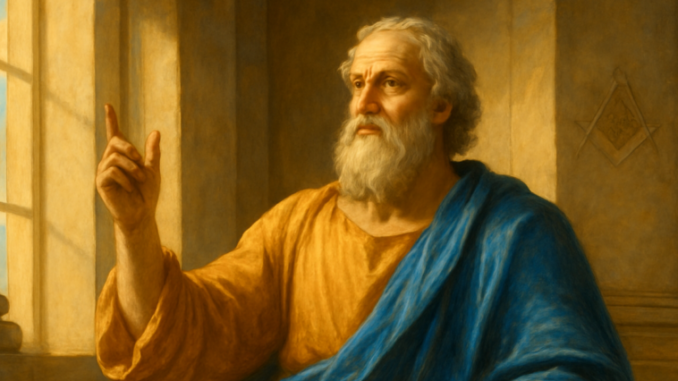
When Plato describes the creation of the universe in his dialogue Timaeus, he introduces a figure that would sound remarkably familiar to Freemasons centuries later: the demiurge — a divine craftsman who brings order out of chaos. Is this mere coincidence, or does Plato touch upon a universal truth that resonates deeply within the Lodge? This essay explores the striking parallels between Plato’s cosmology and the Masonic concept of the Great Architect of the Universe.
The Paradox of the Creative Craftsman
A fascinating tension lies at the heart of Plato’s creation narrative. His demiurge does not create from nothing. Instead, he works with pre-existing matter — much like a sculptor works with marble or a mason works with stone. The demiurge looks toward the eternal Forms, the Ideas, and impresses them upon the resistant substance of the material world. He is not an omnipotent god in the later monotheistic sense, but a skilled craftsman doing his best with the materials at hand.
This image immediately raises a profound question: is creation not divine, but artisanal? And if so, what does this tell us about our own creative capacities as human beings? Plato seems to suggest that the highest form of creation is not arbitrary but ordered, not chaotic but harmonious, not impulsive but deliberate. The act of building — of shaping raw material according to a higher design — becomes a sacred endeavor in itself.
The Great Architect and Cosmic Design
For Freemasons, the concept of the Great Architect of the Universe stands as a central symbol. It is not a dogmatic deity but a principle that every Brother may interpret according to his own understanding. What is remarkable is the clear resonance with Plato’s demiurge: both represent the idea that the universe is not accidental, but the result of conscious design and intentional ordering.
The Freemason sees in Plato’s demiurge a foreshadowing of the Great Architect — not as a personal god, but as a principle of cosmic order and purposeful creation.
The working tools of the Freemason — the compasses, the square, the plumb line — are symbols of precisely the ordering activity that Plato attributes to his demiurge. The compasses draw circles representing perfection; the square ensures right angles and fair proportions. These are not arbitrary instruments. They are the very means by which order is drawn from chaos — in the cosmos, in the Lodge, and in the individual soul.
A Critical Note: Is Order Truly the Highest Good?
Yet this line of thinking deserves a critical counterpoint. Is the emphasis on order and design not an overly convenient comfort? The world as we experience it is not only structured — it is also full of pain, conflict, and apparent randomness. Plato himself acknowledges this in the Timaeus by pointing to the limitations of matter, what he calls ananke or necessity, which even the demiurge cannot fully overcome.
Here lies perhaps the deepest lesson for the Freemason. The pursuit of perfection — the completed temple — is an ideal that can never be fully realized. The rough ashlar is polished, but it remains stone. The Brother works upon himself, but never attains flawlessness. This is not cause for despair, but an invitation to continual labor — to what Plato elsewhere calls the philosophical way of life. The journey matters more than the destination, and the commitment to building matters more than the finished structure.
The Soul as Bridge Between Idea and Matter
In the Timaeus, the World Soul plays a crucial role. It connects the realm of eternal Ideas with the tangible, ever-changing material world. According to Plato, each human being carries a spark of this World Soul, making it possible for us to recognize and aspire to the divine.
For the Freemason, this offers a rich parallel. The Lodge is a space where Brethren come together to work on their inner temple — to polish the rough stone of their character. This inner work is precisely that: an effort to embody higher principles — virtue, truth, compassion — in everyday life. The soul as bridge between the ideal and the actual finds its practical application in the moral development of the individual Brother. Each meeting, each ritual, each moment of self-reflection becomes an act of alignment between what is and what ought to be.
Synthesis: Building Toward Meaning
What Plato and the Masonic tradition share is a deep-rooted faith in the meaningfulness of building. Not building as a merely material activity, but as a metaphor for ordering one’s life, cultivating virtue, and seeking truth. The demiurge builds the universe; the Freemason builds himself and the fellowship of Brethren around him.
Consider the key parallels: Plato’s demiurge as a divine craftsman who creates order; the Great Architect as an open symbol of cosmic design; the working tools as symbols of the ordering labor; the soul as a bridge between the ideal and the real; and building itself as a metaphor for moral and spiritual growth. Each of these threads weaves through both traditions with striking consistency.
It is tempting to read Plato as a forerunner of Freemasonry, but that would oversimplify the historical picture. Yet the kinship is undeniable. Both traditions refuse to see the world as mere chaos. Both believe in the possibility — and the duty — to create order. And both acknowledge, with clear-eyed honesty, the imperfection inherent in every human attempt to do so.
An Open Question
Perhaps the most important question the Timaeus leaves us is not whether the universe was designed, but what that implies for our own creative responsibility. If the cosmos is the work of a master builder, are we not called to become builders ourselves? And if we are building — building ourselves, our relationships, our communities — toward what ideal do we set our compasses and square?
Plato’s Timaeus has remained a source of wonder and reflection for more than two thousand years. For the Freemason who knows both traditions, this dialogue opens a window onto the deep roots of the builder’s craft as a spiritual principle.
The answer to the question of the creator may be less important than the question it inspires: what are you building, and according to what design? In the end, both Plato and the Masonic tradition point us toward the same truth — that the act of building with intention, with virtue, and with an eye toward the eternal is itself the highest form of human expression. The tools are in our hands. The blueprint awaits our attention.
Copyright text & image: devrijmetselaar.nl
Texts are based on the ideas and content of the author of devrijmetselaar.nl, reviewed, corrected, and supplemented with the assistance of OpenAI. Images are created based on the ideas of the author of devrijmetselaar.nl using OpenAI/DALL-E.

Be the first to comment