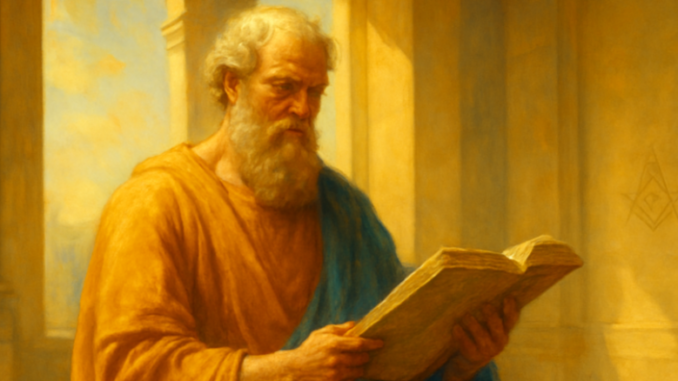
What if beauty is not merely something we perceive, but a memory of something we once knew? Plato’s dialogue Phaedrus poses this question with a force that has echoed through Western philosophy for over two millennia. But where did Plato’s vision actually come from? What thinkers and traditions formed the intellectual soil from which his ideas about the soul, beauty, and divine madness grew? In this article, we explore the philosophical roots of the Phaedrus and discover why this ancient work still resonates profoundly with anyone searching for deeper truth — including those who walk the path of Freemasonry.
Why Did Plato Write About the Soul and Beauty?
To understand Plato’s Phaedrus, we first need to understand the world in which he thought and wrote. Fourth-century Athens was a vibrant center of intellectual debate. Sophists like Gorgias and Protagoras had called absolute truths into question. They taught that the power to persuade mattered more than truth itself. Plato saw a danger in this: if everything is relative, what remains worth striving for?
His teacher Socrates had shown him that something does exist beyond mere human opinion. There are Forms — Ideas — that are eternal and unchanging. The Phaedrus became Plato’s attempt to demonstrate how the human soul gains access to that higher reality, and beauty plays a crucial role in that process.
Which Philosophical Traditions Influenced Plato?
Plato’s thinking did not emerge in a vacuum. He drew from diverse sources that shaped his vision of the soul and beauty:
The Pythagoreans believed in the immortality of the soul and its cyclical journey through different bodies. Plato adopted this idea of transmigration and developed it further in his myth of the winged soul.
Heraclitus had written about the tension between opposites and the hidden harmony within the cosmos. In the Phaedrus, we see this reflected in the struggle between the two horses of the soul — one noble and one unruly — pulling the charioteer in opposite directions.
Parmenides emphasized that true knowledge concerns unchanging Being, not the fleeting world of the senses. Plato’s Theory of Forms builds directly on this foundation.
The Orphic Mysteries taught that the soul is imprisoned in the body and can return to its divine origin through purification. This religious background colors Plato’s language about the soul as something that has lost its wings and longs to regain them.
The Role of Socrates in the Phaedrus
Socrates is not merely the main character of the dialogue — he also represents a philosophical method. By asking questions rather than providing answers, he invites his conversation partner Phaedrus to think for himself. This maieutic process, the “midwifery” of thought, was characteristic of the historical Socrates and was elevated by Plato into an art form.
But there is more. In the Phaedrus, Socrates also speaks about divine madness — the mania that overtakes poets and seers. This seems to contradict his rational method. Yet it is precisely this tension that makes the dialogue so rich. Plato suggests that true wisdom requires both rational insight and a kind of inspired enthusiasm — a fire that reason alone cannot kindle.
For Plato, beauty is no superficial pleasure. It is a spark that reminds the soul of its origin in the world of Ideas.
How Does the Phaedrus Relate to Freemasonry?
This is perhaps the most intriguing question. Freemasonry as an organized fraternity did not emerge until the eighteenth century, but its symbolic language and philosophical foundations reach much further back. Plato’s idea that the soul is on a journey — that it must be purified and refined to reach higher truths — resonates deeply with Masonic ritual.
In the lodge, Masons speak of the rough ashlar that must be shaped into a perfect cube. This is no coincidental parallel with Plato’s image of the soul regaining its wings. Both traditions see the human being as a work in progress — one who, through deliberate labor upon the self, can draw ever closer to the light.
The journey of the Masonic candidate mirrors the ascent Plato describes: from darkness to illumination, from ignorance to understanding, from the material to the transcendent. The philosophical DNA of the Phaedrus runs through the very fabric of Masonic thought.
The Symbolism of the Winged Soul
In the Phaedrus, Plato describes how the soul once possessed wings that allowed it to fly among the gods and behold the pure Ideas in their fullness. Through its fall into earthly existence, the soul lost those wings — but the memory remains. When we encounter beauty, those wings are nourished once more. They begin to grow again.
For Freemasons, this is a deeply recognizable motif. Masonic ritual is steeped in symbols of ascent: the winding staircase with its steps, the light that floods in when the blindfold is removed, the search for the Lost Word. All of these images point to the same fundamental human experience — the longing to rise above the mundane and come into contact with something greater than ourselves.
The winged soul is not just a poetic metaphor. It is a map of spiritual aspiration that both Plato and the Masonic tradition understand as central to the human condition.
What Can the Phaedrus Teach Us Today?
The Phaedrus is not a dusty document from a distant past. It is a living text that invites us to reflect on what truly moves us. Are we merely consumers of beauty, or can we see it as a guide toward deeper insight? Plato would say that real philosophy begins with wonder — and that beauty is the catalyst that ignites that wonder.
For anyone drawn to Freemasonry, Plato’s dialogue offers a philosophical foundation of remarkable depth. It reveals that the search for truth, beauty, and wisdom belongs to a venerable tradition stretching back to the oldest sources of Western thought. Socrates, Pythagoras, Plato — they are not strangers to those who enter the lodge. They are forerunners on the same path.
In a world that often reduces beauty to the aesthetic and wisdom to information, the Phaedrus calls us back to a more profound understanding. Beauty is not decoration — it is revelation. And the soul’s response to it is not sentimentality — it is recognition.
The Phaedrus teaches us that beauty is not a luxury but a necessity for the soul. Plato built upon Pythagorean wisdom, Orphic mysticism, and Socratic dialogue to create a vision that still inspires seekers of truth today. Those who enter Freemasonry step into the same stream of searching and finding, of falling and ascending. The winged soul is no myth from a distant age — it is an invitation that remains open to every one of us, urging us to remember what we once knew and to begin the journey upward once more.
Copyright text & image: devrijmetselaar.nl
Texts are based on the ideas and content of the author of devrijmetselaar.nl, reviewed, corrected, and supplemented with the assistance of OpenAI. Images are created based on the ideas of the author of devrijmetselaar.nl using OpenAI/DALL-E.
Frequently Asked Questions
What is Plato's central theory about beauty presented in the Phaedrus?
Plato proposes that beauty is not merely something we perceive in the physical world, but rather a memory of something the soul once knew. He suggests that through encountering beauty, the human soul gains access to higher reality and eternal truths beyond mere human opinion, particularly in response to the relativism of the Sophists.
Which philosophical traditions most influenced Plato's ideas about the soul in the Phaedrus?
Plato drew from four major philosophical traditions: the Pythagoreans (who believed in soul immortality and transmigration), Heraclitus (tension between opposites), Parmenides (unchanging Being and the Theory of Forms), and the Orphic Mysteries (the soul as imprisoned in the body seeking divine purification and return).
Why did Plato write the Phaedrus, and what problem was he addressing?
Plato wrote the Phaedrus to counter the relativism of Sophists like Gorgias and Protagoras, who taught that persuasion mattered more than truth and that everything is relative. Following Socrates' teachings, Plato sought to demonstrate that eternal, unchanging Forms and truths do exist beyond mere human opinion, and that the soul can access this higher reality.

Be the first to comment