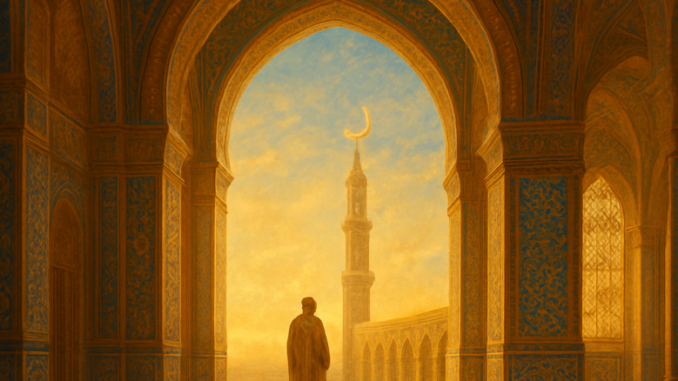
In the quiet of an evening lodge, a Freemason sits alone after the ritual has ended. He leafs through an old book on world religions and stumbles upon a passage from the Quran. The words strike a chord: they speak of steadfastness, of persevering on a path despite opposition. He recognizes something of his own inner quest. How can a text from an entirely different tradition feel so familiar?
What Is Surah Muhammad?
Surah Muhammad is the forty-seventh chapter of the Quran, bearing the name of the Prophet himself. It was revealed in Medina during a period when the early Muslim community was under considerable pressure and steadfastness was essential for survival. The text addresses themes such as maintaining faith under difficult circumstances, the consequences of sincerity versus hypocrisy, and the promise of inner peace for those who persevere on the righteous path.
Unlike some of the Meccan surahs, which tend to be poetic and contemplative, this Medinan text has a more practical tone. It speaks directly to the community, drawing a clear line between genuine devotion and superficial compliance. For the devout Muslim, this surah provides an anchor in times of trial. But what might someone outside this tradition — someone from a different spiritual path — find within its verses?
Two Perspectives: The Believer and the Seeker
For a practicing Muslim, Surah Muhammad serves as a powerful reminder of the core values of faith: sincerity, perseverance, and trust in divine guidance. The text warns against hypocrisy and calls for inner purity. This resonates deeply within Islamic tradition, where the heart is regarded as the seat of true belief.
For someone outside that tradition — a Freemason, for instance — the same text offers a different but equally meaningful point of entry. Freemasonry is not a religion, but it values the study of diverse spiritual sources as a means of personal growth. A Freemason reading the call to steadfastness in Surah Muhammad may well see a parallel with his own initiatory journey: the path from Entered Apprentice to Fellow Craft to Master Mason likewise demands perseverance, self-reflection, and the courage to overcome both inner and outer obstacles.
Steadfastness as a Universal Theme
Surah Muhammad emphasizes that true believers are tested. Verse 31 states that God tests people to reveal who is genuinely steadfast and who merely professes belief in name only. This theme of trial as purification appears in virtually every major spiritual tradition. The Stoic philosopher Marcus Aurelius wrote extensively in his Meditations about enduring adversity as a path to inner freedom. Plato viewed trials as opportunities for the soul to grow toward the Good.
Steadfastness is not passive endurance — it is an active choice to remain faithful to your inner compass, regardless of the storm raging around you.
In Freemasonry, this idea is expressed through the symbol of the rough ashlar, which through persistent effort is polished into a perfect cube. The process is not always pleasant: pieces break off, cracks appear, but the end result is a stronger, purer self. The parallel with the Quranic vision of trial and refinement is striking.
Sincerity Versus Hypocrisy
Another central theme in Surah Muhammad is the distinction between genuine devotion and outward piety that masks inner doubt or even sabotage. The text warns against those who profess faith with their lips while their hearts waver or work against the very principles they claim to uphold. This motif is universally recognizable.
In Freemasonry, the candidate pledges sincerity at the moment of initiation. He is asked to enter with an open heart, without conditions or pretense. The entire Masonic system, in a sense, is built on the assumption that inner authenticity is the foundation of all moral and spiritual progress.
The philosopher Montaigne, whose essays are explored extensively on this site, wrote with great insight about the importance of authenticity. He warned against the temptation to wear a mask in the world, arguing that the real work lies in knowing and accepting yourself as you truly are. Both the Quran and Freemasonry call for that same inner honesty — a willingness to confront who you are beneath the surface.
What Both Traditions Share
Despite the apparent differences between the Islamic faith tradition and Freemasonry, they share a number of fundamental values:
Both prioritize inner purity over outward display. Both hold the conviction that trials and adversity make a person stronger. Both strive toward brotherhood and mutual support. And both recognize a higher moral order that provides direction and meaning to human life.
This makes reading texts like Surah Muhammad valuable for anyone interested in spiritual growth, regardless of personal background. A Freemason need not embrace Islam to learn from its sources. Conversely, Muslims may well recognize elements in the ethical principles of Freemasonry that align with their own deeply held values.
What We Can Learn
Comparing these two worlds teaches us above all a lesson in humility. No single tradition holds a monopoly on wisdom. The search for a meaningful life is a universal human endeavor, and different paths can lead to remarkably similar insights. Surah Muhammad reminds us that perseverance is not a sign of weakness — it is the very core of spiritual strength.
For the Freemason sitting in the lodge at the close of an evening, reading such a text can offer a deeper dimension to his journey. Not as a replacement for his own tradition, but as an enrichment. Because ultimately, both traditions grapple with the same fundamental question: How do I become a better person, and how do I stay true to that aspiration when the road becomes difficult?
Surah Muhammad invites reflection on steadfastness, sincerity, and the inner struggle that every seeker knows. Whether you are a Muslim, a Freemason, or simply someone curious about spiritual traditions, the message transcends all boundaries: perseverance and purity of heart are the keys to genuine growth. In that shared understanding lies the foundation for mutual respect — and a common longing for wisdom.
Copyright text & image: devrijmetselaar.nl
Texts are based on the ideas and content of the author of devrijmetselaar.nl, reviewed, corrected, and supplemented with the assistance of OpenAI. Images are created based on the ideas of the author of devrijmetselaar.nl using OpenAI/DALL-E.

Be the first to comment