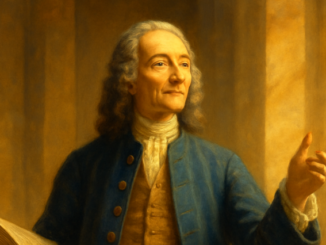
Voltaire on God: Philosophical Roots of an Enlightened Thinker
A candle in the darkness. So simple, so ordinary, and yet so laden with meaning. For Voltaire, the idea of God was exactly like that — a light that human reason needed in order to perceive, but which itself remained elusive. In his celebrated Philosophical Dictionary of 1764, he penned one of his most thoughtful essays on the concept of God. The philosophical roots of that essay, however, reach far deeper than the eighteenth century alone. The Legacy of English Empiricism Voltaire’s thinking about God is unimaginable without the influence of John Locke. During his exile in England from 1726 to 1728, Voltaire encountered Locke’s Essay Concerning Human Understanding. Locke argued that all knowledge arises from sensory experience and reflection. This had far-reaching consequences for any theology: if we cannot perceive God directly, how can we claim to know anything about Him? Voltaire took this question seriously, yet he also departed from Locke in important ways. While Locke still allowed room for a rational proof of God’s existence, Voltaire grew more skeptical about the reach of human reason. Yet unlike the radical atheists of his day, he held firm to the existence of an ordering force in the universe. A […]