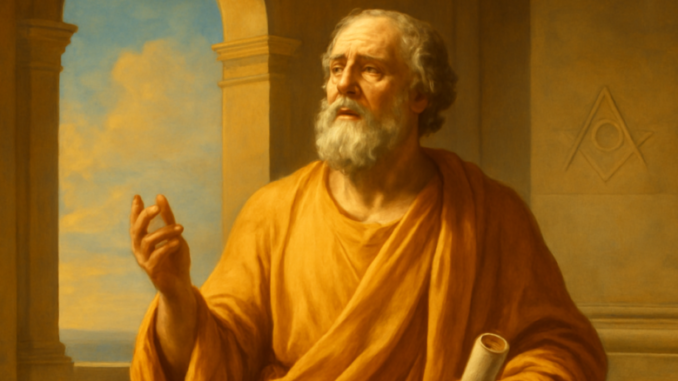
In his forty-first letter to Lucilius, the Roman Stoic philosopher Seneca explores a theme that still resonates nearly two thousand years later: the divine spark that resides within every human being. This letter stands as a cornerstone of Stoic philosophy, and it touches on questions that lie at the very heart of Freemasonry. What makes a person truly great? Where should we look to find the sacred? Seneca’s answer is as simple as it is radical — not in temples or outward rituals, but within the human soul itself.
The Central Idea of Letter 41
Seneca opens this letter with a seemingly simple observation. He praises Lucilius for making progress on the path toward wisdom, but quickly reminds him that true greatness does not come from the outside. The central theme of the letter is that within every person dwells a divine spirit — what the Stoics called the animus — a fragment of the universal rational principle they referred to as the Logos. This inner god, Seneca argues, deserves far more attention than any form of outward worship.
Importantly, the letter does not reject religion or tradition. Instead, it puts the value of external display into perspective. Seneca describes how people are struck with awe when they enter sacred groves, stand beneath ancient oaks, or peer into deep caverns. They feel the presence of something greater than themselves. But this same awe, he argues, should be even more profound when we contemplate the human soul — for that is where something truly divine resides.
Two Perspectives: The Onlooker and the Seeker
Letter 41 can be read as a dialogue between two ways of perceiving the sacred. On one hand, there is the perspective of the onlooker — someone who seeks greatness in what is visible: wealth, power, social status, or impressive ceremonies. This person measures worth by what the eyes can see and the hands can grasp. On the other hand, there is the seeker — the person who learns to turn inward and discovers something there that surpasses all outward splendor.
Seneca uses the image of sacred woodlands to illustrate this contrast. When we enter an ancient forest of towering trees whose canopy shuts out the light, a spontaneous feeling of reverence arises. This natural sense of awe, Seneca suggests, points to a deeper truth: if we are already moved by old trees, how much more moved should we be by the human spirit, which is capable of virtue, wisdom, and moral beauty?
The Images Seneca Offers
The Roman philosopher illustrates his argument with several vivid images that stir the imagination:
The sacred grove, where people spontaneously experience the divine. The source of a great river, as a symbol of origin and purity. The deep cavern where warm water wells up, as a sign of hidden forces at work beneath the surface. And finally — perhaps most powerfully — the person who remains steadfast in the face of adversity, as the highest proof of inner divinity.
This last image is particularly striking. Seneca paints a portrait of the wise person who stays calm amid disaster. Where others crumble under fear or grief, the true philosopher stands firm. This inner tranquility, Seneca insists, is evidence that something lives within us that is stronger than any external circumstance — a divine core that cannot be touched by fate.
Where Both Perspectives Meet
Despite the apparent contrast between the outward-looking and the inward-looking gaze, Seneca acknowledges that both spring from the same human need: the longing for contact with something greater than ourselves. The onlooker who feels awe standing beside an ancient oak and the sage who examines his own soul are drinking from the same well. Both are searching for meaning, for connection with the universe, for an anchor in a world of constant change.
The divine spark within us is not something we must earn or acquire — it has always been there, waiting only to be recognized. This insight forms the heart of Seneca’s message. The divine need not be sought in distant temples or exotic rituals. It is present in the daily choices we make, in the way we handle adversity, and in our willingness to grow in wisdom and virtue.
The Connection to Freemasonry
The themes Seneca raises resonate powerfully with the symbolism and philosophy of Freemasonry. Within the lodge, inner development stands at the center of the Work. The rough ashlar that must be shaped into a perfect cube is a symbol for this very same journey — from outward imperfection toward inner refinement. Just as Seneca invites us to look beyond the superficial, Freemasonry calls on its members to recognize the divine potential within every human being.
The symbol of the Great Architect of the Universe points to this universal principle that both Stoics and Freemasons acknowledge. It is not about a specific religion, but about the recognition that within the universe — and within the human person — there is an ordering, creative principle at work. Seneca would have recognized himself in this symbolism.
What We Can Learn from Letter 41
Letter 41 offers a timeless lesson that is every bit as relevant for the twenty-first-century reader as it was for Lucilius in ancient Rome. In a world that constantly invites us to look outward — for validation, for status, for distraction — Seneca reminds us that the true treasure lies within. The journey toward wisdom is not a journey to some distant destination; it is a homecoming.
For the Freemason reading this letter, it offers a philosophical foundation for what lodge symbolism portrays. The working tools, the journey from West to East, the light that shines in the darkness — all are expressions of the same fundamental idea: that human greatness is not measured by external riches, but by the degree to which we bring the divine spark within ourselves into full bloom.
Seneca’s Letter 41 on the divinity within us is an invitation to self-examination that has lost none of its power after nearly two thousand years. Whether we approach this text as Stoics, as Freemasons, or simply as seekers of truth, the message is the same: the sacred is not far away. It lives within us, present in every act of courage, every moment of calm amid the storm, and every sincere effort to become a better version of ourselves. The rough stone carries within it the perfect form — all it asks is that we begin the work.
Copyright text & image: devrijmetselaar.nl
Texts are based on the ideas and content of the author of devrijmetselaar.nl, reviewed, corrected, and supplemented with the assistance of OpenAI. Images are created based on the ideas of the author of devrijmetselaar.nl using OpenAI/DALL-E.

Be the first to comment