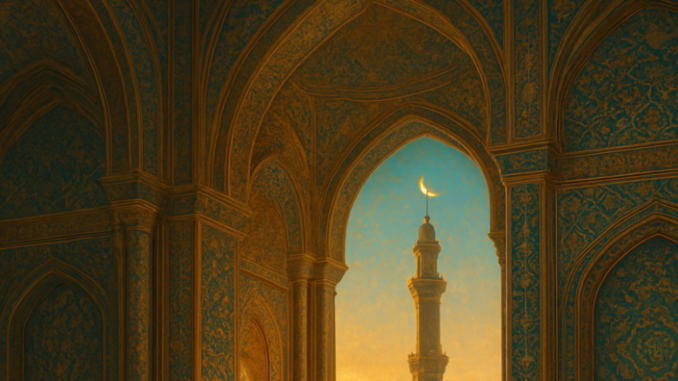
When a Muslim bows in prayer, the forehead touches the ground in an act of complete surrender. When a Freemason enters the lodge, the outside world falls away and an inner journey begins. At first glance, these two acts seem to have little in common. But look deeper, and a shared essence emerges: the willingness to diminish one’s own ego in service of something greater. In this article, we explore Surah 32 of the Quran — titled The Prostration — and place its message alongside the spiritual practice of Freemasonry.
The Heart of Surah 32: The Prostration
Surah 32 is one of the Meccan revelations and consists of thirty verses. Its title refers to verse 15, which describes how believers prostrate themselves in worship when they recognize the signs of their Creator. The surah opens with an affirmation that the Quran is, without doubt, from the Lord of all worlds, and it calls the reader to reflect on the creation of the heavens and the earth, on time, and on the human soul.
At its center lies the theme of recognition. The person who perceives divine signs does not bow out of compulsion but out of inner conviction. It is a voluntary surrender born from insight. The surah also warns against those who turn away, who ignore the signs despite having received them. In this way, a contrast emerges between the spiritually awakened person and the one who remains asleep in indifference.
The Muslim Perspective: Becoming Small to Receive Something Great
For the faithful Muslim, the prostration — sujud — is the pinnacle of prayer. It is the moment when a person makes themselves as small as possible while simultaneously standing closest to the Divine. This paradox — becoming small in order to receive something great — lies at the very heart of Islamic spirituality. The prostration is not humiliation; it is elevation. The body expresses what the heart experiences: gratitude, awe, and connection with a reality that transcends human understanding.
The classical Islamic scholar Al-Ghazali described in the eleventh century how prayer only gains meaning when the heart is truly present. A body that bows without a heart that bows alongside it misses the essence entirely. This inner dimension — the presence of consciousness — transforms a physical act into a spiritual one.
The Masonic Perspective: Bowing Without Kneeling
Freemasonry prescribes no prayer posture, yet the symbolic language of the lodge speaks just as clearly of surrender and transformation. Upon entering the temple, the candidate leaves behind social status and worldly rank. The blindfold worn during initiation symbolizes the temporary setting aside of personal certainties. The Freemason does not literally bow, but bows nonetheless — bending the ego, releasing prejudice, and letting go of attachment to external truths.
Johann Wolfgang von Goethe, himself a Freemason, wrote about the necessity of inner transformation as a precondition for genuine insight. A person must be willing to descend before they can ascend. This principle resonates throughout the Masonic degree structure, in which each step represents a deeper level of self-knowledge.
What Both Traditions Share
Despite their different forms and contexts, the Islamic prostration and the Masonic inner posture share remarkable common ground:
Both call for voluntary surrender — not through coercion, but through insight. Both emphasize the importance of inner presence over outward form. Both regard humility as a gateway to wisdom. And both place the individual’s search within a greater whole.
True spirituality begins where the ego ends: in the willingness to bow before that which is greater than ourselves.
The philosopher and mathematician Blaise Pascal wrote about the need to bend the mind before mysteries it cannot fully comprehend. This bending is not intellectual capitulation but an acknowledgment of the limits of human understanding. Both the Muslim in prayer and the Freemason in contemplation practice this discipline of spiritual openness.
Lessons for the Modern Seeker
In an age where self-expression and individualism are often held up as supreme values, both traditions offer a counterbalance. The prostration — whether literal or figurative — reminds us that growth does not only come through expansion but also through contraction. An ego that makes room creates space for something else: for connection, for insight, for wonder.
Freemasonry invites people of all backgrounds to work together toward moral and spiritual growth. It explicitly recognizes the value of different religious traditions. A Muslim Freemason can practice in the lodge the same attitude of surrender he knows from his daily prayers. A non-religious Freemason can recognize in the symbolism of prostration a universal truth about human humility.
Two Paths, One Horizon
Where the Muslim prostrates five times a day in prayer, the Freemason periodically enters the silence of the lodge. Both rituals interrupt the flow of daily life and create a sacred space. Within that space, something happens that is difficult to put into words: consciousness shifts, the usual hierarchies dissolve, and the individual stands momentarily alone before the mystery of their own existence.
Surah 32 closes with a promise: for those who believe and do righteous deeds, the gardens of eternity await. The Freemason speaks of building an inner temple that transcends time. Both visions point beyond the transient toward something lasting — and both begin with the same first step: the willingness to bow.
The comparison between the Islamic prostration and the Masonic inner posture teaches us that spirituality, at its core, is not about specific forms but about the intention behind them. Whether one presses the forehead to the ground or enters the lodge in silence, the movement is fundamentally the same — an inward turning, a making-small of the self, and a quiet opening toward the sacred. In a world that constantly urges us to stand taller, both traditions whisper the same ancient wisdom: sometimes the deepest truths are found not by reaching up, but by bowing down.
Copyright text & image: devrijmetselaar.nl
Texts are based on the ideas and content of the author of devrijmetselaar.nl, reviewed, corrected, and supplemented with the assistance of OpenAI. Images are created based on the ideas of the author of devrijmetselaar.nl using OpenAI/DALL-E.

Be the first to comment