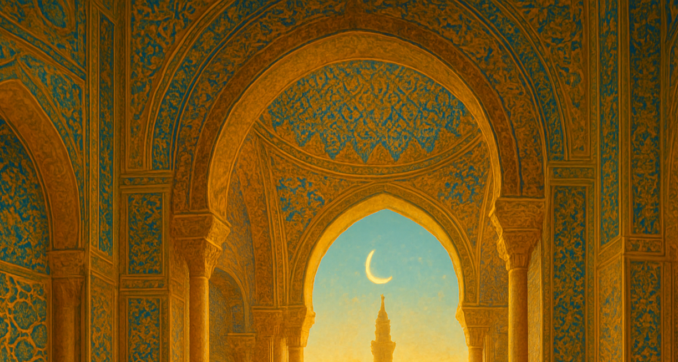
What happens to a civilization that has everything but forgets to be grateful for it? The Quran tells the story of the Kingdom of Sheba in Surah Saba — a land of abundance that collapsed under the weight of spiritual blindness. This story, over a thousand years old, raises questions that remain strikingly relevant today, and that resonate deeply with the spiritual journey undertaken by Freemasons.
What Does Surah Saba Actually Tell Us?
Surah Saba, the 34th chapter of the Quran, takes its name from the ancient Kingdom of Sheba, located in present-day Yemen. The Queen of Sheba, a figure known from both the Bible and the Quran, once visited King Solomon, drawn by his legendary wisdom. But the surah itself extends far beyond that historical encounter. It paints a picture of a people blessed with fertile gardens, an ingenious irrigation system, and material prosperity — yet who ultimately came to take all of these blessings for granted.
The central message is as simple as it is profound: gratitude and awareness are the keys to a meaningful life. When the people of Saba lost this inner orientation, their civilization fell apart. The gardens withered, the community fractured. It is a warning, but also an invitation — remain awake to what truly holds value.
Why Does This Story Speak to Freemasons?
You might reasonably wonder: what does a Quranic narrative about an ancient Arabian kingdom have to do with Freemasonry? The answer lies not in the literal text, but in the underlying themes. Freemasons work on their inner temple — a structure built not of stone, but of character, wisdom, and moral growth. The fall of Saba illustrates precisely what happens when that inner construction is neglected.
Material prosperity without spiritual grounding is like a temple without a foundation: impressive on the outside, but destined to collapse.
In Freemasonry, much is said about the importance of light — not only as a symbol of knowledge, but also of conscious awareness. The people of Saba had access to abundance, but they lost the light of inner gratitude. They could no longer see what they had, and in doing so, they lost everything. This parallel is no coincidence: both the Quran and Freemasonry emphasize that true wealth is found within.
What Can We Learn from King Solomon in This Context?
Solomon, a central figure in Freemasonry as the builder of the Temple in Jerusalem, also appears in Surah Saba. His wisdom is praised, along with his ability to communicate with all beings — even jinn and birds. But what truly stands out is that Solomon, despite all his power and knowledge, never lost his gratitude. He never forgot the source of his gifts.
Freemasonry knows Solomon through the legend of Hiram Abiff, the master builder of the Temple. Both traditions — Islamic and Masonic — present Solomon as someone who united material greatness with spiritual depth. He did not merely build a physical temple; he also cultivated an inner sanctity. That is the lesson Surah Saba indirectly offers: build, but build with awareness.
How Do Gratitude and Brotherhood Relate to Each Other?
One of the most fascinating aspects of Surah Saba is its emphasis on community. The people of Saba did not fall individually — they fell as a whole. Their bonds with one another weakened as gratitude disappeared. This raises a question that also sits at the heart of Freemasonry: how do we keep our brotherhood alive?
The answer the surah suggests is that brotherhood is nourished by shared appreciation. When we collectively acknowledge what we have received — knowledge, connection, the opportunity to grow — we strengthen the ties that unite us. Freemasons gather in the lodge not only to perform rituals, but to reflect together on the values that bind them. This practice of communal reflection is an antidote to the spiritual blindness that brought Saba to its knees.
What Does This Story Mean for Your Own Journey?
Perhaps you recognize something of the story of Saba in your own life. Moments when you forgot to be grateful for what you have. Periods when the daily grind obscured the blessings all around you. The spiritual tradition of Freemasonry invites us to pause regularly — to inspect, as it were, the temple of our own hearts: are the foundations still solid? Does light still flow in?
The Quran describes how the people of Saba were given the chance to return to awareness, but they refused the invitation. That is the turning point every person eventually faces. Freemasonry offers no ready-made answers, but it does provide tools: rituals, symbols, and brotherly conversations that help us stay awake. The story of Sheba is, in that sense, not a condemnation but a mirror.
Consider these key takeaways:
Gratitude as the foundation of spiritual growth. Without it, even the greatest achievements ring hollow.
Awareness as a counterweight to spiritual blindness. Conscious living is not a luxury — it is a necessity.
Brotherhood strengthened through shared reflection. Community thrives when its members pause together in appreciation.
The inner temple demands constant maintenance. The work is never finished; it is an ongoing practice.
Surah Saba tells an ancient story, but the questions it poses are timeless. What are you truly building in your life? And are you aware of the sources that make it possible? Freemasonry and the Quran share a deep insight here: spirituality does not begin with the pursuit of more, but with the appreciation of what already is. In that recognition lies the foundation for every temple that truly stands the test of time.
Copyright text & image: devrijmetselaar.nl
Texts are based on the ideas and content of the author of devrijmetselaar.nl, reviewed, corrected, and supplemented with the assistance of OpenAI. Images are created based on the ideas of the author of devrijmetselaar.nl using OpenAI/DALL-E.

Be the first to comment