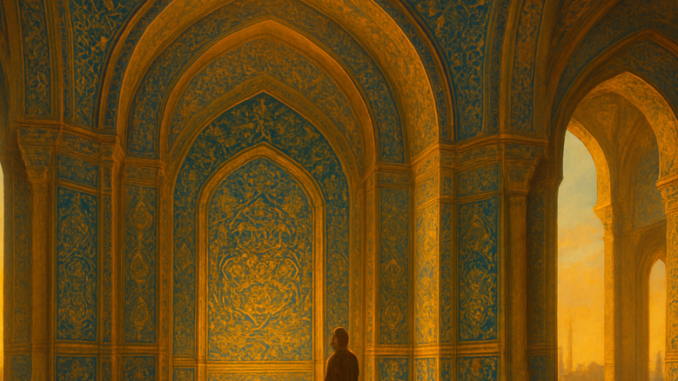
There is a paradox rarely spoken aloud: the most profound moments of spiritual growth do not begin with gentleness — they begin with a jolt. A tearing away from the familiar, an uprooting that hurts before it liberates. The seventy-ninth chapter of the Quran, known as “The Extracting Angels” (An-Nazi’at), opens with vivid images of celestial beings forcefully pulling souls free. At first glance, the text sounds awe-inspiring, even terrifying. But those willing to look deeper will discover a universal truth that resonates powerfully within Freemasonry: real transformation only begins when you dare to let go.
A Chapter That Shakes the Foundations
Surah 79 is one of the shorter chapters of the Quran and belongs to the early Meccan revelations. It opens with a series of powerful oaths sworn by angels performing various cosmic tasks: those who violently extract, those who gently release, those who glide through the universe and race ahead. The imagery is cosmic in scope, evoking a universe where nothing stands still, where forces are perpetually in motion, and where the soul is inevitably confronted with its own destiny. The chapter then transitions to the story of Moses and Pharaoh, before closing with a meditation on the Day of Judgment and the haunting question of what we have truly prepared for that inevitable moment.
It is tempting to read this text in purely eschatological terms — as a warning about the end of days. But there is a second layer that is at least as powerful. The angels who extract and release can also be understood as inner forces: the conscience that tugs at us, the discomfort that shakes us awake, those moments when we are ripped from complacency. Read in this way, Surah 79 becomes not a text about fear, but about awakening.
Being Torn Free as a Prerequisite for Growth
Freemasonry operates on a remarkably similar principle, though it is expressed through different symbolism. The candidate who enters the lodge for the first time undergoes a ritual experience that is deliberately disorienting. Everything familiar is stripped away. The blindfold, the symbolic divestment, the entry into an unknown space — these are all forms of detachment. Not out of cruelty, but from the conviction that a person can only truly begin to build themselves once old certainties have fallen away. The rough ashlar can only be worked once it has been broken free from the rock.
Spiritual growth does not begin by adding knowledge — it begins by daring to release what you thought you knew.
What Surah 79 and the Masonic ritual share is the insight that transformation is uncomfortable. The angels in the Quranic imagery do not pull gently; they extract with force. The initiation rite in the lodge is not a casual conversation; it is an experience that touches your vulnerability. Both traditions acknowledge that human beings tend to cling to the familiar, even when the familiar holds them captive.
Moses, Pharaoh, and the Courage to Speak Truth
Midway through the chapter, the perspective shifts to the story of Moses, who is sent by God to confront Pharaoh. In Islamic tradition, Pharaoh represents human arrogance and the refusal to see beyond one’s own power and possessions. Moses is instructed to speak gently, yet still proclaim the truth. It is a remarkable moment: even in the face of the greatest tyranny, the call is not for violence but for clear and courageous witness.
This theme resonates deeply with the Masonic tradition. The Brotherhood does not ask its members to change the world through force, but to bear witness in their own lives to values such as truth, justice, and brotherly love. Voltaire, himself initiated as a Freemason shortly before his death in 1778, wrote extensively about the courage required to speak truth to power. And while the contexts are entirely different, the core of Moses’ mission touches the same principle: the inner strength to stand up — not with the sword, but with the word.
The Question That Lingers
The closing passage of Surah 79 confronts the reader with a direct and inescapable question. The text describes how, one day, every person will see everything they have done and will ask themselves whether they have prepared enough. The Quran employs the image of someone who only realizes the night has passed when the morning breaks. It is an image of urgency, but also of hope: as long as morning has not yet arrived, there is still time.
In Freemasonry, this urgency is translated into the concept of mortality as a teacher. The memento mori — the reminder of death — is not a morbid obsession but an invitation to live consciously today. The death symbolism that appears in certain Masonic degrees serves precisely the same purpose as the Quranic depiction of the final hour: not to instill fear, but to pose the question of what you are doing with your time.
Where the Traditions Meet
It is striking how different spiritual traditions converge at this point. The Islamic mystic Ibn Arabi wrote in the thirteenth century about the necessity of “dying before death” — an inner process in which the ego is released so that the soul may awaken. The Christian mystical tradition holds similar notions, as do the Kabbalistic currents that have influenced the ritual structure of Freemasonry. What unites all these traditions is the conviction that a human being is more than their daily occupations, but that they must actively work to reach that deeper dimension.
Freemasonry has always drawn on this rich tapestry of wisdom traditions — not to syncretize or blur boundaries, but to recognize that the search for Light is a universal human endeavor. The extracting angels of Surah 79, the symbolic death and rebirth of the Masonic initiation, the mystic’s call to transcend the ego — all point toward the same fundamental truth: that which holds us back must be released before we can move forward.
Surah 79 is not an easy text. It shakes, it extracts, it confronts. But perhaps that is precisely its power. In an age when spirituality is often reduced to comfort and self-affirmation, this ancient chapter — and the Masonic tradition alongside it — reminds us that genuine growth demands something of us. It demands that we allow ourselves to be shaken loose, that we face uncomfortable truths, and that we take seriously the question of how we spend the time we have been given. The extracting angels are not enemies; they are catalysts. And the lodge, like the sacred text, is a space where we can learn to welcome the discomfort that precedes all true transformation.
Copyright text & image: devrijmetselaar.nl
Texts are based on the ideas and content of the author of devrijmetselaar.nl, reviewed, corrected, and supplemented with the assistance of OpenAI. Images are created based on the ideas of the author of devrijmetselaar.nl using OpenAI/DALL-E.

Be the first to comment