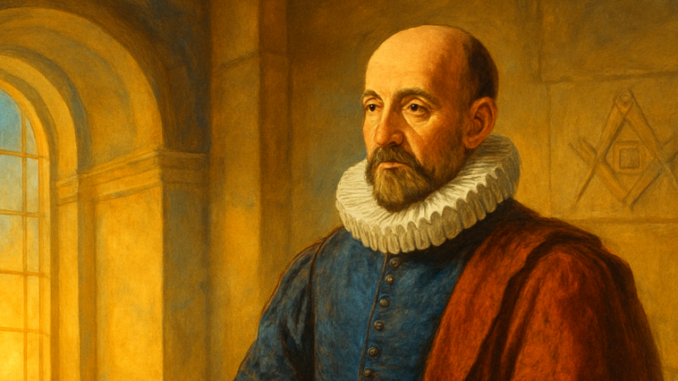
What happens when a sixteenth-century philosopher and an age-old brotherhood arrive at the same conclusion by entirely different routes? Michel de Montaigne argued in his essay ‘Of the Uncertainty of Our Judgment’ that we should never cling too tightly to our own convictions, because the outcome of any decision remains fundamentally uncertain. Freemasonry teaches its members something remarkably similar: that true connection only becomes possible when you are willing to question your own beliefs. This article places both perspectives side by side — not to declare a winner, but to discover where they meet and what that still has to tell us today.
Montaigne’s World: Doubt as Liberation
Michel de Montaigne lived in an age of religious wars, political upheaval, and intellectual revolution. While Europe was being torn apart by factions defending their own version of truth with sword and fire, he retreated to his study and posed the most fundamental question a person can ask: how certain am I, really, of what I think I know?
In the forty-seventh essay of the first book of his Essais, Montaigne examines how military decisions, political choices, and personal convictions are time and again overtaken by chance. Strategies that seemed brilliant in the moment turned out to be disastrous in hindsight. Actions dismissed as foolish sometimes led to unexpected victory.
For Montaigne, this was no cause for despair — it was cause for liberation. If no judgment is unassailable, then there is no reason to condemn anyone for holding a different opinion. In this, he echoed the skepticism of classical antiquity, particularly that of Sextus Empiricus and the Pyrrhonists, as well as the humanistic spirit of Erasmus. Doubt, for him, was not a weakness. It was the precondition for genuine human connection: anyone who acknowledges that they might be wrong opens the door to truly listening.
The Freemason’s World: Connection Through Self-Reflection
Freemasonry approaches the same question from an entirely different starting point. Where Montaigne unfolds his thoughts in the solitude of the written word, the Freemason deliberately seeks out the community of the lodge. Ritual serves as the vehicle. In the stillness of shared work, the Freemason learns not so much what to think, but how to reflect. The search for truth in Freemasonry is not merely an intellectual exercise — it is a living practice that unfolds in the encounter with others.
Central to this practice is the principle that no single member can claim absolute truth. The lodge brings together people of diverse backgrounds, beliefs, and worldviews. That diversity is not simply a byproduct of the brotherhood — it is its very essence. Brotherhood in the Masonic sense means recognizing that the other person carries a piece of truth that you may not yet see. This attitude requires precisely the kind of humility that Montaigne so passionately advocated.
Where Both Paths Converge
At first glance, the essayist and the brotherhood seem to have little in common. Montaigne was a solitary thinker, averse to dogma and ritual. Freemasonry is by definition communal and makes deliberate use of ritual and tradition. Yet their paths meet on a deeper level — in the shared conviction that the inability to know everything is not a limitation, but an invitation to grow.
True connection begins where certainty ends: only those who dare to doubt their own judgment can truly listen to another.
Both traditions warn against the dangers of rigid certainty. Using military examples, Montaigne demonstrated how generals who placed unwavering trust in their strategy often lost to opponents who remained flexible. In Freemasonry, the same insight returns in the image of the rough ashlar that must be shaped: a person is never finished, never perfect, and it is precisely that imperfection that drives the ongoing work of self-improvement. The parallel is striking. Where Montaigne writes that the outcome of a decision can never be fully foreseen, the Freemason learns that the search for light and knowledge is a journey that is never complete.
What This Comparison Teaches Us About Virtue and Listening
The power of this comparison lies not only in the similarities, but also in the differences. Montaigne remained, at heart, an individualist. His doubt was personal; his conclusions were equally so. Freemasonry elevates that personal doubt to a collective level. In the lodge, the willingness to suspend judgment becomes a shared value — a foundation upon which brotherhood can rest. This distinction is essential. Montaigne shows us that doubt makes a person wiser. Freemasonry shows us that shared doubt connects people to one another.
Johann Wolfgang von Goethe, himself a Freemason and an admirer of Montaigne, embodied this duality like no other. His lifelong quest for knowledge was at once deeply personal and emphatically connected to a community of like-minded seekers. Aristotle had written centuries earlier that the human being is by nature a social creature. Montaigne added the nuance that social connection only becomes fruitful when it is accompanied by intellectual honesty. Freemasonry brings those two insights together in its daily practice.
Three Shared Principles
Intellectual humility: Both Montaigne and Freemasonry regard the acknowledgment of one’s own limitations as a virtue, not a deficiency. The willingness to say “I may be wrong” is not a sign of weakness but of strength — a strength that opens the path to deeper understanding.
Tolerance as a way of life: Both view differences of opinion not as threats, but as sources of enrichment. For Montaigne, encountering a contrary view was an opportunity to refine his own thinking. In the lodge, the meeting of different perspectives is the very mechanism through which brothers grow together.
Continuous self-reflection: The person who stops questioning themselves stops growing. Whether you are a solitary essayist working through ideas at your desk or a Freemason participating in the shared ritual of the lodge, the imperative is the same: never assume you have arrived, because the journey itself is the point.
Montaigne and Freemasonry arrived at a strikingly similar truth through very different paths. The philosopher found his way through the written word, turning doubt into a tool for personal liberation. The Masonic brotherhood took that same doubt and wove it into a communal practice of growth, tolerance, and mutual recognition. Together, they remind us of something that our certainty-obsessed age desperately needs to hear: the most profound connections we can form with others begin not with knowing, but with the honest admission that we do not — and perhaps cannot — know it all. It is in that shared uncertainty that true brotherhood finds its strongest foundation.
Copyright text & image: devrijmetselaar.nl
Texts are based on the ideas and content of the author of devrijmetselaar.nl, reviewed, corrected, and supplemented with the assistance of OpenAI. Images are created based on the ideas of the author of devrijmetselaar.nl using OpenAI/DALL-E.
Frequently Asked Questions
What is the main connection between Montaigne's philosophy and Freemasonry teachings?
Both Montaigne and Freemasonry arrive at the conclusion that true human connection requires willingness to question one's own beliefs. Montaigne argued in his essay that acknowledging uncertainty in our judgments liberates us to listen to others, while Freemasonry teaches that genuine connection only becomes possible when members are willing to question their own convictions through ritual practice and self-reflection in community.
How did Montaigne's historical context influence his philosophy of doubt?
Montaigne lived during an age of religious wars, political upheaval, and intellectual revolution when Europe was torn apart by factions defending their own versions of truth violently. In response, he retreated to his study and questioned how certain he really was of what he believed. This led him to recognize that strategies and convictions are often overtaken by chance, which he viewed not as cause for despair but as liberation to accept different opinions without condemnation.
How does Freemasonry practice the principle of questioning beliefs differently from Montaigne's approach?
While Montaigne unfolds his thoughts through solitary written reflection, Freemasonry deliberately seeks community through the lodge. Freemasonry uses ritual as a vehicle for members to learn how to reflect within the encounter with others. The search for truth in Freemasonry is not merely an intellectual exercise but a living practice that unfolds through shared work and community engagement rather than individual contemplation.

Be the first to comment