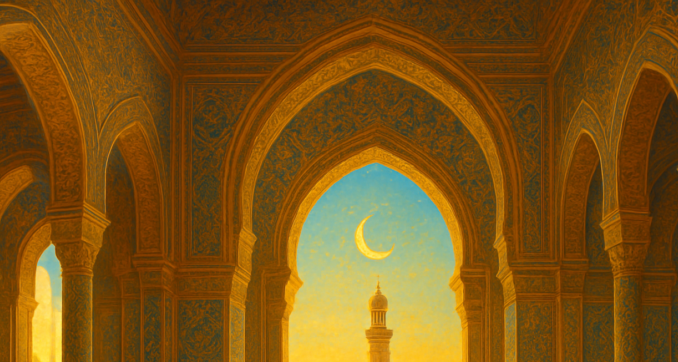
What if there were beings we cannot see, yet who respond to the same truth we do? Surah 72 of the Quran, titled ‘The Djinn,’ tells the remarkable story of invisible creatures who overhear divine revelation and find themselves profoundly moved by it. It is a text that compels us to reflect on what lies hidden, on humility before the unknowable, and on the universal pull of light and truth — themes that sit at the very heart of Freemasonry. In this exploration, we turn to an ancient scripture and discover what it still has to say to seekers today.
What Is Surah 72 Actually About?
Let us start at the beginning. Surah 72 describes how a group of djinn — beings from another dimension of creation — secretly listen to a recitation of the Quran. What they hear touches them deeply. They recognize the beauty and guidance contained in the words and resolve to turn toward the straight path. They say to one another: “We have heard a wondrous recitation that guides to the right way, and we believe in it.”
It is a scene that is both mysterious and moving. Beings normally hidden from human sight are themselves transformed by a message they never expected to receive. The surah also makes clear that the djinn, like human beings, possess free will. Some choose the good path; others go astray. There are factions among them: “Among us are those who submit, and among us are those who deviate.” This freedom of choice is a core idea that reaches far beyond Islamic theology alone. It touches one of the oldest philosophical questions: what does a conscious being do with its capacity to choose?
What Does the Invisible Have to Do with Freemasonry?
Perhaps this is the most obvious question to ask. Freemasonry has always maintained a distinctive relationship with the invisible, the hidden, and the not-yet-known. Its entire ritual system is built around the idea that behind visible reality lies a deeper truth — one that must be discovered not with the eyes but with the heart and the mind. The Freemason’s journey is, at its core, a passage from darkness to light, from ignorance to understanding.
That very theme echoes throughout Surah 72: the djinn dwell in the unseen, yet they are drawn irresistibly toward the light of knowledge and revelation. Aristotle wrote that all human beings by nature desire to know. The medieval Islamic philosopher Ibn Rushd — known in the West as Averroës — built upon that Aristotelian foundation and argued that reason and revelation need not exclude one another. This idea is equally recognizable in Freemasonry, where the Volume of the Sacred Law rests upon the altar as a source of inspiration, regardless of which holy book that may be for the individual Brother. The djinn in Surah 72 affirm precisely this principle: truth attracts, regardless of the nature of the one who listens.
Why Is Free Will So Central Here?
Because Freemasonry without free will would be meaningless. The entire initiatory path presupposes that a person — or in this case, any conscious being — chooses of their own accord to take a step forward. No one is forced to knock at the door of the Lodge. No one is compelled to work on themselves. The rough ashlar is only shaped when the Mason takes up the tools willingly. In Surah 72, we see the same principle at work among the djinn: they have the choice to listen or to walk away, to follow the light or to remain in shadow. The text does not so much condemn those who stray as it describes them as beings who have simply made a different choice.
This freedom of choice also connects directly to the ethical framework of Freemasonry. James Anderson stated in his Constitutions of 1723 that a Freemason is bound to obey the moral law. But that obedience is voluntary — born of conviction, not coercion. It is fascinating to observe how a seventh-century Arabian text and an eighteenth-century London document share the same foundational insight: moral growth is only genuine when it is freely chosen.
What Does the Surah Teach About Humility Before the Divine?
Another striking element in Surah 72 is its emphasis on not-knowing. The djinn openly admit that they do not know whether harm is intended for those on earth, or whether their Lord intends goodness for them. This openness — this willingness to acknowledge one’s own limitations — is a form of intellectual and spiritual humility that resonates deeply with the Masonic tradition. The initiate begins his journey blindfolded, as a sign that he does not yet see, does not yet know, does not yet understand. Only gradually does the light enter.
Goethe, himself a Freemason, wrote in Faust about a man who, despite all his learning, realizes that he can truly fathom nothing. Montaigne posed the same question in his famous motto, “Que sais-je?” — What do I actually know? The djinn in the Quran ask the very same question, and it is precisely this honest doubt that opens the door to faith and growth. The deepest spirituality begins not with what we can see, but with the humble recognition that there is more to existence than what is visible — and that every conscious being has the freedom to reach toward the light.
What Can Modern Seekers Take from This?
The message of Surah 72 transcends the boundaries of any single tradition. It reminds us that the search for truth is universal, that the invisible is not by definition unimportant, and that moral choices define the essence of every conscious creature. For the Freemason, this text holds up a mirror: we, too, move between the visible and the hidden. We, too, choose anew each day whether to build — both ourselves and the world around us.
Truth attracts, regardless of who is listening. Free will is the prerequisite for genuine moral growth. And humility before what we cannot fully know is not weakness — it is the very foundation upon which all authentic seeking rests. Whether one encounters these ideas in a seventh-century surah, in the ritual of a Masonic Lodge, or in the philosophical writings of Averroës and Goethe, the invitation is the same: step forward, listen closely, and let the light do its work.
Surah 72 offers a profound reminder that the pursuit of truth knows no boundaries — not of form, not of tradition, and not even of the visible world. The djinn, hidden and unknown, are drawn to the same light that guides every sincere seeker. For Freemasons, this ancient text resonates with the core of the Craft: the journey from darkness to light, the sacred gift of free will, and the humility to acknowledge that we do not yet see all there is to see. In a world that often prizes only what can be measured and observed, perhaps the greatest wisdom lies in listening — truly listening — to what remains unseen.
Copyright text & image: devrijmetselaar.nl
Texts are based on the ideas and content of the author of devrijmetselaar.nl, reviewed, corrected, and supplemented with the assistance of OpenAI. Images are created based on the ideas of the author of devrijmetselaar.nl using OpenAI/DALL-E.

Be the first to comment