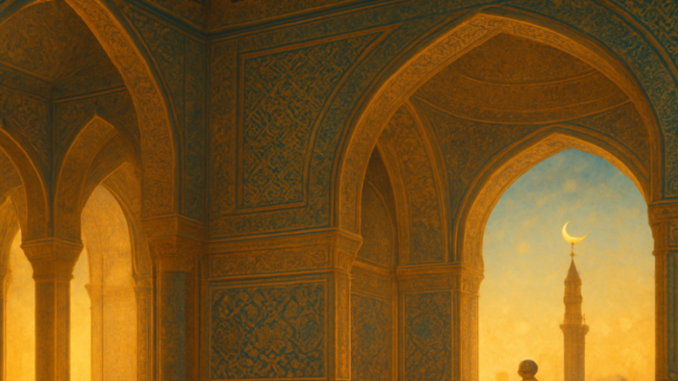
Imagine living in the seventh century and hearing that the mighty Byzantine Empire has suffered a crushing defeat at the hands of the Persians. The world as you knew it seems to teeter on the edge. Then a text appears — one that not only offers consolation but makes a remarkable prediction: within a few years, the tide will turn. This is the essence of Surah Ar-Rum, the thirtieth chapter of the Quran, which deals with the Romans. Today, we explore this text through two lenses: that of the faithful Muslim and that of the seeking Freemason. What can both perspectives teach us about impermanence, resilience, and spiritual growth?
The Historical Context of Surah Ar-Rum
Surah Ar-Rum opens with a reference to a concrete historical event: the defeat of the Byzantines — referred to in the Islamic tradition as “the Romans” — by the Persian Empire around 614 CE. The verses speak of a victory that will follow within “a few years.” Historically, this prediction proved accurate when Emperor Heraclius turned the tide and defeated the Persians in 627 CE. For believers, this is a sign of divine knowledge; for historians, it is a fascinating example of prophetic literature intersecting with real-world events.
But the surah goes far beyond a political prediction. It uses the rise and fall of empires as a starting point for deeper reflections on the nature of creation, the signs of God in the natural world, and the necessity of inner contemplation. The Romans thus become a mirror for every civilization — and for every human being who wrestles with adversity and hopes for renewal.
The Perspective of the Faithful Muslim
For the Muslim, Surah Ar-Rum is an affirmation of God’s omniscience and the truth of divine revelation. The text invites contemplation of the “signs” within creation: the alternation of day and night, the diversity of languages and colors among people, the rain that brings barren earth back to life. These verses are read as evidence of an underlying order — a divine plan unfolding despite human hardship.
Central to this reading is the concept of tawakkul, or trust in God, even when circumstances seem hopeless. The believer is invited to look beyond the surface of worldly events and recognize the hand of the Creator in both prosperity and adversity. This is not passive resignation but an active trust that provides the courage to persevere.
The Perspective of the Seeking Freemason
The Freemason approaches sacred texts not from the standpoint of dogma, but out of curiosity for universal wisdom. Freemasonry is not a religion — it is a brotherhood that unites people of all faith backgrounds in the pursuit of truth, light, and self-improvement. When a Freemason reads Surah Ar-Rum, he encounters themes that resonate deeply with his own tradition.
The cycle of the rise and fall of empires is a reminder of the impermanence of all human constructions, whether physical temples or societal structures. The Freemason symbolically builds an inner temple, knowing that every stone must be placed with care, yet also accepting that nothing endures forever. This attitude frees one from attachment to outward success and redirects the gaze toward what is truly lasting: character, wisdom, and brotherly love.
Both the Quran and Freemasonry teach us that true strength lies not in avoiding adversity, but in the ability to rise again after every fall, enriched with renewed wisdom.
What Both Perspectives Share
Despite their different starting points, we discover surprising common ground between these two traditions. Both emphasize the value of reflection and contemplation. Both see nature as a source of insight. And both acknowledge that the individual is part of a greater whole that transcends the self.
Impermanence as a teacher: Both the surah and the Masonic tradition point to the temporary nature of earthly power as a call to humility. Signs in creation: The Muslim seeks God’s signs in nature; the Freemason seeks symbolic meaning in the geometric order of the universe. Hope as a spiritual force: Both traditions provide a foundation for resilience that reaches beyond cynical pessimism or naive optimism.
Thinkers such as Averroës and Maimonides, who bridged Islamic and Jewish traditions with Greek philosophy, would have recognized this search for common ground. Their work demonstrates that wisdom is not the exclusive possession of any single tradition but a shared heritage of humanity.
Practical Wisdom for Today
What can we take away from this comparison in practical terms? First, an invitation: in times of adversity, do not despair but trust in a deeper order — whether we call it God, the Grand Architect of the Universe, or the mystery of existence. Second, a call to action: continue actively seeking signs of beauty and truth in the world around us, even when that world appears chaotic.
The Romans in the Quran remind us that no empire lasts forever, but that this is no reason for cynicism. On the contrary, it is an invitation to build what does endure. Inner growth, brotherhood, and the willingness to begin anew — these form the foundation of both the spiritual life and Masonic practice.
Surah Ar-Rum holds up a mirror in which we can recognize ourselves, regardless of our religious background. The cycle of defeat and victory, of decline and restoration, is universally human. Whether we read the text as a faithful Muslim or as a seeking Freemason, the message remains powerful: impermanence is not an enemy but a teacher. In accepting the temporary nature of all things, we find the freedom to truly build what matters most. That is the spiritual core both traditions share — and a lesson worth carrying into every lodge, every prayer, and every new day.
Copyright text & image: devrijmetselaar.nl
Texts are based on the ideas and content of the author of devrijmetselaar.nl, reviewed, corrected, and supplemented with the assistance of OpenAI. Images are created based on the ideas of the author of devrijmetselaar.nl using OpenAI/DALL-E.
Frequently Asked Questions
What is Surah Ar-Rum and why is it significant?
Surah Ar-Rum is the thirtieth chapter of the Quran that references the defeat of the Byzantine Empire by the Persian Empire around 614 CE. It is significant because it makes a prediction that the Byzantines will achieve victory within a few years, which historically came true when Emperor Heraclius defeated the Persians in 627 CE. Beyond this political prediction, the surah uses the rise and fall of empires as a foundation for deeper reflections on creation, divine signs, and inner contemplation.
What does the article mean by viewing the Romans as 'a mirror for every civilization'?
The article suggests that the historical account of the Romans' defeat and eventual victory in Surah Ar-Rum serves as a universal metaphor. It reflects the cyclical nature of human struggle and renewal that applies not only to empires and civilizations, but also to individual human beings who face adversity and seek renewal. The rise and fall of the Romans demonstrates eternal patterns of impermanence and resilience.
What is tawakkul and how does it relate to the Muslim perspective on Surah Ar-Rum?
Tawakkul is the Islamic concept of trust in God, even when circumstances appear hopeless. In the context of Surah Ar-Rum, tawakkul is not passive resignation but rather an active trust that provides believers the courage to persevere through hardship. The surah invites Muslims to recognize divine order and God's hand in both prosperity and adversity, which strengthens their ability to maintain hope during difficult times.


Be the first to comment