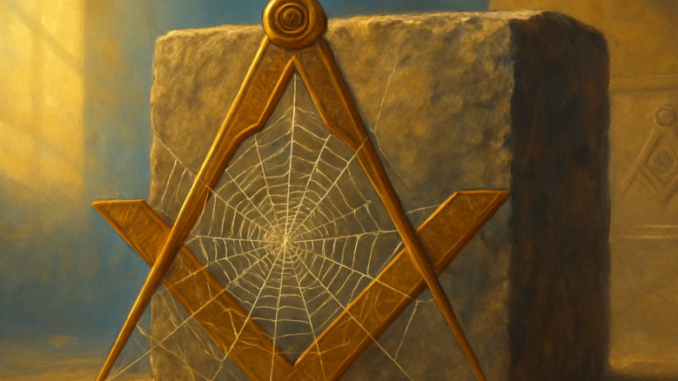
Why would a sacred book name an entire chapter after a spider? It seems like a strange choice — until you realize that this small creature carries a powerful lesson about the fragility of our inner constructions. In this twenty-ninth installment of our series exploring the Quran through a Masonic lens, we turn to Surah Al-Ankabut — The Spider — and pose the questions every seeker of truth should be willing to ask.
What Does This Surah Actually Tell Us?
Surah Al-Ankabut, the twenty-ninth chapter of the Quran, opens with a direct challenge. It confronts the idea that it is enough to simply declare, “I believe,” without that belief ever being tested. True spiritual growth, this text teaches, only emerges when we pass through fire. The trials of life are not punishments — they are tests that reveal what truly lives in our hearts.
The central image of the spider appears later in the surah, when it speaks of those who seek protectors apart from ultimate truth. Their construction is compared to the web of a spider: the frailest of all houses. A web that a single sweep of the hand can destroy. This is not a condemnation of the spider itself, but a mirror held up to anyone who builds their certainties on unstable foundations.
Why Does This Theme Resonate So Deeply with Freemasons?
Freemasonry understands the concept of building like few other traditions. We speak of working the rough stone, of raising the inner temple, of laying foundations meant to endure for generations. The image of the spider-web house, therefore, speaks directly to our craft. What are we really building? Are our inner constructions made from durable material, or are we weaving illusions that collapse at the first storm?
The true builder is not distinguished by what he erects in times of calm, but by what remains standing when the storms arrive.
Hiram Abiff, the master builder whose story stands at the heart of Masonic tradition, embodies precisely this lesson. His secret did not die with him because it was some external formula. It died with him because it pointed to an inner truth that cannot be stolen — only discovered through one’s own labor.
How Do Trials Relate to Spiritual Growth?
The surah explicitly recounts the stories of prophets who were tested: Noah, Abraham, Lot, Shuaib, and Moses. Each of them endured periods of doubt, opposition, and isolation. Their faith was not accepted on the basis of words alone but proven through steadfastness. This resonates deeply with what the Stoic philosopher Seneca wrote about trials being gifts of fortune — opportunities to reveal what lies hidden within us.
In Freemasonry, we know the Chamber of Reflection — the dark room of contemplation that precedes initiation. Here, the candidate is confronted with himself, with his own spider webs of vanity, fear, and insecurity. Only by facing this confrontation honestly can the process of genuine construction begin.
What Does the Spider Teach Us About Appearance and Substance?
A spider’s web is a remarkable piece of engineering. Mathematically precise, architecturally ingenious, functionally effective. And yet the Quran calls it the frailest of all houses. A deeper wisdom lies beneath this paradox. It is not about the outward beauty or complexity of what we build, but about its substance. A golden palace built on sand is weaker than a simple hut set upon rock.
Consider three images side by side. The spider-web house: beautiful but perishable, a symbol of false certainties. The tested believer: confirmed through adversity, strengthened by every storm. The inner temple: built upon self-knowledge, not upon outward display.
Voltaire, who despite his well-known critique of organized religion showed deep interest in Eastern wisdom traditions, would likely have appreciated this metaphor. His own search for truth beyond outward forms reflects the same impulse that echoes through this surah.
Can We Recognize Our Own Spider Webs?
This may be the hardest question of all. We are often blind to our own constructions of false security. The career that defines us, the possessions that reassure us, the opinions we defend as if our lives depended on them — are these solid foundations, or are they webs, woven from habit and fear?
Freemasonry does not offer ready-made answers to this question. What it does offer is a method: the regular gathering in lodge, the ritual that draws us out of our daily patterns, the symbols that serve as mirrors. And the brotherhood that dares to confront us with our weaknesses — not to judge, but to build.
A Universal Message
What this surah shares with Freemasonry is the conviction that spiritual development is not a passive process. It demands active participation, a willingness to be tested, and the honesty to acknowledge our own spider webs before the storm blows them away for us. The spider itself is not guilty for the fragility of its web — it builds according to its nature. But human beings have the capacity to choose what they build and what they build upon.
Surah Al-Ankabut invites us into an honest conversation with ourselves. What have we built that truly endures? Which trials have we avoided that might have made us stronger? The Freemason recognizes in these questions the very core of his own quest: not the accumulation of titles or degrees, but the slow, patient work of crafting an inner structure that can withstand the storms of life. May this twenty-ninth chapter of our series offer a moment of reflection — a quiet question that continues to echo long after the page has been turned.
Copyright text & image: devrijmetselaar.nl
Texts are based on the ideas and content of the author of devrijmetselaar.nl, reviewed, corrected, and supplemented with the assistance of OpenAI. Images are created based on the ideas of the author of devrijmetselaar.nl using OpenAI/DALL-E.
Frequently Asked Questions
Why is an entire chapter of the Quran dedicated to a spider?
Surah Al-Ankabut dedicates its central image to the spider as a powerful metaphor for spiritual fragility. The spider's web represents the frailest of all houses—a construction so delicate that a single sweep of the hand can destroy it. This imagery teaches that building our certainties on unstable foundations, whether through false protectors or untested beliefs, creates illusions that collapse when trials arrive. The spider itself is not condemned, but rather serves as a mirror to reflect how we construct our inner lives.
What is the connection between Surah Al-Ankabut and Freemasonry?
Both traditions emphasize the importance of building durable inner structures. Freemasonry speaks of working the rough stone and raising an inner temple, while Surah Al-Ankabut challenges believers to construct their faith on solid foundations. The surah's central question—'Are our inner constructions made from durable material, or are we weaving illusions?'—directly resonates with the Masonic principle that a true builder is distinguished not by what he erects in calm times, but by what remains standing when storms arrive. Hiram Abiff, the master builder of Masonic tradition, exemplifies this by possessing a secret that cannot be stolen but only discovered through one's own labor.
How do trials and tests relate to spiritual growth according to this surah?
Surah Al-Ankabut explicitly teaches that true spiritual growth only emerges when belief is tested through life's trials. The surah recounts stories of prophets—Noah, Abraham, Lot, Shuaib, and Moses—who all endured doubt, opposition, and isolation. Their faith was not accepted based on words alone but proven through steadfastness. This teaches that trials are not punishments but tests that reveal what truly lives in our hearts, and that real spiritual development requires passing through these fires to strengthen our inner foundations.

Be the first to comment