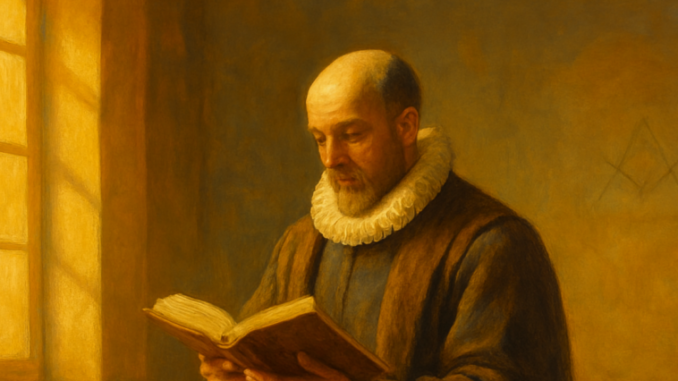
Perhaps you’ve experienced this yourself: you pick up a book that left you cold for years, and suddenly it strikes you to your very core. Not because the book has changed, but because you have. That experience lies at the heart of Michel de Montaigne’s essay On Books. But where did this idea originate? Which philosophers whispered to him that reading is not an achievement but a mirror? And what does any of this have to do with the way Freemasons approach knowledge and self-examination? Let us descend together into the philosophical roots of this remarkable essay.
Skepticism as the Foundation
To understand Montaigne, you must begin with skepticism — not the cynical kind that dismisses everything, but the inquiring skepticism of the Greek philosopher Sextus Empiricus and the Academic school of Carneades. These thinkers taught that certainty is an illusion and that the wise person suspends judgment. Montaigne adopted this principle as his personal motto: “Que sais-je?” — What do I know? He carried that question like a weapon through all of his essays, but nowhere as openly as in On Books.
In this essay, Montaigne refuses the role of authority. He freely admits that he puts books aside when they bore him, that his memory is unreliable, and that he has no pretension of mastering everything. This is not false modesty. It is a deliberate philosophical choice, rooted in Pyrrhonian skepticism — the conviction that honest doubt is preferable to unjustified certainty. For you as a reader, this means something surprising: Montaigne does not invite you to believe him. He invites you to think for yourself.
Seneca and Plutarch as Guides
Two names stand out when Montaigne discusses his favorite authors: Seneca and Plutarch. This is no accidental preference. Seneca, the great Roman Stoic, offered Montaigne a model of practical wisdom. Seneca’s letters to Lucilius are not abstract treatises but personal conversations about how to live well, how to handle adversity, and how to shape one’s character. Montaigne recognized in them his own ideal: philosophy as the art of living, not as an academic exercise.
Plutarch served a different purpose. His Lives and Moralia provided Montaigne with a treasure trove of human stories, full of nuance and contradiction. Where Seneca was the philosopher of direct counsel, Plutarch was the storyteller who revealed how genuinely complicated human beings are. Montaigne valued that richness immensely. He wrote that you can never exhaust Plutarch, that there is always more to discover. You might say that Plutarch was to Montaigne what a good mentor can be to any of us: someone who does not hand you ready-made answers but raises questions you must answer for yourself.
Stoicism and the Art of Self-Examination
Although Montaigne never labeled himself a Stoic, the influence of Stoicism on On Books is unmistakable. The Stoic tradition — from Zeno of Citium through Epictetus to Marcus Aurelius — emphasized that true knowledge begins with knowing yourself. You can read a thousand books, but if you do not know who you are and what drives you, all that learning remains hollow. Montaigne applied this principle to his own reading habits: he read not to appear learned, but to learn about himself.
Marcus Aurelius wrote in his Meditations that one should stop accumulating books and instead digest what has already been read. Montaigne did exactly that. He described how he casually picked up books and set them down again, how he forgot specific passages yet retained something essential — a change within himself. This is a profoundly Stoic insight: knowledge only has value when it shapes your character. Montaigne did not read to collect information. He read to encounter himself. That is what makes his essay On Books a philosophical invitation to anyone who seeks more than mere data.
Renaissance Humanism and the Liberation of Thought
Montaigne did not write in a vacuum. He stood at the center of Renaissance humanism, an intellectual movement that placed the human being at the heart of inquiry and looked back to the classics for inspiration. Thinkers like Erasmus and Petrarch had paved the way by making the texts of antiquity accessible once more. Montaigne went a step further. Where many humanists revered classical texts as unquestionable authorities, he dared to criticize them. He found Cicero too vain and long-winded. He considered some of Plato’s works unnecessarily roundabout. That candor was revolutionary.
Humanism gave Montaigne the tools: access to Greek and Roman sources, a culture of intellectual curiosity, and the ideal of the well-rounded individual. But his skepticism gave him the freedom to use those tools in his own way. He took what suited him and left the rest behind. This is an attitude you may recognize if you have ever sat in a Lodge: you are invited to think, not to follow blindly.
The Connection with Freemasonry
What does all of this have to do with Freemasonry? More than you might initially think. Freemasonry shares with Montaigne a fundamental conviction: that self-knowledge is the foundation of all genuine development. In the Lodge, a Brother is not asked to accept dogmas but to examine himself. Just as Montaigne used books as mirrors, the Freemason uses ritual and fraternal dialogue as tools for inner growth.
The philosophical tradition that Montaigne followed — seeking without pretension, regarding doubt as a virtue, valuing the formation of character above the accumulation of facts — runs like a golden thread through the history of Masonic thought. James Anderson, who compiled the first Constitutions in 1723, already emphasized that the Brotherhood is a place for people of all convictions who are willing to improve themselves. That openness, that refusal to impose a single dogmatic truth, echoes Montaigne’s spirit across the centuries.
When Montaigne picked up a book, he was not performing an intellectual exercise. He was engaging in a form of self-examination remarkably similar to the work every Freemason undertakes when he enters the Lodge. The rough ashlar is not shaped by memorizing texts — it is shaped by allowing those texts to change who you are. Montaigne understood this intuitively, and his essay On Books remains one of the most eloquent expressions of that timeless idea.
Montaigne’s essay On Books is far more than a literary preference list. It is a philosophical manifesto rooted in skepticism, Stoicism, and Renaissance humanism — traditions that all converge on a single truth: genuine wisdom begins with honest self-knowledge. For Freemasons, this resonance is impossible to ignore. Whether you encounter yourself through the pages of a book or through the symbols and rituals of the Lodge, the journey is the same. The question is never how much you know. The question, as Montaigne reminded us, is always: What do I truly know about myself?
Copyright text & image: devrijmetselaar.nl
Texts are based on the ideas and content of the author of devrijmetselaar.nl, reviewed, corrected, and supplemented with the assistance of OpenAI. Images are created based on the ideas of the author of devrijmetselaar.nl using OpenAI/DALL-E.

Be the first to comment