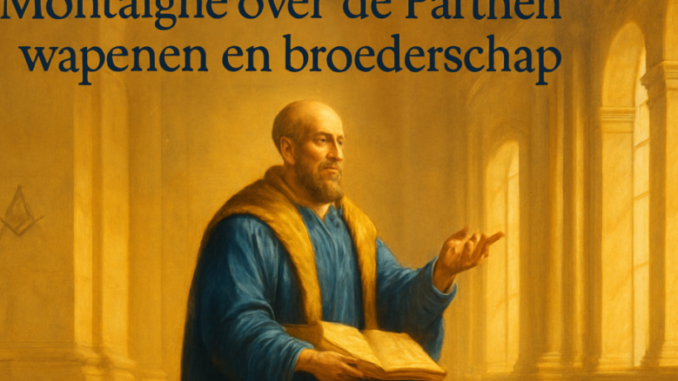
Perhaps you’ve experienced it yourself — a conversation where you chose to step back, not out of weakness, but to find better words. A moment when you deliberately took a step in retreat, precisely to get closer to the other person. If that resonates, then you already understand something of what Michel de Montaigne wrote in his essay ‘On the Parthian Manner of Fighting,’ and why that essay has a surprising amount to say about the way Freemasons seek connection.
The Art of the Conscious Retreat
In the ninth essay of his second book, Michel de Montaigne examines the battle tactics of the Parthians — an ancient people famous for their feigned retreats. While their enemies believed the Parthians were fleeing, the mounted warriors would turn in their saddles and fire arrows with deadly precision at their pursuers. It was a strategy that relied not on brute force, but on intelligence, timing, and the ability to weaponize apparent vulnerability.
Montaigne doesn’t use this image to glorify warfare. Quite the opposite. For him, the Parthian tactic serves as a metaphor for something deeply human: the wisdom of not always charging head-on, of not meeting every conflict with raised fists. Sometimes it is precisely the apparent retreat that opens the way to genuine connection. You likely know this from your own life. Think of that one disagreement with a friend where you chose to stay silent — not because you were wrong, but because you understood that the relationship mattered more than being right.
Vulnerability as a Bridge to Others
What makes this essay so remarkable is its underlying message about vulnerability. The Parthian rider shows his back to the enemy — literally the most vulnerable thing one can do on a battlefield. Yet it is precisely within that vulnerability that his power lies. Montaigne seems to be telling us that true courage resides not in rigidity, but in the willingness to expose your unprotected side.
This touches on something you encounter in a unique way within Freemasonry. When you first cross the threshold of a lodge, you are asked to open yourself up — not armored with certainties, but stripped of them. The search for light and knowledge in Freemasonry begins with the willingness to admit that you don’t yet know everything, that you still need to grow. This is essentially the same movement Montaigne describes: making yourself deliberately vulnerable, not as a sign of weakness, but as the only honest starting point for genuine growth.
Real connection doesn’t come from hiding behind armor of certainty. It comes from having the courage to show your vulnerable side — just as the Parthians dared to turn their backs to danger.
Brotherhood Beyond the Battle
There is another layer in Montaigne’s essay that speaks directly to Masonic values. The Parthians didn’t fight as individuals but as a tightly organized unit. Their tactic only worked when every rider trusted the others completely. The horseman who turned to fire had to be certain his comrades would cover him. Without that trust, the entire strategy would collapse.
That mutual trust is precisely what characterizes brotherhood within Freemasonry. In the lodge, you don’t just learn to know yourself — you learn to trust others. You share insights, doubts, and convictions with brothers you might never have met in everyday life. That trust doesn’t emerge on its own. It grows because everyone is willing to make the same vulnerable movement — to show their back, knowing that the others stand guard.
Montaigne as a Mirror for Self-Reflection
What makes Montaigne so powerful as a writer is that he never positions himself above his reader. He doesn’t write as a sage proclaiming truth, but as a searching human being thinking aloud. His entire body of work — the famous Essays — is in essence one extended experiment in self-reflection. He examines himself with the same curiosity he brings to studying the Parthians, the Romans, or the philosophers of antiquity. In this, he resembles Socrates, who claimed that the only thing he knew was that he knew nothing, or Marcus Aurelius, who in his Meditations also measured himself — not to condemn, but to grow.
That attitude of honest self-reflection is one of the cornerstones of Freemasonry. As a Freemason, you are continually invited to look in the mirror — not with vanity, but with sincerity. Who are you really? Where do your virtues fall short? Where could you listen better, be more patient, show greater understanding? These are questions Montaigne posed in the sixteenth century, and they still echo in every lodge today.
The Search for Truth as a Shared Journey
What ultimately makes this essay so valuable — both for readers of Montaigne and for Freemasons — is the insight that truth is not a destination but a journey. The Parthians didn’t achieve their goals by standing still. They retreated, turned, fired, and rode on. That constant movement, that refusal to become fixed in one position, is an approach to life that Montaigne deeply admired.
In Freemasonry, you recognize that movement in the understanding of inner growth as a process that is never complete. There is no moment at which you can say: now I am finished. Moral perfection is not a destination but a direction — a compass that gives you a heading without ever promising arrival. Montaigne would have recognized this immediately. After all, he wrote not to give answers, but to ask better questions.
Perhaps that is the most beautiful parallel between Montaigne’s essay and Freemasonry: both invite you not to fear movement. To turn around, to make yourself vulnerable, and to trust that it is precisely in that openness where the deepest connection is found. Not despite the vulnerability, but because of it. The Parthian retreat was never about running away — it was about finding the perfect moment to engage. In just the same way, the Masonic journey is never about having all the answers. It is about remaining in motion, staying open, and trusting your brothers along the way.
Copyright text & image: devrijmetselaar.nl
Texts are based on the ideas and content of the author of devrijmetselaar.nl, reviewed, corrected, and supplemented with the assistance of OpenAI. Images are created based on the ideas of the author of devrijmetselaar.nl using OpenAI/DALL-E.
Frequently Asked Questions
What is the Parthian Retreat and why does Montaigne use it as a metaphor?
The Parthian Retreat refers to the battle tactics of ancient Parthian warriors who would feign retreat, turn in their saddles, and fire arrows at their pursuers. Montaigne uses this as a metaphor not to glorify warfare, but to illustrate the wisdom of strategic withdrawal and apparent vulnerability. He suggests that sometimes stepping back—rather than charging head-on into conflict—is the most intelligent and human approach to genuine connection and understanding.
How does Montaigne's essay relate to Freemasonry?
Montaigne's message about vulnerability and conscious retreat parallels the Masonic journey. When entering a Freemasonry lodge, initiates are asked to open themselves up without the armor of certainty, admitting they don't know everything and need to grow. This willingness to be vulnerable and expose one's unprotected side—as the Parthian rider does—is the honest starting point for genuine growth and connection within Freemasonry, just as Montaigne describes it in his essay.
What does the article suggest about vulnerability and true courage?
The article argues that true courage does not reside in rigidity or always charging ahead, but in the willingness to expose your unprotected side and admit uncertainty. Vulnerability is presented as a bridge to others and a source of power, not weakness. By making yourself deliberately vulnerable—by choosing to step back or remain silent when the relationship matters more than being right—you create the conditions for genuine human connection and understanding.

Be the first to comment