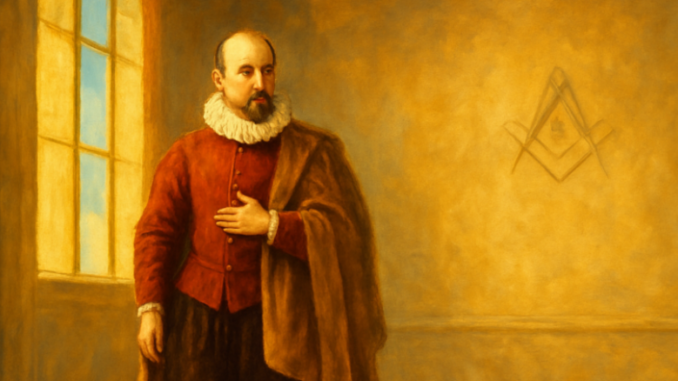
It is a cool evening in 1572. In his tower study in Bordeaux, a man sits hunched over yellowed manuscripts. Candle wax drips onto passages of Seneca, the margins filled with his own annotations. He asks himself: why do we grieve for people we barely knew? Why do our feelings reach beyond our immediate experience? This seemingly simple question would grow into one of the most penetrating essays of the Renaissance. Michel de Montaigne drew upon a rich philosophical heritage for this third essay — a heritage that continues to inspire Freemasons in their pursuit of self-knowledge to this day.
The Stoic Legacy: Emotions Under the Microscope
Montaigne’s inquiry into the reach of human feeling is deeply rooted in Stoic philosophy. Seneca, the Roman philosopher and statesman, was his most important teacher from across the centuries. In his letters to Lucilius, Seneca explored at length how emotions can overwhelm us and how we might deal with them wisely. The Stoic ideal of apatheia — freedom from disruptive passions — fascinated Montaigne, but he did not embrace it fully. Instead, he used it as a starting point for his own, more nuanced view of emotional life.
The Stoics taught that our emotional reactions arise from judgments about reality. When we mourn a distant king or rejoice at a victory that does not directly affect us, we are making a cognitive error, according to their framework. Montaigne took this analysis seriously but questioned whether such feelings are truly irrational. Perhaps, he suggested, they reveal something essential about our connection to others — about the fundamentally social nature of human beings.
Plutarch and the Art of Comparison
Alongside Seneca, Plutarch was a constant companion in Montaigne‘s study. The Greek biographer and moralist offered, in his Lives of the Noble Greeks and Romans, a rich collection of human characters, virtues, and failings. Montaigne read him in Jacques Amyot’s French translation, a work that embodied the humanistic ideals of the Renaissance. Plutarch’s method of parallel lives — placing Greek and Roman heroes side by side — taught Montaigne that human experience follows universal patterns.
Studying others is a mirror for knowing ourselves.
This idea, rooted in the classical tradition, resonates powerfully with the Masonic commitment to self-examination. Just as a Mason works his rough stone, Montaigne refined his own character against the examples of antiquity. The stories of how great figures dealt with loss, triumph, and uncertainty offered him a framework for understanding his own emotional life — a framework that remains remarkably relevant for anyone walking the path of inner development.
Skepticism as a Method of Inquiry
Montaigne’s thought is often associated with skepticism, and rightly so. His famous motto “Que sais-je?” — What do I know? — was inscribed on his coat of arms for good reason. This attitude of doubt he inherited from the Pyrrhonist tradition, which he encountered through the writings of Sextus Empiricus. Yet Montaigne’s skepticism is not a nihilistic doubt about everything. It is, rather, a methodical humility — an acknowledgment that human knowledge has limits and that certainties often prove to be illusions.
In this essay on feelings that reach beyond ourselves, Montaigne applied his skeptical method to emotions. He asked not only what we feel, but why we believe we feel what we feel. Are we truly saddened by the death of a distant king, or are social conventions playing tricks on us? These questions invite ongoing reflection — a process that Freemasons recognize as the work of building the inner temple. The willingness to question one’s own emotional responses, rather than accepting them at face value, is a hallmark of both Montaigne’s philosophy and Masonic practice.
Renaissance Humanism and the Revaluation of the Individual
The intellectual climate in which Montaigne wrote was steeped in humanistic ideals. The rediscovery of classical texts, the emphasis on personal development, and the renewed appreciation of earthly existence defined the Renaissance. Erasmus of Rotterdam had paved the way with his advocacy for a Christian humanism that united classical wisdom and faith. Montaigne went a step further by placing the individual — in all its contradictions and mysteries — at the center of philosophical inquiry.
Several key humanistic principles formed the fertile ground for Montaigne’s essay: the idea of humanity as the measure of all things, echoing Protagoras; self-knowledge as the highest wisdom, following the Delphic oracle’s command to “know thyself”; the unity of body and mind, challenging medieval dualism; and a spirit of tolerance toward human weakness and difference. These are not merely historical curiosities — they are living principles that continue to shape Masonic thought and ritual.
Montaigne examined feelings not as abstract categories but as the concrete experiences of a living, breathing human being. This approach made his work accessible and timeless, relevant for seekers in every age — whether sitting in a Renaissance tower or gathering in a Masonic lodge.
The Echo in Freemasonry
The philosophical traditions that nourished Montaigne are also the wellsprings from which Freemasonry drew when it developed its symbolic language and rituals. The Stoic ideal of character formation, the skeptical humility toward dogma, the humanistic confidence in human development — these are pillars that support both traditions. When a Freemason reflects in silence on his place in the chain of brotherhood, on his feelings for brethren he may only meet a few times a year, he is in a certain sense repeating the questions Montaigne posed in his tower study.
The question of why our feelings reach beyond ourselves is not an academic matter. It is an existential puzzle that touches on brotherhood, compassion, and the mysterious bonds that connect people across time and space. Montaigne offered no definitive answer. He offered something far more valuable: an invitation to keep asking, to keep feeling, and in that process to come to know ourselves more deeply.
Montaigne’s third essay is no isolated literary exercise. It is a crystallization point of ancient wisdom traditions — from the Stoics who dissected emotions, to the skeptics who questioned certainty, to the humanists who championed the dignity of the individual. These streams of thought flowed into the philosophical foundations of Freemasonry, where the work of self-knowledge continues in every lodge, at every meeting, in every moment of honest reflection.
Montaigne’s exploration of feelings that transcend the self remains as vital now as it was in the sixteenth century. For Freemasons and philosophical seekers alike, his essays offer a mirror — not one that flatters, but one that reveals. The invitation stands open: to examine our emotions with honesty, to question our certainties with courage, and to recognize in our capacity for feeling beyond ourselves the very essence of what it means to be human. In the space between the question and the answer, the real work of the inner temple takes place.
Copyright text & image: devrijmetselaar.nl
Texts are based on the ideas and content of the author of devrijmetselaar.nl, reviewed, corrected, and supplemented with the assistance of OpenAI. Images are created based on the ideas of the author of devrijmetselaar.nl using OpenAI/DALL-E.
Frequently Asked Questions
What is the connection between Montaigne's philosophy and Freemasonry?
Montaigne's pursuit of self-knowledge through studying human emotions and classical examples directly parallels the Masonic commitment to self-examination and personal development. Both traditions encourage individuals to refine their character by learning from the experiences of others and questioning their assumptions about reality. This shared emphasis on introspection and intellectual growth makes Montaigne's work particularly relevant to Masons seeking deeper understanding of themselves and their place in the world.
How did Montaigne use Stoic philosophy in his thinking?
Montaigne drew inspiration from Stoic thinkers like Seneca but did not simply accept their teachings uncritically. Rather than viewing emotions as purely irrational errors, he questioned whether feelings that transcend our immediate experience might actually reveal something essential about human nature and our connection to others. This nuanced approach—combining classical wisdom with personal inquiry—reflects the Masonic value of using the great traditions as tools for deeper self-knowledge rather than dogmatic rules.
Why did Montaigne study the lives of great historical figures?
Montaigne believed that studying the experiences of others provided a mirror for understanding ourselves, a principle he learned from Plutarch's parallel lives. By examining how great figures dealt with loss, triumph, and uncertainty, Montaigne developed a framework for understanding his own emotional life. This method of learning through the examples of others resonates with the Masonic practice of drawing wisdom from the experiences and teachings of those who came before us.
What does Montaigne's motto 'Que sais-je?' mean for personal development?
Montaigne's motto, 'What do I know?', represents a skeptical approach to inquiry that encourages constant questioning and intellectual humility rather than accepting beliefs without examination. This attitude of productive doubt is essential for genuine self-discovery and personal growth, values that Freemasonry also holds dear. By maintaining an open and questioning mind, individuals can continue to deepen their understanding and refine their character throughout their lives.


Be the first to comment