Freemasonry has long sparked a sense of mystery and fascination. What happens behind the doors of a lodge? Where does this centuries-old tradition come from? And why does it continue to inspire men around the world to work on themselves and strive for a better society? In this article, we take a deep dive into the history of Freemasonry — not as dry historians cataloguing facts, but as curious explorers searching for meaning, inspiration, and connections that have stood the test of time.
Medieval Roots: From Master Builders to Brotherhood
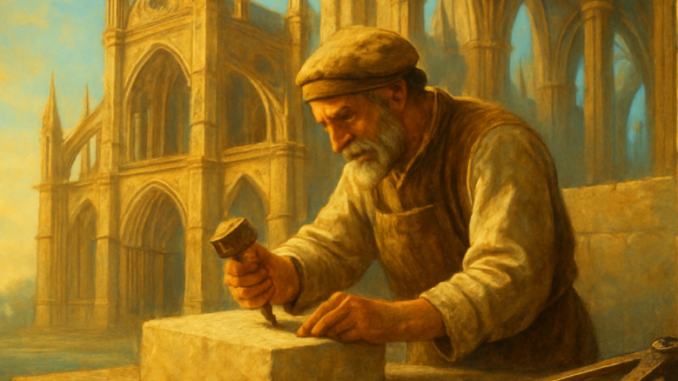
The origins of Freemasonry are layered with symbolism, myth, and historical complexity. Most historians trace its roots back to the Middle Ages — specifically to the stonemason guilds that built Europe’s great cathedrals. These guilds were far more than trade organizations. They passed on not only technical skills but also cultivated moral and ethical values among their members.
The construction of Gothic cathedrals was no simple undertaking. It required cooperation, dedication, and above all: vision. The symbolism of building — shaping rough stones into a harmonious whole — remains at the very heart of Freemasonry today. The only difference is that the “building site” has become an inner one.
From Workshop to Symbolic Lodge
Around the 17th century, a remarkable transformation began to take shape. Rather than admitting only working tradesmen, lodges gradually opened their doors to thinkers, philosophers, and intellectuals. This marks the beginning of what is known as speculative Freemasonry — a form of the Craft that is no longer concerned with physical construction, but with building one’s own character and conscience.
This transition mirrored a broader cultural shift: the dawn of the Enlightenment. Freedom of thought, individual responsibility, and moral development became central themes. It was during this period that the first written constitutions of Freemasonry appeared, most notably James Anderson’s famous “Constitutions of the Freemasons” in 1723. This document laid the groundwork for how lodges would be organized and governed for centuries to come.
The Spread Across Europe
Freemasonry spread rapidly across Europe. The number of lodges grew steadily in England and Scotland, followed by Germany, France, and the Netherlands. In the Netherlands, the first lodge was established in The Hague in 1734. From that moment on, a thriving Masonic community developed across the Low Countries, with a strong emphasis on tolerance, spirituality, and personal growth.
Throughout the 18th and 19th centuries, Freemasonry often found itself at the intersection of culture, politics, and science. It exerted its influence through symbolism and moral philosophy rather than through power or authority. Freemasons were actively involved in education, healthcare, and the advancement of civil rights.
Freemasons Who Changed the World
Over the centuries, Freemasonry has counted countless influential members among its ranks — not because of their titles, but because of their drive to contribute to the world. Here are some notable examples:
Wolfgang Amadeus Mozart — whose music was rich with symbolic references and who regarded his lodge as a spiritual home. His opera The Magic Flute is widely considered to be infused with Masonic themes and ideals.
Benjamin Franklin — an American statesman, scientist, and diplomat who translated Masonic values into political ideals, playing a pivotal role in shaping the young American republic.
George Washington — the first President of the United States, who used Freemasonry as an ethical compass while helping to build a new democracy. He was inaugurated as President while holding a Masonic Bible.
Eduard Douwes Dekker (Multatuli) — a Dutch writer and fierce opponent of colonial oppression in the Dutch East Indies. His Masonic background helped him frame ethical questions within a broader moral framework, producing some of the most powerful social criticism in Dutch literary history.
Persecution and Resilience
Freemasonry has not always been welcomed with open arms. During periods of totalitarian rule or religious extremism, lodges were banned and their members persecuted. Under the Nazi regime in Germany, thousands of Freemasons were arrested and their lodges shut down. Freemasonry was also forbidden in Franco’s Spain and throughout the Soviet era.
Yet the brotherhood endured — sometimes in secret, sometimes in exile, but always faithful to its core values: liberty, equality, and fraternity. This resilience speaks to the depth and strength of the principles upon which Freemasonry is built.
A Revival in the Modern Era
The 20th and 21st centuries brought a renewed interest in meaning, purpose, and personal development. Freemasonry fits seamlessly into this modern quest. While many traditional institutions have faded in relevance, Freemasonry continues to offer stability, meaning, and space for spiritual exploration — without dogma.
Today, the Netherlands alone has more than 150 active lodges. Men from all walks of life, religions, and backgrounds come together to work on themselves — and by extension, on society. What unites them is not any outward characteristic, but an inner aspiration: the desire to become the best version of themselves.
Freemasonry Today: Experience Over Knowledge
The history of Freemasonry is far more than a list of dates and names. It is a living story — one that begins anew in every man who decides to search for meaning, depth, and brotherhood.
Freemasonry does not offer ready-made answers. Instead, it challenges you to ask the right questions. It invites you to view your life as a building project in which you yourself are the architect. The tools are symbolic, the work is real, and the journey is deeply personal.
What Can You Take Away from the History of Freemasonry?
Freemasonry teaches us that the work of self-improvement has ancient roots — roots that stretch back centuries and connect us to generations of men who walked the same path. It shows us that brotherhood and freedom are universal values that transcend every era and every culture. And above all, it reminds us that your personal journey is always connected to a larger story.
You are not alone. You follow a path that thousands before you have also walked — each with their own questions, doubts, and longing for a better self and a better world.
Perhaps you feel the call — the call to set out on your own journey, to build, to grow, and to become part of a tradition that has endured for centuries. The history of Freemasonry is not a closed book. It is an ongoing story, and there may well be a chapter waiting for you.
Copyright text & image: devrijmetselaar.nl
Texts are based on the ideas and content of the author of devrijmetselaar.nl, reviewed, corrected, and supplemented with the assistance of OpenAI. Images are created based on the ideas of the author of devrijmetselaar.nl using OpenAI/DALL-E.
Frequently Asked Questions
What are the origins of Freemasonry?
Freemasonry traces its roots back to the medieval stonemason guilds that built Europe's great cathedrals during the Middle Ages. These guilds were more than just trade organizations—they passed on technical skills while cultivating moral and ethical values among their members. The symbolism of building and shaping rough stones into a harmonious whole remains at the heart of Freemasonry today.
How did Freemasonry change from the Middle Ages to modern times?
Around the 17th century, lodges transformed from admitting only working tradesmen to welcoming thinkers, philosophers, and intellectuals. This marked the beginning of speculative Freemasonry, which shifted focus from physical construction to building one's own character and conscience. This transition aligned with the Enlightenment's emphasis on freedom of thought, individual responsibility, and moral development.
What is the significance of James Anderson's Constitutions of 1723?
James Anderson's "Constitutions of the Freemasons" published in 1723 was a landmark document that established how lodges would be organized and governed for centuries to come. It provided the foundational framework for Freemasonry as a formal institution and helped standardize practices across the fraternity.
How has Freemasonry contributed to society throughout history?
Throughout the 18th and 19th centuries, Freemasons were actively involved in education, healthcare, and the advancement of civil rights. Rather than exerting influence through power or authority, Freemasonry has made its impact through symbolism, moral philosophy, and the personal development of its members, who have worked toward building a better society.
Why does Freemasonry continue to attract members today?
Freemasonry continues to inspire men around the world because it provides a framework for personal growth, self-improvement, and meaningful connection with others. The fraternity's emphasis on moral development, tolerance, spirituality, and working together toward a better society resonates with individuals seeking deeper purpose and fellowship in their lives.

Be the first to comment