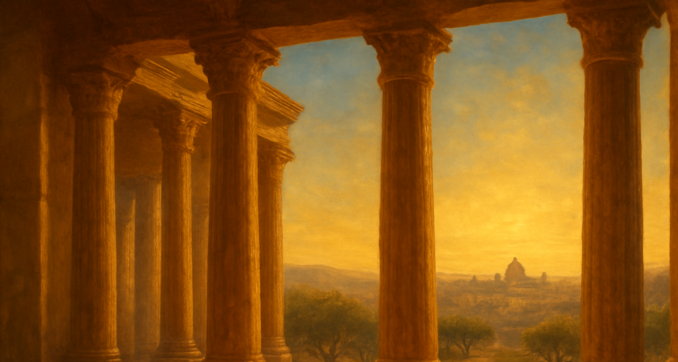
A brother pauses to reflect on the words just read aloud. It is evening, the candles flicker, and the text lingers in the silence of the temple room. The passage comes from the Epistle to the Hebrews — words about faith as a foundation, about a heavenly city being built, about perseverance on a path that is not always visible. Something in those ancient words strikes a chord, touching on his own journey as a Freemason.
A Letter on Faith and Perseverance
The Epistle to the Hebrews occupies a unique place within the New Testament. Unlike most of the Apostle Paul’s letters, the author of this work remains unknown. As early as the third century, the Church Father Origen wrote that only God knows who truly penned it. Yet its message has inspired people for millennia. At its core, the epistle revolves around faith as a driving force, perseverance in times of trial, and the building of something that transcends the earthly realm.
For Freemasons, this letter contains striking parallels. The eleventh chapter — often called the “faith chapter” — describes faith as the substance of things hoped for, the evidence of things not seen. This definition has resonated through the centuries with thinkers from Thomas Aquinas to later Enlightenment philosophers who wrestled with the relationship between reason and trust. For the builder — the Mason working on his inner temple — this raises a fundamental question: how do you build something when you cannot see the finished result?
The Heavenly City and the Royal Art
One of the most evocative images in the Epistle to the Hebrews is that of the heavenly city. The author speaks of Abraham, who looked forward to a city with foundations, whose architect and builder is God. This image of divine craftsmanship speaks directly to Masonic symbolism. The Great Architect of the Universe — the creative principle as it is known in Freemasonry — is not coincidentally tied to architecture and construction.
The operative masons of the Middle Ages built cathedrals that reached toward the heavens. They worked with stone and mortar, but their legacy is more than material. The speculative Freemasonry that emerged later adopted this craftsmanship as a metaphor for inner development. The Epistle to the Hebrews emphasizes precisely this idea: we build something temporal here, but we strive toward something enduring.
Faith is the foundation upon which the Freemason builds — not as dogma, but as trust in the journey he has undertaken.
The Cloud of Witnesses and Brotherhood
The twelfth chapter opens with a powerful image: we are surrounded by a great cloud of witnesses. This refers to all those who have walked the path of faith before us. For Freemasons, this is a deeply recognizable concept. The chain of brothers stretches across centuries and continents. Figures such as James Anderson, Jean Théophile Desaguliers, and the many unknown builders who preceded them form an invisible community that sustains today’s Freemason.
This cloud of witnesses is not a passive audience. They are examples who inspire perseverance. The Epistle to the Hebrews calls on us to run the race with endurance, to not grow weary when the way becomes difficult. In the lodge, this idea is reflected in the gradual path a candidate walks — from Entered Apprentice to Fellow Craft to Master Mason. Each step demands perseverance; each degree reveals new challenges.
Melchizedek and the Mystery of Origin
A fascinating element in the Epistle to the Hebrews is the figure of Melchizedek — the King of Salem and Priest of the Most High God. He appears in Genesis when he blesses Abraham, and the Epistle to the Hebrews devotes considerable attention to his mysterious character. Melchizedek has no recorded genealogy, no beginning of days, no end of life. He symbolizes a priesthood older and more universal than any earthly system.
This mystery has captivated esoteric thinkers throughout the ages. Early Church Fathers, medieval mystics, and Renaissance philosophers such as Marsilio Ficino saw in Melchizedek a pointer toward a primordial wisdom. For Freemasons — who know the legend of Hiram Abiff as the central narrative of their ritual — the concept of a figure whose origin is shrouded in mystery is far from unfamiliar. It serves as a reminder that some truths cannot be captured in words.
Practical Application: Building Character
The Epistle to the Hebrews is no abstract theological treatise. Its closing chapters contain concrete exhortations: be hospitable, remember those in prison, honor the sanctity of marriage, be content with what you have. This practical ethic aligns closely with Freemasonry’s emphasis on virtue and conduct in daily life. A Freemason is not shaped solely within the lodge — he proves his character in the world beyond its walls.
The shared ground between the Epistle to the Hebrews and Freemasonry can be distilled into several key themes: faith as a foundation for action rather than a substitute for reason; perseverance on the path even when the destination remains invisible; connection with those who came before as a source of strength and inspiration; and practical virtue as the outward expression of inner growth.
The bridge between this ancient text and the Masonic tradition does not lie in identical beliefs but in shared themes. Both traditions call for trust in a process greater than the individual, dedication to a path of improvement, and the courage to build something that only becomes visible to those who dare to believe.
The Epistle to the Hebrews invites reflection on what it truly means to build on faith. For the Freemason working on his rough ashlar, this ancient text offers deeply recognizable themes: the invisible foundation, the cloud of predecessors, the call to perseverance. Not as religious prescription, but as a mirror for the inner journey. In the silence after the ritual, when the words have been spoken and the candles slowly dim, one question remains: what city are you building?
Copyright text & image: devrijmetselaar.nl
Texts are based on the ideas and content of the author of devrijmetselaar.nl, reviewed, corrected, and supplemented with the assistance of OpenAI. Images are created based on the ideas of the author of devrijmetselaar.nl using OpenAI/DALL-E.
Frequently Asked Questions
What is the connection between the Epistle to the Hebrews and Freemasonry?
The Epistle to the Hebrews contains striking parallels to Masonic teachings, particularly regarding faith as a foundation and the symbolism of building. The eleventh chapter defines faith as 'the substance of things hoped for, the evidence of things not seen,' which directly relates to how Masons build their inner temple without seeing the finished result. Additionally, the epistle's image of the heavenly city with divine architecture mirrors Masonic symbolism of the Great Architect of the Universe and the concept of inner spiritual development through craftsmanship.
Who wrote the Epistle to the Hebrews?
The author of the Epistle to the Hebrews remains unknown, despite being attributed to Paul. Church Father Origen wrote as early as the third century that only God knows who truly penned it. Despite this uncertainty about authorship, the epistle's powerful message about faith, perseverance, and building something transcendent has inspired readers for nearly two thousand years.
How does the article explain the difference between operative and speculative Freemasonry in relation to the Epistle?
Operative masons of the Middle Ages literally built cathedrals with stone and mortar, creating physical structures that reached toward the heavens. Speculative Freemasonry, which emerged later, adopted this craftsmanship as a metaphor for inner spiritual development rather than physical construction. The Epistle to the Hebrews supports this distinction by emphasizing that while we build something temporal here on earth, we strive toward something enduring and spiritual, with faith serving as the foundation for this inner development.

Be the first to comment