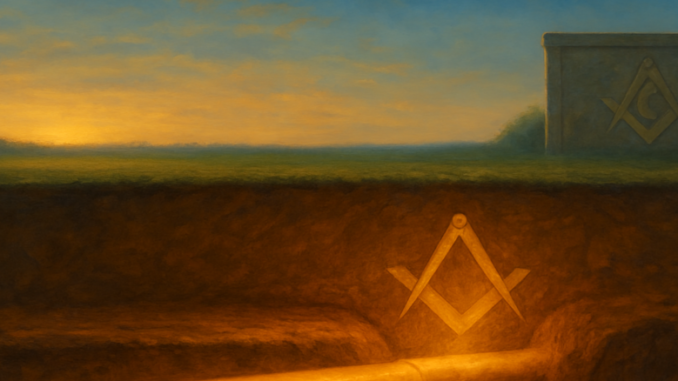
A pipe buried underground. Invisible, forgotten — until the news reminds us it exists. European gas prices drop following a peace agreement between the United States and Iran, and suddenly the pipeline becomes what it always was: a vein in the body of civilization. But what do we truly see when we look at that pipe? A piece of infrastructure? Or an invitation to reflect more deeply on what it means when energy flows freely once again?
The Invisible Network
Beneath our feet lies a world we rarely consider. Pipes, cables, conduits — they form a network that makes daily life possible without us sparing it a second thought. Only when the flow stops, when the warmth fails to arrive, do we realize how dependent we are on this hidden infrastructure. The peace accord now calming the energy markets makes visible something that was always there: our profound interconnectedness.
Freemasonry has a rich tradition of contemplating what is hidden and what is revealed. The building of the Temple, so central to our symbolism, is not merely about stones and columns. It is about the invisible structures that support a building — the foundations no one sees, but without which nothing can stand.
Flowing Energy as Metaphor
Gas is not a solid body, not a stone you can pick up and examine. It is volatile, invisible, and yet full of potential power. When it flows, it heats our homes and drives our industries. When it stops, we feel the cold of isolation. These qualities make gas an extraordinarily rich symbol for what spiritual traditions have long called life force or inspiration.
Ancient traditions frequently spoke of the breath — ruach in Hebrew, pneuma in Greek. These concepts point to more than mere air: they refer to the breath of life, the animating force that moves through all things. When we speak today of gas flowing freely through pipelines after a peace agreement, we touch the same ancient intuition. Peace opens the channels. Conflict seals them shut.
The Blockage and the Opening
Every conflict — whether between nations or within ourselves — creates blockages. Roads are closed, harbors sealed, pipelines drained. But we know these obstructions in our personal lives as well: relationships that stall, conversations that falter, creativity that dries up. The symbolism of the blocked pipe and the restoration of flow speaks to a universal human experience.
Where two or three come together in peace, the spirit flows freely between them.
In Masonic ritual practice, great care is given to the opening and closing of the Lodge. These are not empty formalities. The opening creates a space in which something can flow that ordinarily remains blocked: openness, brotherhood, shared contemplation. The closing protects what is vulnerable. The same principle applies to the gas pipeline — it must be secured against misuse, yet it fulfills its purpose only when it is open.
Peace as Precondition
The current news reminds us that economic prosperity cannot be separated from political relationships. A falling gas price is not an isolated technical fact. It reflects a change in human relations — an accord, a handshake, a decision to end hostility. Behind every price curve lie human choices.
Freemasonry has positioned itself through the centuries as a space where people of different backgrounds can meet in mutual respect. Not to exchange political positions, but to make genuine dialogue possible. In this sense, the Lodge is much like the pipeline: it creates the conditions under which something can flow. What actually passes through depends on the willingness of participants to truly give and receive.
The Warmth That Connects Us
Ultimately, gas is about warmth. The fire in the hearth, the meal on the table, the comfort that allows us to think about more than mere survival. When that warmth disappears, we contract inward. When it returns, we relax and open ourselves to others.
This physical warmth stands as a symbol for the spiritual warmth every community needs — the brotherly affection, the willingness to support one another, the joy of a shared moment. Without this warmth, every organization becomes a cold mechanism, every relationship a transaction.
Consider what the pipeline teaches us as a symbol:
- The pipeline as a symbol of connection between distant places
- The flow as an image of what must be allowed to move freely
- The blockage as a warning about the consequences of conflict
- The warmth as the ultimate purpose of all effort
A Personal Reflection
When I read the news about falling gas prices, my mind wanders to the invisible connections in my own life. Which pipelines have I allowed to clog through inattention? What warmth have I withheld from people who needed it? And conversely: where has an unexpected gesture of reconciliation set the flow in motion again?
The gas pipeline beneath the ground invites such questions — not as moral reproach, but as a gentle invitation. Look at the invisible, it says. Ask yourself what is flowing and what has stagnated. And remember that every peace accord, however large or small, creates the conditions for new warmth.
The falling gas price is more than an economic statistic. It reminds us of a deep truth: that everything is connected to everything, that peace is the precondition for prosperity, and that the warmth we seek begins with a willingness to open the channels. In the gas pipeline — that forgotten symbol beneath our feet — an ancient wisdom is reflected: let flow what must flow, and cherish the warmth that follows.
Copyright text & image: devrijmetselaar.nl
Texts are based on the ideas and content of the author of devrijmetselaar.nl, reviewed, corrected, and supplemented with the assistance of OpenAI. Images are created based on the ideas of the author of devrijmetselaar.nl using OpenAI/DALL-E.
Frequently Asked Questions
What does Freemasonry teach about hidden or invisible things?
Freemasonry has a rich tradition of contemplating both what is hidden and what is revealed, recognizing that invisible structures often support visible ones. Just as a building's foundations cannot be seen but are essential to its stability, Masonic teachings encourage reflection on the unseen forces and principles that sustain our lives and society.
How does Freemasonry use symbolism like flowing energy or pipes?
Freemasonry uses natural and physical symbols to represent spiritual truths. The concept of energy flowing freely—like gas through a pipeline—represents inspiration, life force, and spiritual openness that the ancient traditions called 'breath' or 'pneuma.' These symbols help Masons contemplate deeper meanings about peace, connection, and the conditions necessary for human flourishing.
What is the significance of opening and closing a Masonic Lodge?
The opening and closing of the Lodge are sacred practices that create a protected space where brotherhood, openness, and shared contemplation can flourish freely. These ceremonies are not mere formalities but intentional acts that establish conditions for meaningful connection and spiritual work, similar to how a pipeline must be properly secured yet remain open to fulfill its purpose.
How does Freemasonry relate conflict and blockage to personal life?
Freemasonry recognizes that conflicts—whether between nations or within ourselves—create blockages that prevent growth and connection, much like closed pipelines prevent energy flow. The Craft teaches that peace opens the channels for inspiration, creativity, and brotherhood to move freely, helping individuals and communities heal and prosper.

Be the first to comment