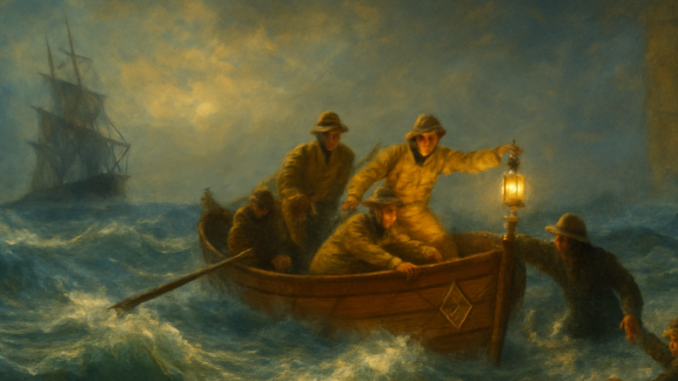
Freemasonry has long been associated with the pursuit of a better world through solidarity, knowledge, and practical action. One of the most tangible contributions Freemasons have made — particularly in the Netherlands — is their pivotal role in establishing organized rescue services. Born out of a response to natural disasters and life-threatening emergencies, these efforts reflect the Masonic ideals of brotherhood and care for one’s fellow human beings in their most powerful form.
The Origins of Organized Rescue Services
The Dutch rescue services trace their roots to the 19th century, a period when devastating storms and floods regularly claimed lives and caused widespread destruction. During this era, there were no official disaster relief organizations. Instead, local communities and philanthropic networks stepped in to fill the void — and Freemasons were at the forefront of these efforts.
Masonic lodges established funds, organized training for volunteers, and procured essential rescue equipment such as boats and other lifesaving tools. These grassroots actions, driven by a genuine sense of duty and compassion, laid the groundwork for what would eventually become the modern, professional rescue infrastructure we know today.
Masonic Ideals at the Heart of Lifesaving
The connection between Freemasonry and rescue work is no coincidence. Several core Masonic values align directly with the principles of emergency aid and humanitarian service:
Brotherhood: The belief that every individual bears responsibility for the safety and well-being of others. This principle naturally extends to organized efforts aimed at saving lives during disasters.
Service: Freemasons view helping others not merely as a charitable act but as both a duty and an honor — especially when lives hang in the balance.
Enlightenment through action: Rather than simply discussing ideals in the lodge room, Freemasons sought to translate their values into concrete deeds. Few acts embody this principle more powerfully than pulling someone from floodwaters or a sinking vessel.
Masonic lodges frequently served as coordination centers for relief operations. Their established networks enabled the rapid mobilization of volunteers and resources when disaster struck — a capability that formal institutions had not yet developed.
Practical Contributions of Freemasons to Rescue Work
The role Freemasons played in the development of rescue services was both broad and deeply practical. Their contributions took many forms:
Funding rescue boats: Freemasons raised significant sums for the construction and maintenance of boats deployed during floods and maritime disasters. Without this financial backing, many communities would have lacked the basic tools needed to save lives.
Training volunteers: Lodges supported programs that taught lifesaving skills such as swimming, diving, and first aid. By investing in human capability, they ensured that communities were better prepared to respond when emergencies arose.
Building local response networks: Perhaps most importantly, Masonic lodges played a key role in organizing local groups that could respond quickly in crisis situations. These networks of trained and equipped volunteers became the backbone of early emergency response in the Netherlands.
From Masonic Initiative to Modern Institution
The rescue infrastructure that Freemasons helped build evolved over time into professional organizations. The most notable example is the Royal Netherlands Sea Rescue Institution (KNRM), which continues to operate today as a highly respected, independent lifesaving organization. While the KNRM and similar bodies now function independently of any Masonic affiliation, the foundational ideals of cooperation and service remain deeply embedded in their missions.
Freemasons demonstrated that philanthropy and idealism can produce a lasting impact — one that endures long after direct involvement has faded. The institutions they helped create continue to save lives every year, a testament to the enduring power of organized compassion.
Inspiration for Future Generations
The story of Freemasonry’s role in the development of rescue services offers a powerful reminder of what is possible when ideals are put into action. Freemasons proved that their principles are not merely a source of personal growth and philosophical reflection — they can also serve as the foundation for structural solutions to societal problems.
The impact of the rescue services they helped establish is still felt today. For current and future generations of Freemasons and civic-minded individuals alike, this history serves as an inspiring example of how organized, creative, and determined action can profoundly improve the well-being of others.
The legacy of Freemasonry in the world of rescue and emergency services stands as one of the Craft’s most compelling real-world achievements. What began as lodge-driven philanthropy — funding boats, training volunteers, and coordinating local response networks — grew into professional institutions that continue to save lives to this day. It is a powerful reminder that when Masonic ideals of brotherhood, service, and action meet genuine need, the results can echo across centuries.
Copyright text & image: devrijmetselaar.nl
Texts are based on the ideas and content of the author of devrijmetselaar.nl, reviewed, corrected, and supplemented with the assistance of OpenAI. Images are created based on the ideas of the author of devrijmetselaar.nl using OpenAI/DALL-E.
Frequently Asked Questions
What role did Freemasons play in establishing rescue services?
Freemasons were instrumental in founding organized rescue services, particularly in the Netherlands during the 19th century when natural disasters claimed many lives. They established funding systems, trained volunteers, and procured essential lifesaving equipment like boats, laying the groundwork for the modern professional rescue infrastructure we have today.
How do Masonic ideals connect to rescue and emergency services?
Core Masonic values like brotherhood, service, and enlightenment through action directly align with humanitarian emergency work. Freemasons believe in taking personal responsibility for others' safety and well-being, and they translate these ideals into concrete lifesaving actions rather than merely discussing them philosophically.
What specific contributions did Freemasons make to rescue operations?
Freemasons made tangible contributions including funding the construction and maintenance of rescue boats, organizing volunteer training programs in lifesaving skills such as swimming and first aid, and using their lodge networks to rapidly mobilize resources and volunteers during disasters when formal institutions were not yet equipped to do so.
Why were Masonic lodges effective coordination centers during emergencies?
Masonic lodges already had established networks of trusted members and organizational structures in place, enabling them to rapidly mobilize volunteers and resources when disasters struck—a capability that formal government institutions had not yet developed in the 19th century.

Be the first to comment