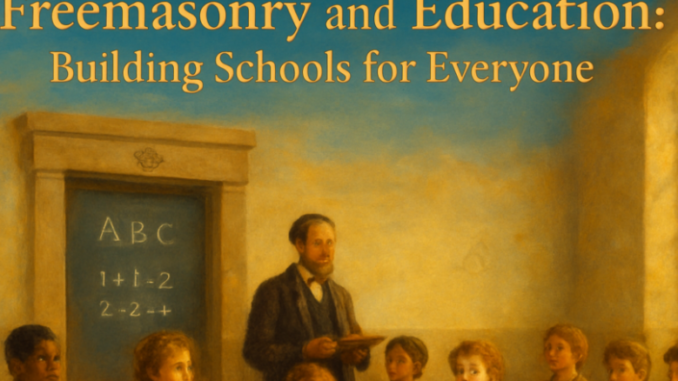
In an era when education was a privilege reserved for the few, Freemasons stepped forward as champions of universal learning. Driven by ideals of enlightenment, equality, and personal growth, they viewed education as the very foundation of a just and progressive society. Their efforts to establish schools and training centers — particularly in the Netherlands — left a lasting mark on how we think about access to knowledge today.
The Origins of Educational Reform
During the 19th century, access to education was largely confined to the upper classes. Children from working-class families had little opportunity to attend school and were often forced into labor at a young age. For Freemasons — who placed immense value on enlightenment and self-improvement — this was a profound injustice. They took it upon themselves to establish schools that would be open to children from all social backgrounds, regardless of wealth or status.
Freemasons envisioned a holistic model of education. Beyond teaching basic reading, writing, and arithmetic, they sought to cultivate values such as critical thinking, tolerance, and brotherhood. This approach was deeply rooted in their broader philosophy of universal human progress — the belief that an enlightened individual contributes to the betterment of society as a whole.
Freemasonry‘s Contributions to Education
The bond between Freemasonry and the pursuit of knowledge has always been strong. Throughout history, Freemasons made significant contributions to education in several key ways:
Founding schools: Masonic lodges established and funded schools specifically designed to serve children from disadvantaged families, providing them with opportunities that would otherwise have been out of reach.
Adult education centers: Beyond schools for children, Freemasons also created training centers for adults, giving workers the chance to develop new skills and improve their prospects — an early forerunner of modern continuing education.
Promoting learning resources: Freemasons supported the distribution of books, scientific instruments, and other educational materials to ensure that quality teaching was possible, even in under-resourced communities.
These efforts had a lasting influence on the accessibility of education, particularly in the Netherlands, where Masonic involvement helped shift public attitudes toward the idea that learning should be available to everyone.
Practical Ways Freemasons Supported Schools
The involvement of Freemasons in education went far beyond philosophy — it was hands-on and practical. Lodges actively contributed to the development and sustainability of schools and training centers in several concrete ways:
Financial support: Masonic lodges organized fundraising efforts to build school buildings and pay teachers’ salaries, ensuring that financial barriers did not stand in the way of a child’s education.
Curriculum development: Many lodge members were experts in science, philosophy, and the arts. They used their knowledge to design curricula that went well beyond the standard educational offerings of the time, encouraging deeper learning and intellectual curiosity.
Mentorship: Freemasons frequently served as mentors to both students and teachers, creating strong ties between the school and the wider community. This personal investment helped foster an environment where learning was valued and encouraged.
The Lasting Impact on Modern Education
While the direct involvement of Freemasons in running schools is less visible today, their influence continues to be felt. The principle that education is a fundamental right — accessible to everyone regardless of background or financial means — is one of the most important legacies of Masonic educational reform. Many of the values they championed in their schools, including inclusion, equality, and critical thinking, remain central pillars of modern education systems around the world.
In the Netherlands especially, Freemasons helped lay the groundwork for a more inclusive educational culture — one that lives on in schools, universities, and vocational training programs to this day.
Inspiration for Future Generations
The educational work of Freemasons offers a powerful source of inspiration as we face the challenges of our own time. Their conviction that knowledge is the key to both personal growth and societal progress remains deeply relevant in a world where equal access to education is still far from guaranteed in many places.
By learning from their example — their dedication, their generosity, and their unwavering belief in the transformative power of education — we can continue building educational systems that are accessible, equitable, and truly transformative.
The story of Freemasonry and education is ultimately a story about the belief that knowledge belongs to everyone. From founding schools for underprivileged children to creating adult training centers and developing forward-thinking curricula, Freemasons turned their ideals into action. Their legacy reminds us that investing in education is one of the most powerful ways to build a more just and enlightened society — a message that resonates as strongly today as it did centuries ago.
Copyright text & image: devrijmetselaar.nl
Texts are based on the ideas and content of the author of devrijmetselaar.nl, reviewed, corrected, and supplemented with the assistance of OpenAI. Images are created based on the ideas of the author of devrijmetselaar.nl using OpenAI/DALL-E.
Frequently Asked Questions
What role did Freemasons play in making education accessible to poor children?
During the 19th century, when education was reserved for the wealthy, Freemasons established schools specifically designed to serve children from disadvantaged families. They provided financial support, built school buildings, paid teachers' salaries, and ensured that economic barriers did not prevent poor children from accessing quality education.
What kind of education did Masonic schools offer beyond basic subjects?
Freemasons believed in holistic education that went beyond reading, writing, and arithmetic. Their schools cultivated critical thinking, tolerance, and brotherhood, reflecting the Masonic philosophy that enlightened individuals contribute to the betterment of society as a whole.
Did Freemasons support education for adults as well as children?
Yes, Freemasons recognized the value of lifelong learning and created adult education centers and training facilities where workers could develop new skills and improve their prospects. These efforts were pioneering examples of what we now call continuing education.
How did Freemasons help schools in under-resourced communities?
Beyond founding schools and training centers, Freemasons actively promoted learning resources by supporting the distribution of books, scientific instruments, and other educational materials. This ensured that quality teaching was possible even in communities that lacked adequate resources.
Why did Freemasons believe education was so important?
Freemasons viewed education as the foundation of a just and progressive society, driven by ideals of enlightenment, equality, and personal growth. They believed that providing universal access to learning would contribute to human progress and create a more enlightened, tolerant world.

Be the first to comment