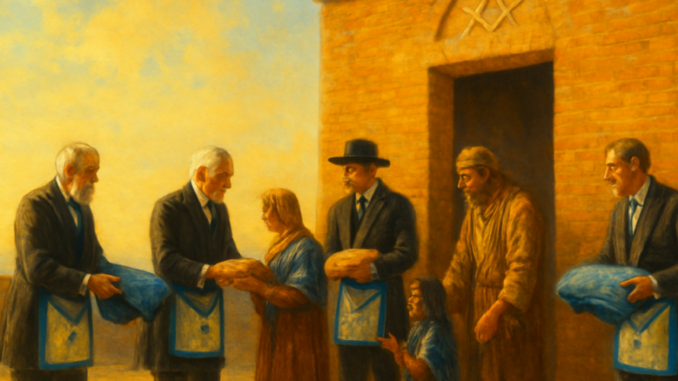
The 19th and 20th centuries saw wave after wave of political and economic refugees, driven from their homelands by war, revolution, and persecution. In these turbulent times, organized aid was scarce and often inadequate. Freemasons — bound by their commitment to brotherhood and humanity — felt a deep obligation to act. Drawing on their resources, networks, and philosophical principles, they established shelters that offered not just a roof over people’s heads, but genuine hope for a better future.
Freemasonry and the Call to Help Refugees
The core ideals of Freemasonry aligned naturally with the cause of refugee relief. Brotherhood, one of the Craft’s most fundamental principles, holds that all human beings are equal and interconnected. Helping those who had been displaced was a direct expression of this universal vision.
Charity — not as an abstract concept, but as hands-on, practical assistance — gave Freemasons a way to translate their beliefs into tangible action. And by supporting refugees in rebuilding their lives, Masons also contributed to strengthening the communities that welcomed them, embodying the Masonic dedication to building a better society.
The Practical Role Freemasons Played
Freemasons were instrumental in establishing and sustaining refugee shelters across Europe and beyond. Their contributions took several important forms:
Funding: Lodges and individual Brethren raised money to finance shelters, provide food, clothing, and other essential supplies. This financial backing was often critical in the early stages when government support was minimal or nonexistent.
Guidance and mentorship: Beyond material aid, Freemasons offered personal guidance to refugees. They helped newcomers find employment, access education, and navigate the complexities of starting over in an unfamiliar country.
Community building: Freemasons worked alongside other charitable organizations to promote integration and combat the prejudice that refugees so often faced. Their extensive networks made them uniquely positioned to bridge divides between displaced populations and established communities.
A Lasting Influence on Modern Refugee Systems
While many of the shelters Freemasons established no longer exist in their original form, their legacy endures. The work done by Masonic lodges and their members helped lay the groundwork for the modern refugee support systems we know today. Principles that Freemasons championed — safety, inclusion, and empowerment — remain at the heart of how the international community approaches refugee crises in the 21st century.
It is worth noting that much of this work was done quietly, without seeking public recognition. This discretion is characteristic of Masonic charity, which has always prioritized the act of giving over the acknowledgment of having given.
Inspiration for the Future
The involvement of Freemasons in refugee relief offers a powerful example of how philosophical ideals can be transformed into meaningful action. At a time when migration and displacement remain among the most pressing global challenges, the Masonic legacy in this field serves as a reminder of what solidarity and compassion can achieve.
The lessons are clear: networks of like-minded individuals, united by shared values, can make an extraordinary difference in the lives of the most vulnerable. The Masonic tradition of building — whether it be temples, character, or communities — finds one of its most compelling expressions in the shelters and support systems created for those who had lost everything.
Building bridges between people and communities is a task that remains as relevant today as it was in centuries past. The Freemasons who opened their doors to refugees demonstrated that true brotherhood knows no borders. Their example challenges all of us — Masons and non-Masons alike — to look beyond our own comfort and extend a hand to those in need. In doing so, we honor not only the Masonic tradition, but the best of our shared humanity.
Copyright text & image: devrijmetselaar.nl
Texts are based on the ideas and content of the author of devrijmetselaar.nl, reviewed, corrected, and supplemented with the assistance of OpenAI. Images are created based on the ideas of the author of devrijmetselaar.nl using OpenAI/DALL-E.
Frequently Asked Questions
What motivated Freemasons to help refugees during the 19th and 20th centuries?
Freemasons felt a deep obligation to help refugees because their core principles of brotherhood and charity aligned naturally with this humanitarian cause. They believed that all human beings are equal and interconnected, and saw refugee relief as a direct expression of translating their philosophical ideals into practical, hands-on action.
What specific types of assistance did Freemasons provide to refugees?
Freemasons contributed in multiple ways: they raised funding through lodges to finance shelters and provide food and clothing; offered personal guidance and mentorship to help refugees find employment and education; and leveraged their extensive networks to promote integration and bridge divides between displaced populations and established communities.
How has Freemasonry's refugee relief work influenced modern systems?
While the original shelters established by Freemasons no longer exist in their original form, their legacy profoundly shaped modern refugee support systems. The principles Freemasons championed—safety, inclusion, and empowerment—remain central to how the international community addresses refugee crises today.
Why is Masonic charitable work often done quietly without seeking recognition?
Discretion in charitable giving has always been characteristic of Freemasonry, as the organization prioritizes the act of giving itself over receiving acknowledgment for having given. This humble approach reflects the Masonic commitment to genuine service rather than public recognition.



Be the first to comment