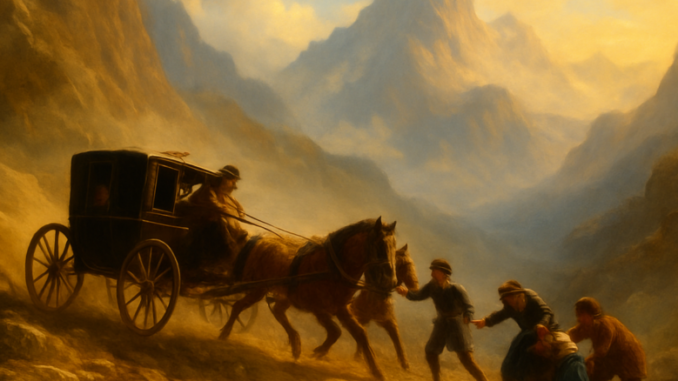
The mountain air is still crisp when the coach begins its descent. Thirteen travelers — strangers to one another — share the same wooden bench, the same sweeping views of Alpine peaks. Then everything tips. In a split second, strangers become companions in fate, bystanders become rescuers, and somewhere in the chaos, something unfolds that Freemasons recognize instinctively: the true nature of brotherhood.
A Mountain Road as a Metaphor for Life
The tragic accident in the Swiss Alps — one dead, twelve injured — shocks us. But beneath the headlines lies a deeper layer of meaning. Anyone who has walked a mountain trail knows the path is rarely predictable. Rocks shift, weather turns, and what seemed stable can give way in the blink of an eye. This is not merely a physical reality; it is a spiritual truth that Freemasons have acknowledged for centuries.
In Freemasonry, we speak of life as a journey from rough to polished. The rough ashlar we symbolically receive at our initiation must be shaped through experience, reflection, and trial. No one chooses to face those trials in the form of an overturned coach on an Alpine pass. Yet it is precisely in such moments that the essence of brotherhood reveals itself.
The Stranger as Brother
What happens when disaster strikes? Social masks fall away. Titles, backgrounds, and status become irrelevant. Someone bleeds, another weeps, a third reaches out to help with whatever is at hand. In that chaos, spontaneous solidarity emerges — a primal form of human connection that requires no ritual to be real.
Brotherhood is not a title you carry, but an act you perform when no one is watching and everything is at stake.
The philosopher Aristotle wrote in his Nicomachean Ethics that true friendship — and by extension, brotherhood — is grounded in mutual goodwill for the other’s own sake. Not for advantage, not for pleasure, but for the intrinsic worth of our fellow human beings. Freemasonry builds on this philosophical foundation. We call each other brothers not because we wear the same apron, but because we share the same human vulnerability.
The Lodge as a Training Ground for Solidarity
Within our lodges, we regularly practice rituals that remind us of impermanence and mutual dependence. The symbolism of death, so present in the Master Mason degree, is not a morbid fascination but a call to awareness. Those who understand that life is finite treat the remaining time differently. Those who realize that everyone shares this same finitude treat others with greater care.
Johann Wolfgang von Goethe, himself a Freemason, once wrote that a person truly becomes human only in relation to others. Our lodge meetings are not an end in themselves — they are practice spaces. We learn to listen without judgment, to help without ulterior motives, and to be present without an agenda. These skills, as simple as they may sound, prove invaluable when crisis strikes.
From Disaster to Reflection
The Alpine accident confronts us with the randomness of fate. Thirteen people boarded that coach in the morning, likely full of anticipation about the views, the fresh air, the adventure. None of them could have imagined what would follow. This randomness is hard to bear for anyone who craves control and certainty.
Yet Freemasonry offers no false comfort in the form of easy answers. We do not claim that everything happens for a reason, or that suffering is always meaningful. What we do offer is a framework within which questions may be asked, where doubt and grief have a rightful place. The lodge is not a shelter from life’s storms — it is a workshop where we learn to face them.
Brotherhood Beyond the Lodge Doors
The true test of brotherhood lies not within the walls of our temples, but beyond them. How do we behave when we witness another person’s suffering? Do we step forward, or do we look away? That Swiss mountain excursion became a trial, but also a stage on which ordinary people performed extraordinary acts. Passersby administered first aid, bystanders called emergency services, strangers comforted the wounded.
These are not exclusively Masonic virtues. On the contrary — they are universally human. But it is precisely this universality that Freemasonry seeks to cultivate and strengthen. We believe the world improves when more people, Freemason or not, embrace this brotherly disposition.
The Stone That Falls, the Heart That Remains
In the aftermath of the accident, the victims and their families face a long road to recovery. Wounds heal, but scars remain. Freemasonry teaches us that scars carry value, too. They tell the story of what we have endured and remind us of the help we received. Every scar is a monument to the brotherhood that was there when we needed it most.
Consider these core truths: Brotherhood shows itself not in words, but in deeds at crucial moments. The lodge prepares us, but life outside the lodge is the real test. Sharing vulnerability is the foundation of genuine human connection. And reflecting on adversity deepens our understanding of what truly matters.
The overturning of a coach on an Alpine road is a tragedy. But in the dust and chaos that followed, something precious also unfolded: the confirmation that when it truly matters, people choose each other. For Freemasons, this is not a surprise — it is a recognition. It is what we practice for, what we gather for, what we continually examine ourselves about. Not to become perfect brothers, but to be present brothers — in the very moment when the road unexpectedly gives way beneath us.
Copyright text & image: devrijmetselaar.nl
Texts are based on the ideas and content of the author of devrijmetselaar.nl, reviewed, corrected, and supplemented with the assistance of OpenAI. Images are created based on the ideas of the author of devrijmetselaar.nl using OpenAI/DALL-E.
Frequently Asked Questions
How does Freemasonry interpret the concept of brotherhood beyond ritual and symbols?
According to the article, Freemasonry views brotherhood not as a title one carries, but as an act performed when everything is at stake. True brotherhood is grounded in mutual goodwill for others' intrinsic worth, similar to Aristotle's concept of true friendship. It is demonstrated through spontaneous solidarity and genuine human connection, particularly evident when social masks fall away during moments of crisis and disaster.
What is the significance of the 'rough ashlar' in Masonic philosophy?
In Freemasonry, the rough ashlar symbolizes the raw state of life at initiation. According to the article, this symbolic stone must be shaped through experience, reflection, and trial—representing the journey from rough to polished. This metaphor illustrates that life's difficulties and challenges, even unexpected tragedies, serve as opportunities for personal and spiritual refinement.
Why does Freemasonry emphasize the symbolism of death and impermanence in its teachings?
The article explains that Masonic symbolism, particularly in the Master Mason degree, emphasizes death and impermanence not out of morbid fascination, but as a call to awareness. Understanding that life is finite and that all humans share this same vulnerability encourages individuals to treat their remaining time differently and fosters deeper compassion and solidarity with others.

Be the first to comment