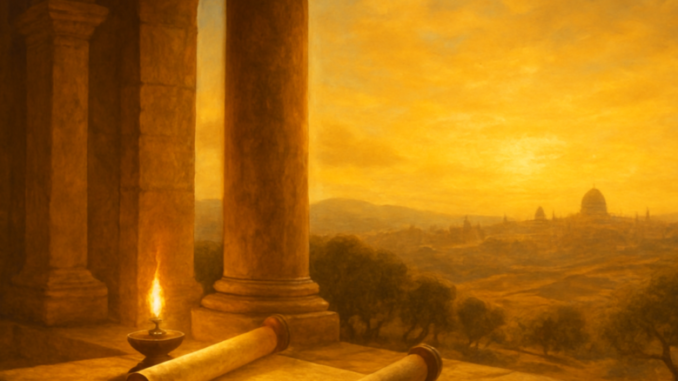
The candles flicker softly as a Freemason, after the night’s labor, opens an ancient biblical text. His eye falls on John’s words describing a city of light — twelve gates, streets of pure gold. For a moment, the symbols of his own initiatory journey seem to come alive in this vision from thousands of years ago.
What Is the Book of Revelation?
The Book of Revelation, also known as the Apocalypse, is the final book of the New Testament. Attributed to John and likely written during his exile on the island of Patmos around 95 AD, it contains a series of visions about the end of times, the battle between good and evil, and the ultimate triumph of light. The word “apocalypse” derives from the Greek apokalypsis, which literally means “unveiling” or “revelation.” It is not primarily about destruction — it is about making visible what was hidden.
The text speaks in a language of symbols: seven seals, seven trumpets, a dragon, a lamb, and ultimately a radiant city descending from heaven. For its original readers — Christians enduring Roman persecution — these images offered hope and comfort. For later generations, they became an inexhaustible source of interpretation, ranging from terrifying end-times prophecies to mystical contemplation.
The Symbolic Language of John
Anyone who reads the Book of Revelation without understanding its symbolic language can easily become lost in the apparent chaos of beasts and catastrophes. But those who find the key discover a carefully woven tapestry of meaning. The number seven recurs constantly: seven churches, seven spirits, seven stars. In antiquity, this number represented completeness and perfection. The seven candlesticks among which Christ walks represent the seven churches, but they also evoke the image of the menorah — the seven-branched candelabrum from Hebrew tradition, a symbol of divine light.
The Lamb that stands “as though slain” presents a paradoxical image: a sacrificial animal that simultaneously reigns. This points to the conviction that suffering can be transformed into strength, that death can give way to new life. The dragon and the beast represent the forces of oppression and deception, while the woman clothed with the sun embodies the divine feminine, protected amid danger.
The New Jerusalem and the Symbolism of Building
Perhaps the most captivating vision in the entire book is that of the New Jerusalem — the holy city that descends from heaven at the end of the narrative. John describes it with the precision of an architect: twelve gates of pearl, walls of jasper, foundations adorned with precious stones, streets of gold as pure as glass. The city needs no temple, for God himself is its temple. It requires no sun or moon, for the glory of God illuminates it.
The New Jerusalem is not so much a physical place as a state of being — a completed inner temple where divine light can shine unobstructed.
For Freemasons, this image is profoundly resonant. The construction of King Solomon’s Temple plays a central role in Masonic symbolism. But while the physical temple was built by human hands and later destroyed, the New Jerusalem points toward a spiritual construction that cannot be demolished. It is the inner temple that every person can erect within themselves, stone by stone, through moral labor and spiritual growth.
Light Versus Darkness: A Universal Theme
The opposition between light and darkness permeates the entire Book of Revelation. Its visions unfold in a cosmic theater where these primal forces struggle for supremacy. In the end, light triumphs — not through violence but through revelation, through the lifting of veils. This theme is deeply interwoven with Freemasonry, where the candidate is literally led from darkness to light during initiation.
The blindfold removed during the initiation ceremony marks the moment when the new brother first beholds the light of the lodge. This ritual moment echoes the apocalyptic promise: what was hidden is revealed. Knowledge that waited in darkness becomes visible to those who have traveled the right path.
Alpha and Omega: The Journey as a Circle
In the Book of Revelation, Christ calls himself the Alpha and the Omega — the first and last letters of the Greek alphabet. This expresses an all-encompassing totality: the beginning and the end are united in a single principle. Creation is not a straight line from start to finish but a circle that returns to its origin, transformed and elevated.
This circular way of thinking resonates strongly in Freemasonry, where the brother’s inner journey ultimately brings him back to himself — but as a changed person. The rough ashlar with which he began has, through labor and reflection, become a perfect ashlar, ready to take its place in the greater edifice. The end of the journey is not a different place but a transformed state of being.
Universal Wisdom in a Particular Form
The Book of Revelation is unmistakably a Christian text, rooted in a specific historical and theological context. Yet it contains themes that reach far beyond any single religious tradition. The struggle between light and darkness, the promise of transformation, the vision of a perfect community, the symbolism of building and rebuilding — these are motifs found in virtually every great spiritual tradition.
Freemasonry, which welcomes brothers of all faiths, invites its members to read these symbols as expressions of universal human aspirations. The New Jerusalem can be understood as the ideal of a brotherhood that embraces all people, built upon foundations of wisdom, strength, and beauty.
With the Book of Revelation, we reach the end of our journey through the New Testament. In this final book, the great themes converge: light triumphing over darkness, the hidden being made manifest, and the eternal call to build — not with mortar and stone alone, but with conscience, compassion, and an unwavering commitment to the light. For the Freemason, these ancient visions remain a living reminder that the most sacred temple is the one we construct within.
Copyright text & image: devrijmetselaar.nl
Texts are based on the ideas and content of the author of devrijmetselaar.nl, reviewed, corrected, and supplemented with the assistance of OpenAI. Images are created based on the ideas of the author of devrijmetselaar.nl using OpenAI/DALL-E.
Frequently Asked Questions
What is the Book of Revelation and what does the word 'apocalypse' actually mean?
The Book of Revelation, also known as the Apocalypse, is the final book of the New Testament attributed to John and written around 95 AD during his exile on Patmos. The word 'apocalypse' derives from the Greek 'apokalypsis,' which means 'unveiling' or 'revelation' — not destruction. It contains visions about the end of times, the battle between good and evil, and the triumph of light, offering hope and comfort to its original readers who were Christians enduring Roman persecution.
Why is understanding symbolic language important when reading the Book of Revelation?
The Book of Revelation is written in symbolic language filled with images like seven seals, seven trumpets, dragons, lambs, and a radiant city. Understanding these symbols is crucial because without this key, readers can become lost in apparent chaos. For example, the number seven represents completeness and perfection, the seven candlesticks evoke the menorah symbolizing divine light, and the Lamb represents how suffering can be transformed into strength and how death can give way to new life.
How does the Book of Revelation connect to Freemasonry?
Freemasons find resonance between the symbols described in the Book of Revelation and their own initiatory journey. The visions in Revelation — particularly the descriptions of light, sacred geometry, and the New Jerusalem with its twelve gates and streets of pure gold — echo the symbolic language and spiritual symbolism used in Masonic ritual and practice, creating a profound connection between biblical imagery and Masonic teachings.

Be the first to comment