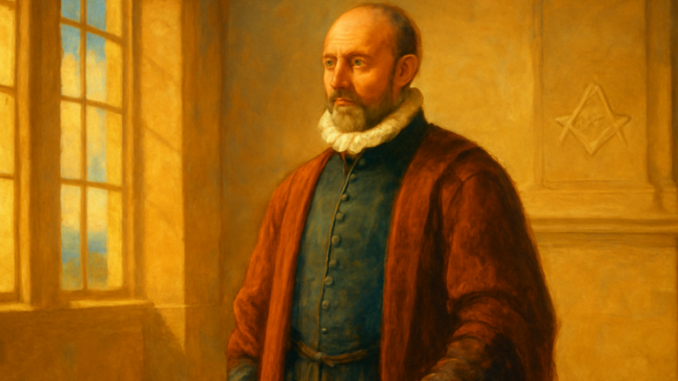
Why do we sometimes laugh when we really want to cry? And why can tears of grief suddenly give way to a liberating burst of laughter? Michel de Montaigne posed this very question in his eighteenth essay, but he was far from the first thinker to wrestle with the capriciousness of human emotion. Behind his elegant prose lies a rich philosophical tradition reaching back to the ancient Greeks and Romans. Let us explore the thinkers and intellectual currents that inspired Montaigne when he wrote this fascinating essay — and consider what their insights mean for Freemasons committed to the work of self-knowledge.
Which Classical Thinkers Whispered in Montaigne’s Ear?
Montaigne was a voracious reader of classical antiquity. His library, housed in the tower of his château, contained hundreds of works, and the ceiling beams of his study were inscribed with quotations from his favourite authors. For this particular essay, he drew heavily on the writings of Seneca, the Roman philosopher who wrote so penetratingly about the instability of human feelings. Seneca described how the very same event can provoke completely opposite reactions in different people — or even in the same person at different moments.
But there was another voice that resonated throughout Montaigne’s reflections: that of Plutarch. This Greek biographer and moralist had written extensively about the complexity of the human soul. His Moralia served as an inexhaustible source of anecdotes and philosophical insights for Montaigne. The idea that emotions are rarely pure — that they are almost always intertwined with their opposite — runs like a thread through Plutarch’s observations on grief and joy alike.
How Did Stoicism Shape Montaigne’s View of Emotions?
The Stoics — Seneca, Epictetus, and Marcus Aurelius chief among them — held a distinctive view of emotions. They regarded intense feelings as disturbances of inner tranquillity, caused by false judgments about reality. When we laugh or cry, the Stoics argued, we do so not because of the event itself, but because of what we believe that event means. Montaigne absorbed this insight but gave it his own characteristic twist. He was no dogmatic Stoic; he acknowledged that emotions are simply part of what it means to be human.
Our emotions reveal not so much the nature of events, but the nature of our own soul.
This nuance matters enormously. Where the strict Stoic strives for imperturbability, Montaigne accepts the fickleness of the human heart as a given. He observes rather than condemns. That is precisely what makes his essay so refreshingly human and so enduringly relevant.
What Role Did Skepticism Play in This Essay?
Montaigne was famously skeptical in his philosophical outlook, a disposition neatly captured in his motto “Que sais-je?” — “What do I know?” This doubt extended to the certainty with which we claim to understand our own emotions. Pyrrhonist Skepticism, named after the Greek philosopher Pyrrho, taught that we should suspend judgment because our perceptions are inherently unreliable. Sextus Empiricus had systematically elaborated these ideas, and Montaigne had studied his work closely.
This skeptical perspective explains why Montaigne does not presume to offer a definitive answer to the question of why we laugh and cry at the same thing. He observes, he marvels, and he leaves the reader with questions rather than conclusions. This is not a weakness — it is a deliberate philosophical choice, one that invites the reader to continue the inquiry on their own terms.
How Does This Essay Fit Within Renaissance Humanism?
The Renaissance brought a renewed fascination with classical antiquity and with the human being as a subject of study. Humanists such as Erasmus and Petrarch had paved the way for a new manner of thinking in which lived human experience took centre stage. Montaigne was an heir to this tradition. His Essays are, at their core, an extended exercise in self-examination — an attempt to understand humanity by looking inward.
The essay on laughter and tears fits perfectly within this humanistic project. It takes an everyday phenomenon as its starting point and uses it to raise deeper questions about human nature. What does it say about us that we are so changeable? Are we truly masters of our feelings, or are we lived by them? These questions, posed more than four centuries ago, remain as pressing as ever.
What Can Freemasons Learn From Montaigne’s Reflections?
Freemasonry invites its members to pursue self-knowledge and reflection. The rough ashlar that must be shaped into a perfect cube represents this very process of inner refinement. Montaigne’s observation that our emotions are unstable — that laughter and tears can spring from the same source — offers a valuable lesson for anyone engaged in the work of self-improvement.
Especially in the lodge, where brethren gather to reflect on the art of living and the cultivation of virtue, the understanding that emotions are changeable carries real significance. It guards us against judging ourselves or others too hastily. It reminds us that the human being is a complex creature, not reducible to simple categories of cheerful or sorrowful, strong or weak.
Consider how this applies in practice. A Brother who understands that grief and joy are not opposites but neighbours is better equipped to offer genuine compassion. A lodge that embraces the complexity of human emotion creates a space where authentic reflection becomes possible — where the masks of certainty can be set aside in favour of honest inquiry.
The Philosophical Threads Woven Together
Montaigne’s essay on laughter and tears is no isolated observation. It stands at a crossroads where several great philosophical traditions converge:
Seneca and the Stoics taught Montaigne about the role of judgment in shaping our emotional responses. Plutarch offered rich examples of emotional complexity drawn from the lives of historical figures. Skepticism counselled caution in claiming certainty about self-knowledge. And Renaissance humanism placed the human being at the centre of intellectual inquiry, making personal experience a legitimate and vital subject of study.
Together, these traditions form the fabric from which this seemingly simple essay is woven — an essay that rewards careful reading with ever deeper layers of insight.
For those who seek to know themselves — as Freemasonry prescribes and as the ancient temple at Delphi commanded — the philosophical background of Montaigne’s essay provides an enriching context. The question “Why am I laughing now?” or “Why do these tears come?” becomes an invitation to deeper self-examination, rooted in a centuries-old tradition of philosophical thought. In embracing the mystery of our own emotions rather than forcing them into neat categories, we take a meaningful step along the path from rough ashlar to polished stone.
Copyright text & image: devrijmetselaar.nl
Texts are based on the ideas and content of the author of devrijmetselaar.nl, reviewed, corrected, and supplemented with the assistance of OpenAI. Images are created based on the ideas of the author of devrijmetselaar.nl using OpenAI/DALL-E.
Frequently Asked Questions
What classical philosophers influenced Montaigne's essay on laughter and tears?
Montaigne drew heavily on the writings of Seneca, the Roman Stoic philosopher who explored the instability of human feelings, and Plutarch, the Greek biographer whose Moralia provided anecdotes and insights about the complexity of the human soul. Both thinkers emphasized that emotions are rarely pure and are often intertwined with their opposites.
How did Stoicism shape Montaigne's understanding of emotions?
While Montaigne was influenced by Stoic philosophers like Seneca, Epictetus, and Marcus Aurelius—who viewed intense emotions as disturbances caused by false judgments about reality—he did not adopt their strict approach. Instead, he accepted the fickleness of human emotion as a natural part of being human, giving Stoic philosophy his own characteristic twist.
What is the key insight about emotions that Montaigne drew from his philosophical sources?
Montaigne recognized that our emotions reveal not so much the nature of events themselves, but rather the nature of our own soul. This nuanced understanding suggests that the same event can provoke completely opposite reactions in different people or even in the same person at different moments, reflecting the complexity of human consciousness rather than objective reality.

Be the first to comment