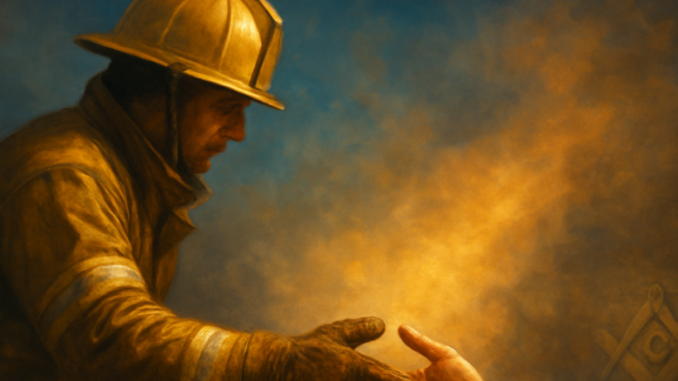
Seventy wildfires are currently raging across Greece. Residents in suburbs around Athens are being evacuated. The flames consume everything in their path — without regard for property or status. And yet, amid the destruction, something remarkable emerges: strangers reach out to one another. Firefighters from across Europe rush to help. Neighbors open their doors to people they’ve never met. Isn’t this precisely what Freemasonry speaks of when it invokes brotherhood — not as an abstract ideal, but as a lived reality that only becomes visible when everything goes up in flames?
The Paradox of Destruction and Connection
There is an unsettling truth in the way disasters bring people together. The Greek philosopher Heraclitus, who saw fire as the primordial element from which all things arise and to which all things return, would perhaps not be surprised. Fire destroys — but in its destruction, it also reveals what truly endures. Possessions burn in minutes. But the impulse to help a stranger, to risk your own safety for another — that impulse proves fireproof.
This is not a romanticization of suffering. The images from Greece are heartbreaking. Families are losing everything. Landscapes that served as home for generations are scorched black. But it is precisely in this darkness that a light appears, one we rarely see so clearly in everyday life: the spontaneous willingness to be a brother to whoever needs it, without questions about background, belief, or political conviction.
Brotherhood as a Verb, Not a Noun
Freemasonry speaks of brotherhood as one of its core values. But what does that actually mean? In the ritual practice of the lodge, brethren learn to extend a hand to one another regardless of social standing. A CEO sits beside a carpenter, an atheist beside a believer. The horizontal bond between equals is consciously cultivated. And yet the question remains: does brotherhood only become real when it is tested?
Brotherhood is not a sentiment you feel — it is an action you perform when another person needs you.
The eighteenth-century Freemason and philosopher Johann Gottfried Herder wrote that true humanity reveals itself in deeds, not in words. When Greek villagers hand out water to exhausted firefighters, when hotel owners open rooms free of charge, when European emergency services cross borders to help — we see brotherhood not as an ideal but as a verb. It is no longer an abstraction. It is sweat, courage, and sacrifice.
Fire as a Teacher
In the symbolism of many traditions, including Freemasonry, fire plays an ambiguous role. It can destroy, but it can also purify. It can illuminate, but it can also blind. The Greek myth of Prometheus, who stole fire to give it to humanity, speaks of knowledge that both liberates and creates responsibility. To master fire is to carry a burden.
Marcus Aurelius, the Stoic emperor-philosopher, would perhaps see a lesson in these fires about what lies within our control and what does not. We cannot stop the drought. We cannot command the wind. But we can choose how we respond. We can flee, or we can help. We can lament what is lost, or we can begin to rebuild. That choice — that moral freedom amid natural compulsion — is what makes us truly human.
From Crisis to Community
There is a difference between solidarity and brotherhood. Solidarity can operate at a distance — a donation, a shared post on social media. Brotherhood demands proximity. It requires you to get your hands dirty, to take risks, to not merely support the other but to truly meet them. The Greek crisis reveals both forms of response, and the difference becomes painfully clear.
The firefighter who ignores his own exhaustion to save one more house. The neighbor who shares her last water with a stranger. The volunteer who travels from another country, not for recognition, but because it must be done. These are not heroes in the classical sense. They are ordinary people who, when confronted with the extraordinary, discover what they are capable of. And perhaps that is the very essence of what Freemasonry seeks to cultivate: not the creation of extraordinary people, but the awakening of the extraordinary in ordinary people.
The Question That Keeps Smoldering
When the fires are extinguished, when the cameras leave, and when the world shifts its attention to the next headline — one question remains: what survives of this brotherhood? Will the spontaneous unity evaporate once the crisis has passed? Or can it, like fire that tempers metal into stronger steel, bring about a lasting transformation?
Freemasonry offers no definitive answer, but it does offer a method. It holds that brotherhood requires maintenance — ritual repetition, conscious practice. It is not enough to discover in a crisis that we can care for one another. We must translate that discovery into daily life, into the moments when no one is watching and no flames force our hand.
The seventy fires in Greece remind us of an uncomfortable truth: we often only discover what we are worth when everything we possess is at stake. Brotherhood, it turns out, is not a word we speak — it is a deed we perform. The question that keeps smoldering, long after the last fire is extinguished, is this: can we also be brothers when nothing is burning? Or do we need the flames to remember who we are?
Copyright text & image: devrijmetselaar.nl
Texts are based on the ideas and content of the author of devrijmetselaar.nl, reviewed, corrected, and supplemented with the assistance of OpenAI. Images are created based on the ideas of the author of devrijmetselaar.nl using OpenAI/DALL-E.
Frequently Asked Questions
What does Freemasonry mean by 'brotherhood'?
In Freemasonry, brotherhood is not merely an abstract ideal or feeling, but a lived practice and active verb—demonstrated through concrete actions of service, compassion, and mutual aid regardless of social status, beliefs, or background. As exemplified by the Greek wildfires, true brotherhood reveals itself when people spontaneously help strangers and risk their own safety for others, showing that this principle transcends lodge walls and becomes visible in our response to human suffering.
How does Freemasonry teach members to treat people from different backgrounds?
Freemasonry deliberately cultivates horizontal bonds of equality among all members through its rituals and practice, where individuals from vastly different social standings—such as a CEO and a carpenter, or an atheist and a believer—sit together as equals. This conscious cultivation of brotherhood across dividing lines prepares members to extend genuine compassion and assistance to anyone in need, regardless of their background or beliefs.
What is the significance of fire in Freemasonry?
Fire holds ambiguous symbolic meaning in Freemasonry and many spiritual traditions—it can destroy, but also purify; it can illuminate, but also blind. The Greek wildfires demonstrate fire's paradoxical teaching: while it destroys possessions and landscapes, it reveals what truly endures—the human impulse to help others, the fireproof nature of compassion, and our capacity for genuine brotherhood when tested by adversity.
Why do Masonic ideals of brotherhood matter in modern society?
Freemasonry's emphasis on brotherhood as a lived reality—not mere sentiment—offers a powerful counterforce to divisions in modern society by teaching members to recognize their fundamental kinship with all people. The Greek wildfires show us that this principle has practical urgency: when crisis strikes, the brotherhood cultivated in lodges translates into the spontaneous willingness to help strangers, cross borders, and sacrifice for others without asking about their background or beliefs.

Be the first to comment