When a major European football club expresses interest in a young talent, a familiar question surfaces: is this player ready for the next step? Rarely is the answer found in technical skill alone. It comes down to character — to who someone truly is when the pressure mounts and temptation grows. The recent interest of a Champions League–winning club in a promising young attacker from Amsterdam invites a deeper, philosophical exploration of a question Freemasons have grappled with for centuries: what makes a person truly valuable, and how does adversity shape who we become?
The Paradox of Talent and Character
Here we encounter a paradox that sits at the heart of both the sporting world and Freemasonry. Talent is a gift — something bestowed upon a person without any effort on their part. Character, on the other hand, is a structure built stone by stone through choices, setbacks, and self-reflection. The question is not whether talent matters, but whether talent without character can ever lead to true greatness.
The ancient Greeks understood this well. Aristotle drew a careful distinction between potentiality and actualization. A person may possess the innate capacity for excellence, but without the right formation, that capacity remains dormant — a seed that never germinates.
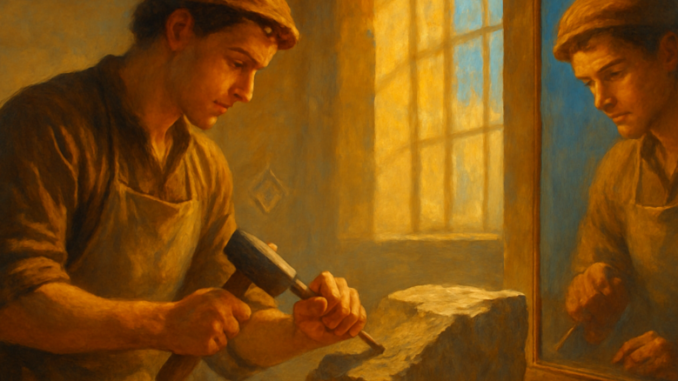
In Freemasonry, this insight returns powerfully in the symbol of the rough ashlar. Every candidate who enters the lodge is presented as a rough, unworked stone. The purpose of the Masonic path is not to discover talent — that is already present. The purpose is to refine that talent into something that serves the greater community, to shape the rough stone into one that fits within the larger edifice. This process demands not only skill but, above all, self-knowledge and a willingness to be shaped.
The Temptation of the Quick Leap
When glory beckons, a moral crossroads appears. The Stoic philosopher Seneca, writing in first-century Rome, repeatedly warned against the dangers of rising too fast — not because success is inherently bad, but because a personality that has not been tempered by trial often crumbles under the weight of sudden fame. The question a Freemason would ask himself is not “Can I handle this?” but rather “Have I laid the foundation to carry this with dignity?”
This is not an argument for false modesty or the rejection of opportunity. It is an invitation to honest self-examination. Johann Wolfgang von Goethe, himself a Freemason, wrote extensively about the necessity of knowing oneself before stepping out to meet the world. That self-knowledge is not forged in moments of triumph. It emerges in the quiet hours of doubt, in the confrontation with one’s own shortcomings, in the act of persevering when no one is watching.
Personality as Architecture
Freemasonry does not treat personal development as an abstract ideal. It approaches it as a concrete craft. Just as a stonemason lays stone upon stone according to a deliberate plan, so the Freemason builds his inner edifice. Every ritual, every lodge meeting, every conversation with brethren serves this purpose. The goal is not perfection — that remains beyond mortal reach. The goal is direction: the continual movement toward a nobler version of oneself.
True greatness lies not in what someone can do, but in who someone becomes when everything is at stake.
This insight casts a different light on the question of whether a young talent is ready for a major leap. The answer is not found in statistics or performance metrics alone. It lies in how someone handles setbacks, how he treats colleagues who are less successful, how he behaves when the cameras are off. The Roman emperor and philosopher Marcus Aurelius noted in his Meditations that the quality of a person is revealed in his actions in private, not in his performance before an audience.
The Role of Community
No one forms themselves in isolation. Freemasonry acknowledges this through its emphasis on brotherhood. The lodge is not a collection of individuals who happen to share the same space. It is a community that supports, corrects, and inspires its members. A young talent who moves to an environment where only performance counts may lose the very soil in which character takes root. A community that celebrates only results and condemns failure produces people who tie their entire sense of self-worth to external validation.
The question for any young person facing a major life decision is therefore also this: in which community do I want to continue building who I am becoming? Will I surround myself with people who value me only for what I produce, or will I find an environment that also values who I am and who I have the potential to become?
The philosopher Michel de Montaigne emphasized the importance of sincere friendship over superficial admiration. Real growth, he wrote, takes place in relationships where honesty matters more than flattery. This resonates deeply with the Masonic principle that brethren owe each other truth — even when that truth is uncomfortable.
An Open Question
We return to the paradox with which we began. Talent is a gift; character is a construction. The world sees the former; the Freemason works on the latter. When external opportunities present themselves, the ultimate test emerges: does a person know himself well enough to understand whether he is ready — not for the success itself, but for the person that success will demand he become?
Freemasonry does not offer definitive answers to such questions. It offers a method for asking the question of yourself, again and again. And perhaps that is precisely what a young talent needs most — not the certainty that he is ready, but the wisdom to keep asking whether he is becoming the person he truly wants to be.
The interest of great clubs in young talents reminds us of a timeless truth: skills open doors, but character determines whether someone walks through them with dignity. Freemasonry teaches that character building is a lifelong craft — never finished, always in progress. In the end, the rough stone is not judged by its raw potential, but by the care and intention with which it has been shaped. That lesson applies far beyond the lodge, reaching into every arena where human beings are tested by opportunity, adversity, and the ever-present question of who they choose to become.
Copyright text & image: devrijmetselaar.nl
Texts are based on the ideas and content of the author of devrijmetselaar.nl, reviewed, corrected, and supplemented with the assistance of OpenAI. Images are created based on the ideas of the author of devrijmetselaar.nl using OpenAI/DALL-E.
Frequently Asked Questions
What does Freemasonry teach about the relationship between talent and character?
Freemasonry teaches that while talent is a natural gift, true greatness comes from character—which is built through choices, setbacks, and self-reflection. The organization uses the symbol of the rough ashlar (unworked stone) to represent how each member refines their natural abilities into something that serves the greater community. This process requires self-knowledge and a willingness to be shaped into someone of integrity and worth.
How does Freemasonry help members develop their character?
Freemasonry approaches personal development as a concrete craft, similar to how a stonemason builds with stone upon stone according to a deliberate plan. Members progress through the organization's teachings and degrees, engaging in self-examination, confronting their shortcomings, and building their inner foundation through quiet reflection and perseverance. This structured approach ensures that character development is intentional and rooted in principles that have endured for centuries.
Why does Freemasonry warn against rising too quickly to success?
Freemasonry, drawing on ancient wisdom from philosophers like Seneca, recognizes that a personality not tempered by trial often crumbles under sudden fame and pressure. The organization encourages members to ask themselves whether they have laid a solid foundation to carry success with dignity, rather than simply asking if they can handle opportunity. This emphasis on proper preparation ensures that members pursue advancement in a way that strengthens rather than compromises their character.
What is the purpose of the rough ashlar symbol in Freemasonry?
The rough ashlar represents each candidate as they enter the lodge—possessing natural talent and potential, but unrefined. It symbolizes that the purpose of the Masonic path is not to discover talent (which already exists) but to refine it into something of value to the community. Through the Masonic journey, members work to shape themselves into finished stones that fit harmoniously within the larger structure of society.


Be the first to comment