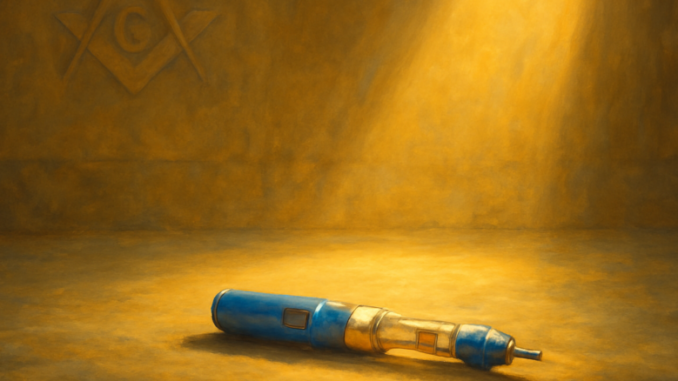
A large-scale theft of insulin pens from pharmaceutical giant Novo Nordisk has sent shockwaves through the medical world this week. While millions of diabetes patients depend on this life-saving medication, criminals have chosen to place their self-interest above the well-being of the community. This stark contrast between selfishness and care for others touches on a fundamental question that Freemasons have contemplated for centuries: what does brotherhood truly mean, and how do we relate to the most vulnerable members of our society?
The Criminal and the Brother: Two Worlds
Imagine two people looking at the same shipment of insulin pens. The first sees merchandise — an opportunity for quick profit, regardless of the consequences for others. The second sees lives that depend on these small, seemingly simple devices. The first operates from a world in which other people are merely a means to an end. The second operates from a world in which every person is an end in themselves.
This distinction is nothing new. The philosopher Immanuel Kant expressed it as his categorical imperative: act in such a way that you treat humanity, whether in your own person or in the person of any other, always as an end and never merely as a means. Freemasons recognize in this idea an echo of their own working tools. The compasses draw a circle in which all are equal. The square directs our actions toward justice and righteousness.
The Criminal Logic: Self-Interest as a Compass
The world of the thief is one of calculation without conscience. The insulin pens do not represent the diabetes patient who needs them — they represent only their market value on illegal channels. This logic is ancient. Thomas Hobbes described in the seventeenth century a state of nature in which man lives as a wolf to man, driven by fear and desire. Without mutual obligations, he argued, human relations devolve into a war of all against all.
What makes the theft from Novo Nordisk so painful is that the victims are among the most vulnerable. Insulin is not a luxury good. For millions of people, it is the difference between life and death, between functioning and deterioration. The criminal who steals this medication is not committing an act against some anonymous corporation — it is an act against individuals whose bodies depend on a stable supply every single day.
The Fraternal Logic: Responsibility as a Foundation
Standing in opposition to the criminal logic is the fraternal one. Freemasonry, established in the eighteenth century with Anderson’s Constitutions as its foundation, places the bond between people at its center. James Anderson and Jean Théophile Desaguliers laid the groundwork for a brotherhood that transcends social, religious, and political divides. The Freemason does not ask: what can I gain from this person? He asks: what can I do for this person?
Brotherhood is not a sentimental expression of feeling — it is the daily choice to regard another person’s vulnerability as your own responsibility.
This conviction has deep roots. Aristotle described friendship as the highest form of human connection, based not on utility or pleasure, but on mutual virtue. The Stoic philosopher Marcus Aurelius constantly reminded himself to see humanity as one body, in which every part serves the well-being of the whole. Voltaire, himself a Freemason, saw the Lodge as a place where people could practice tolerance and mutual respect.
What Both Worlds Share: The Power of Choice
Both the criminal and the brother face choices. No one is born a thief or a benefactor. Every day, we choose which world we inhabit. Freemasonry does not offer ready-made answers, but it does offer a method. Through ritual, reflection, and dialogue, brethren are confronted with their own motives. The rough ashlar — symbol of the unrefined self — must be continuously shaped and improved.
The theft of insulin pens confronts us with an uncomfortable truth: our society produces both worlds simultaneously. The same economic systems that make life-saving medication possible also create the black markets on which stolen goods are traded. The question is not only how we punish criminals, but how we cultivate a culture in which brotherhood is more rewarding than self-interest.
Lessons for the Modern Freemason
What can the Freemason learn from this current event? First, that brotherhood does not end at the Lodge door. The working tools used within the temple — the compasses and the square — are symbols for an attitude that applies everywhere. The diabetes patient who cannot get their insulin is just as much a fellow human being as the brother sitting beside you during Lodge work.
Brotherhood demands active engagement with the vulnerable members of society. Self-interest is human, but it must be tempered by responsibility. Ritual and reflection help us examine our own motives. And brotherhood is not a feeling — it is a daily practice.
Second, this theft reminds us that evil is rarely abstract. It manifests in concrete actions with concrete victims. Montaigne wrote in his essays about the human tendency to rationalize cruelty — to look away from the face of the other. The brother trains himself to keep seeing that face, even when it is uncomfortable to do so.
The theft of insulin pens is more than a crime report. It is a mirror held up to each of us, asking which world we choose to inhabit. The criminal and the brother are not fixed categories but extremes on a spectrum along which every person moves. Freemasonry offers no guarantee of moral perfection, but it does offer a path of continuous self-improvement. In a world where some choose to rob the vulnerable, there is a question that every brother must ask himself — and answer through action: for whom do I bear responsibility, and what am I doing about it?
Copyright text & image: devrijmetselaar.nl
Texts are based on the ideas and content of the author of devrijmetselaar.nl, reviewed, corrected, and supplemented with the assistance of OpenAI. Images are created based on the ideas of the author of devrijmetselaar.nl using OpenAI/DALL-E.


Be the first to comment