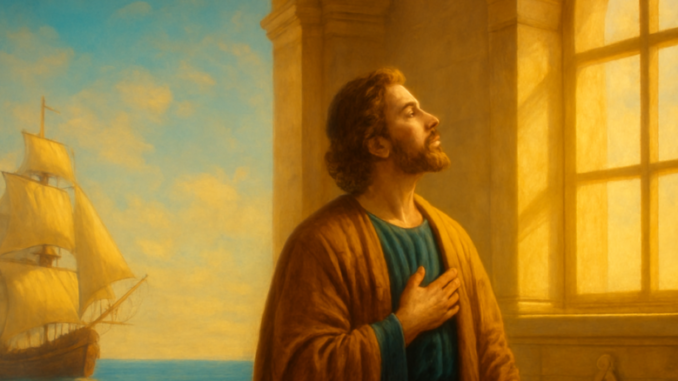
Few novels have sparked as much public curiosity about Freemasonry as Dan Brown’s The Lost Symbol. The book paints a world in which ancient signs, hidden in the architecture of Washington D.C., hold the key to profound secrets. But what exactly does the novel claim about these symbols? And how do those claims hold up against what historians and Freemasons themselves actually know? In this article, we place two perspectives side by side: the world as Dan Brown constructs it, and the world as it reads through the lens of Masonic history.
The World According to the Book: Symbols as Hidden Code
Dan Brown’s The Lost Symbol rests on a powerful premise: the Founding Fathers of the United States — many of whom were Freemasons — deliberately embedded a network of symbols in the monuments, street patterns, and buildings of the nation’s capital. These symbols, Brown suggests, are far more than decorative. Together, they form a kind of map pointing toward ancient, lost knowledge. The book ties this knowledge to what it calls the “Ancient Mysteries,” a collection of wisdom traditions stretching back to antiquity.
Throughout the novel, dozens of specific symbols take center stage. The double-headed eagle, the pyramid with the all-seeing eye, the pentagram, the ouroboros, the Masonic square and compasses, and various mathematical and alchemical signs are not only named but interpreted as components of a larger whole. Brown’s protagonist — a professor of symbology — deciphers these signs as though they constitute a coherent secret language. The underlying suggestion is always the same: behind the visible lies a hidden layer of meaning, and Freemasonry is the guardian of that layer.
The World According to History: Symbols as a Path of Learning
Historically speaking, it is absolutely true that Freemasons use symbols, and that many of those symbols are indeed ancient. The square and compasses, the all-seeing eye, the rough and polished ashlar, the acacia, and the Temple of Solomon have been part of the Masonic vocabulary for centuries. James Anderson laid the first standardized foundation for modern Freemasonry in his Constitutions of 1723, in which symbolic references to the craft of building already played a central role. Jean-Théophile Désaguliers, one of the founders of the Grand Lodge of England, helped embed this tradition intellectually within Enlightenment thought.
But there is a fundamental difference from the picture Dan Brown paints. In historical Freemasonry, symbols are not codes to be cracked in order to reveal a hidden treasure or secret. They function as pedagogical tools within the ritual. The rough ashlar is not a cryptogram — it is an invitation to self-reflection: am I willing to work on myself? The all-seeing eye does not point to a hidden location — it serves as a reminder of conscience, of the awareness that our actions matter. Isaac Newton and Gottfried Wilhelm Leibniz used symbols in their mathematical and philosophical work not as ciphers either, but as a language to make complex ideas accessible. Symbols in the lodge work the same way.
Where the Two Worlds Meet
It would be unfair to claim that Dan Brown fabricated everything. The Lost Symbol contains a surprising number of verifiable references. The House of the Temple in Washington D.C., headquarters of the Scottish Rite, is very real and does indeed contain impressive symbolic elements. The pyramid on the Great Seal of the United States actually exists, and the involvement of Freemasons in the founding of the American republic is historically documented. Benjamin Franklin was a Freemason, as was George Washington. Wolfgang Amadeus Mozart, though European, wove Masonic themes into The Magic Flute, illustrating just how far the cultural influence of these symbols reached.
What both perspectives share is the conviction that symbols matter. In the world of the novel and in historical reality alike, it is recognized that an image can say more than a thousand words. Johann Wolfgang von Goethe, himself a Freemason, wrote extensively about the power of the symbol as a bridge between the visible and the invisible. In that sense, Dan Brown draws on an authentic tradition — even if he wraps it in a thriller plot.
The symbols Dan Brown describes in The Lost Symbol largely exist in reality, but their function differs fundamentally: where the novel presents them as secret code, Freemasonry uses them as mirrors for personal growth.
The Difference Between a Secret and a Mystery
This is where we touch on the core misunderstanding that The Lost Symbol — perhaps unintentionally — reinforces. The book treats Freemasonry as though it guards a secret that can be revealed. Historically, it is precisely the opposite: Freemasonry preserves a mystery that can only be experienced. A secret can be told. A mystery must be lived through.
Plato described in his Allegory of the Cave how true knowledge cannot be transferred through words alone — it must be understood through personal experience. The Mysteries of Eleusis in ancient Greece worked the same way: the initiate could not afterward explain exactly what had happened, not because it was forbidden, but because the experience defied language.
Something comparable applies in Freemasonry. The ritual surrounding the legend of Hiram Abiff — the master builder of the Temple of Solomon — is not an encoded message waiting to be decoded. It is a lived experience that touches every brother in his own way. Dan Brown references Hiram Abiff and the temple legend in The Lost Symbol, but by placing them within a framework of puzzles and deciphering, he shifts their meaning. What is meant as an inner journey becomes an outer chase. What is meant to be felt becomes something to be solved.
This distinction — between secret and mystery, between decoding and experiencing — is perhaps the most important thing any reader of The Lost Symbol can take away. Dan Brown tells a gripping story, and he has undeniably introduced millions of readers to Masonic symbolism. But the real power of those symbols does not lie in what they conceal. It lies in what they reveal to those who are willing to engage with them on a deeper level.
Dan Brown’s The Lost Symbol is a masterful thriller that draws heavily on real Masonic symbols, buildings, and historical figures. Many of its references check out. But the novel’s central conceit — that these symbols form a secret code pointing to hidden knowledge — diverges sharply from how Freemasonry actually works. In the lodge, symbols are not riddles to solve but tools for reflection. They are not locks to be picked but doors to be walked through. Understanding that difference is, in its own way, a small initiation in itself.
Copyright text & image: devrijmetselaar.nl
Texts are based on the ideas and content of the author of devrijmetselaar.nl, reviewed, corrected, and supplemented with the assistance of OpenAI. Images are created based on the ideas of the author of devrijmetselaar.nl using OpenAI/DALL-E.
Frequently Asked Questions
Are the Masonic symbols hidden in Washington D.C. architecture real?
While Dan Brown's The Lost Symbol suggests that Founding Fathers deliberately embedded a network of symbols throughout Washington D.C. as a hidden code pointing to ancient knowledge, historical evidence does not support this narrative. Although many Founding Fathers were Freemasons and Masonic symbols are indeed ancient and meaningful, historians find no evidence of a coordinated, hidden symbolic map embedded in the nation's capital with secret purposes.
Do Freemasons actually use symbols, and are they ancient?
Yes, absolutely. Freemasons have used symbols for centuries, and many of these symbols—such as the square and compasses, the all-seeing eye, the rough and polished ashlar, and references to the Temple of Solomon—do have ancient origins. The standardized foundation for modern Freemasonry was established in James Anderson's Constitutions of 1723, which centered on symbolic references to the craft of building.
What is the key difference between how Dan Brown portrays Masonic symbols and what history actually shows?
Dan Brown depicts Masonic symbols as a hidden, coherent secret language forming a map to lost ancient knowledge. In reality, while Freemasons do use and value symbols as part of their tradition, these symbols function as a path of learning and philosophical development within the craft itself, not as a hidden code embedded in architecture or pointing to supernatural mysteries. The symbols are meaningful to Masons but not in the conspiratorial way the novel suggests.

Be the first to comment