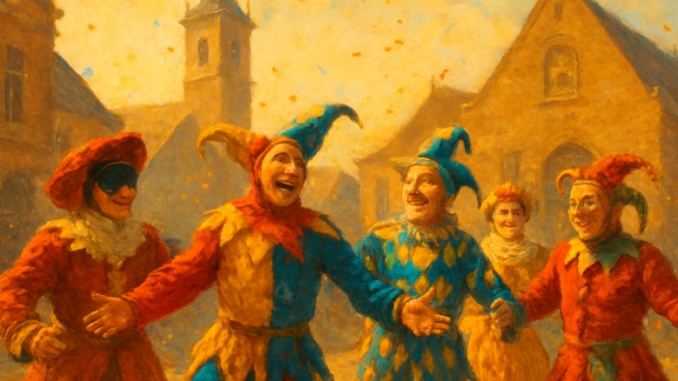
A troupe of jesters parades through the streets of a small town in the southern Dutch province of Brabant. They wear outlandish costumes, speak in exaggerated dialects, and fill entire halls with laughter through wickedly accurate caricatures of everyday people. It’s carnival — comedy, celebration, and chaos rolled into one. But anyone willing to look beyond the face paint and confetti will discover something remarkable: behind the jester’s mask lies an ancient ritual of equality, connection, and brotherhood that shares striking parallels with the very heart of Freemasonry.
The Mask as the Great Equalizer
A popular Brabant comedy series recently turned the spotlight on carnival culture, and while the production may appear to be lighthearted entertainment on the surface, it touches on something far deeper. Carnival has always been, at its core, a festival of inversion. The farmer becomes the prince, the mayor becomes the fool, and everyone wears a mask. It is precisely that mask which is so fascinating — it does not conceal who you are, but rather reveals who you could be when rank and status fall away.
Freemasonry operates on a strikingly similar principle. When brethren enter the lodge, they leave their professional titles and social standing at the door. The company director sits beside the carpenter, the physician beside the schoolteacher. The apron that every Freemason wears functions, in a sense, as a kind of mask: it covers outward differences and makes visible the truth that every person is equal in the pursuit of wisdom and virtue. Carnival and the lodge share this foundation. Both create a space where social hierarchy temporarily dissolves and people meet each other as equals.
The Fool as Philosopher
Brabant’s carnival humor is famous for its bite. Beneath the laughter often lies a razor-sharp observation about human weakness, vanity, and self-deception. The jester holds a mirror up to society, much as the court fool did for centuries at the royal courts of Europe. Erasmus of Rotterdam — not a Freemason himself, but a thinker whose spirit echoes throughout the Craft — wrote in his celebrated In Praise of Folly that it is the fool who is permitted to speak the truths that the wise man dares not utter. The fool enjoys a freedom that the serious person denies himself.
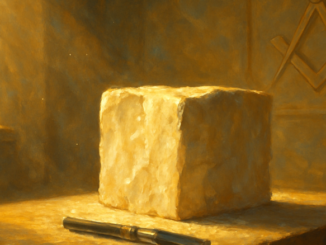
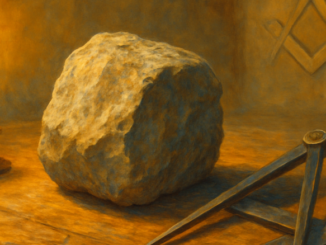
This idea resonates deeply within Freemasonry. The ritual work in the lodge invites brethren to look honestly at themselves, beyond the facades they maintain in daily life. The rough ashlar — one of the central symbols in Freemasonry — represents the unworked human being with all his imperfections. Shaping that stone requires precisely the courage the jester embodies: the willingness to acknowledge imperfection, to sometimes laugh at it, and then to work on it. Anyone who cannot put himself in perspective cannot grow.
Brotherhood does not arise in spite of our imperfections, but precisely because we are willing to share them with one another — sometimes with a tear, sometimes with a laugh.
Shared Laughter as a Ritual of Connection
What makes Brabant’s carnival comedy so powerful is not only the humor itself, but its collective nature. An entire hall laughing together experiences a moment of shared release. The philosopher Henri Bergson described laughter as a fundamentally social phenomenon — we rarely laugh alone. Laughter connects; it creates a sense of belonging that reaches far beyond words. It is, in the most literal sense, a common language.
Freemasonry has its own forms of collective experience. Walking through a ritual together, sharing a meal afterward, singing songs in unison — these are all moments when individual brethren merge into a brotherhood. The Brabant parade, the communal comedic speeches, the collective singing of carnival songs — here, too, individual participants form a temporary but intensely felt bond. Aristotle wrote long ago that man is a social being who only truly flourishes in community. Both carnival and the lodge affirm that ancient wisdom.
Three Days and Three Degrees
Carnival traditionally lasts three days. It begins with exuberance, reaches a climax, and ends on Ash Wednesday with introspection and reflection. This threefold structure is remarkable when you place it alongside the three degrees of Freemasonry: Entered Apprentice, Fellow Craft, and Master Mason. In both cases, the participant embarks on a journey. The Apprentice enters an unfamiliar world, much like the carnival-goer who puts on a mask for the first time. The Fellow Craft learns to understand the rules and language of the celebration. The Master, finally, knows that behind the revelry lies a deeper truth — and returns to everyday life after the festival with an enriched awareness.
It would be tempting to push this parallel too far, and doing so would not do justice to the unique character of either tradition. But the structural resemblance is undeniable: both rituals mark a temporary passage into a different state of being, in which the participant learns something about himself and his place within the community. The German poet Johann Wolfgang von Goethe, himself a Freemason, wrote that a person only truly comes to know himself through action, never through contemplation alone. Carnival is action par excellence: dancing, singing, playing, laughing.
What Remains When the Mask Comes Off
When the confetti has been swept away and the masks have been put down, something lingers. Anyone who has truly participated in carnival — who has allowed himself to be carried along by the collective joy — returns as a different person than when he left. The mask has laid something bare. The laughter has loosened something deep inside. The shared experience has forged a bond stronger than words can express.
This is precisely the promise of brotherhood in Freemasonry. It is not about secret handshakes or hidden knowledge, but about the willingness to enter a space together where honesty, vulnerability, and equality are the norm. The Brabant comedy makers, with their carnival production, remind us that such a space does not exist only within the solemn walls of a lodge. It can be found wherever people have the courage to drop their everyday masks, to laugh together at the absurdity of life, and to recognize in one another a shared humanity that transcends all outward differences.
Whether in the decorated streets of a Brabant town or in the candlelit stillness of a Masonic temple, the same timeless truth reveals itself: genuine human connection begins where pretense ends. The jester and the Freemason both understand that it takes courage to be truly seen — and that the reward for that courage is brotherhood in its most authentic form. The next time you witness the spectacle of carnival, look a little deeper. Behind the laughter, the music, and the masks, you may just catch a glimpse of something sacred.
Copyright text & image: devrijmetselaar.nl
Texts are based on the ideas and content of the author of devrijmetselaar.nl, reviewed, corrected, and supplemented with the assistance of OpenAI. Images are created based on the ideas of the author of devrijmetselaar.nl using OpenAI/DALL-E.
Frequently Asked Questions
What is the connection between carnival masks and Freemasonry?
Both carnival masks and Masonic practices serve as equalizers that temporarily dissolve social hierarchy. In Brabant's carnival tradition, masks allow people of different social standings to meet as equals by concealing rank and status. Similarly, in Freemasonry, when brethren enter the lodge and wear the Masonic apron, they leave their professional titles and social standing behind, creating a space where a company director sits beside a carpenter as equals in the pursuit of wisdom and virtue.
How does the fool's role in carnival relate to Freemasonry?
Both the carnival jester and the Masonic tradition value the fool's ability to speak truth that others dare not utter. Erasmus of Rotterdam noted that the fool is permitted to reveal truths about human weakness and self-deception that serious people avoid. This mirrors Freemasonry's invitation for brethren to look honestly at themselves during ritual work, moving beyond the facades they maintain in everyday life.
What do carnival and Freemasonry have in common philosophically?
Both carnival and Freemasonry are founded on the principle of creating spaces where normal social conventions are suspended and people encounter each other as equals. They share a deep commitment to revealing truth beneath surface appearances, whether through comedy and caricature in carnival or through ritual and self-reflection in the lodge. Both traditions emphasize connection, brotherhood, and the dissolution of social rank as a path to understanding humanity.


Be the first to comment