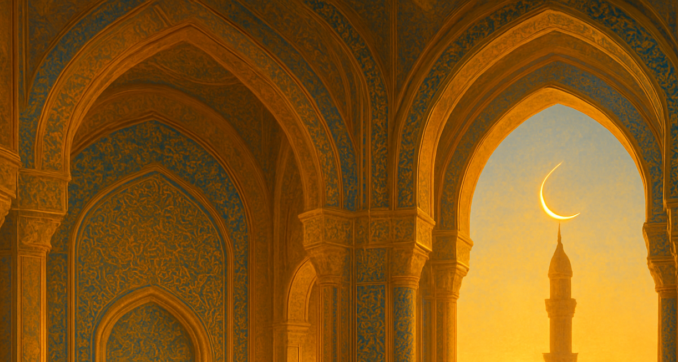
Imagine this: you’ve reached the end of a long, busy week. The phone goes off, the screen fades to black, and suddenly everything is quiet. In that silence, an uncomfortable question surfaces — if someone could see your entire life today, every word, every choice, every thought, would you be satisfied with what they’d find? That question lies at the heart of Surah 84 of the Quran, known as The Splitting. And it is the very same question that every Freemason is called to ask themselves on a regular basis.
What Is The Splitting About?
Surah 84, known in Arabic as Al-Inshiqaq, is one of the shorter chapters of the Quran. Its title refers to the splitting of the sky — a cosmic moment when everything breaks open and nothing remains hidden. The earth casts out what it carries, each person receives their book of deeds, and everyone is confronted with the sum total of their life. It is a powerful image of total accountability.
But this chapter is far more than a description of the end times. It contains a deeply practical message: your life is a journey from stage to stage, and at every stage you are invited to act with awareness and honesty. The text states explicitly that human beings move from state to state. This is not abstract theology. It is a daily reality that everyone recognizes.
The Discomfort of Honest Self-Knowledge
Why is it so difficult to look at yourself honestly? Because we all tell ourselves a story that protects us. We are the hero of our own narrative, and we unconsciously smooth out the rough edges. Surah 84 breaks through that pattern with one inescapable image: the book of your deeds is opened. Not by someone else — it is placed in your own hands.
Freemasonry has a strikingly similar practice. At the close of every lodge meeting, the Freemason is invited to engage in what is often called “silent labor” — a moment of inner reflection. The rough ashlar, that well-known symbol of the unrefined self, demands constant honest inspection. Where are the irregularities? Which corners still need work? These questions are never comfortable, but they are essential for genuine growth.
Honest self-knowledge is not punishment. It is the foundation upon which every meaningful life is built — both in the Quranic tradition of The Splitting and in the practice of Freemasonry.
Three Practical Lessons You Can Apply Today
The power of Surah 84 does not lie in some distant apocalyptic vision. It lies in what you can do with it right now. Here are three ways to bring the essence of this chapter into your daily life.
1. Keep Your Own Book of Deeds
Every evening, take five minutes to write down three things: something you did well, something you could have done better, and something you want to approach differently tomorrow. This is not a diary in the conventional sense. It is your personal “book of deeds,” consciously maintained. The Stoic philosopher Marcus Aurelius did something remarkably similar. In his Meditations, he wrote down his thoughts night after night — not for publication, but to keep himself sharp and accountable. Many Freemasons maintain a comparable habit as part of their personal path of learning and self-improvement.
2. Recognize Your Transitions Consciously
The Splitting speaks of moving from state to state. In daily life, we race from one phase to the next without pausing at the threshold. From morning to afternoon, from work to home, from one conversation to the next. Try pausing consciously at least once today during a transition. Stand still for a moment before you open your front door after work. Breathe in. Let the workday go. Step consciously into the next phase. Freemasons know this principle intimately from the ritual: every step through the lodge is a deliberate transition, charged with meaning. That awareness can be carried into the world outside the temple.
3. Let Light Fall on the Cracks
The image of splitting is not purely destructive. When something breaks open, light pours in. Think of a moment in your life when a certainty fell away — a job that vanished, a relationship that ended, a belief that no longer held true. It felt like a fracture, but in hindsight it was often the beginning of something new. Surah 84 invites you not to fear those breaking points, but to welcome them as opportunities for insight. In Freemasonry, the search for light is one of the most fundamental driving forces. The candidate enters the lodge in darkness and moves step by step toward illumination. That process requires old certainties to crack open.
The Connection Between Splitting and Building
At first glance, splitting and building appear to be opposites. But every master builder knows that you must first tear down before you can rebuild. Ignoring cracks in a wall leads to collapse. Honestly examining a crack leads to repair and reinforcement. The great medieval cathedrals — such a rich source of inspiration for Freemasons — were not built by laying perfect stones side by side. They were built through constant measuring, correcting, and starting over wherever it was needed.
Johann Wolfgang von Goethe, himself a Freemason and one of the greatest thinkers in the Western tradition, wrote that a person only truly becomes human when they dare to shape themselves. That shaping begins with honestly observing what is already there — including the cracks. The Quranic tradition and Freemasonry meet at precisely this point: both invite the individual to look beyond the surface and find the courage for genuine self-transformation.
Why This Matters Now
We live in an era where honest self-reflection is becoming increasingly rare. Social media rewards the polished image, not the vulnerable truth. Algorithms confirm what we already believe. Surah 84 is a countervoice — an invitation to set aside the mask and face your own story without embellishment. Not because you are expected to be perfect, but because real growth begins only when you are willing to see yourself clearly.
For Freemasons, this is not a new idea. The entire Masonic journey — from Entered Apprentice to Master Mason — is structured around the principle that self-knowledge precedes all other knowledge. The tools of the Craft, the square, the compass, the plumb line, are instruments of measurement and correction. They remind us that the work is never finished, and that every honest assessment brings us closer to the person we are meant to become.
Surah 84 and the Masonic tradition share a profound truth: the moments when things split open are not endings — they are invitations. They invite us to stop, to look, and to begin again with greater honesty and purpose. Whether you find meaning in the Quranic image of the sky breaking apart or in the Masonic symbol of the rough stone awaiting the chisel, the call is the same. Dare to examine your own book of deeds. Dare to pause at the threshold between one state and the next. And dare to let light fall on the cracks — because that is where the real building begins.
Copyright text & image: devrijmetselaar.nl
Texts are based on the ideas and content of the author of devrijmetselaar.nl, reviewed, corrected, and supplemented with the assistance of OpenAI. Images are created based on the ideas of the author of devrijmetselaar.nl using OpenAI/DALL-E.
Frequently Asked Questions
What is Surah 84 (Al-Inshiqaq) and why is it called 'The Splitting'?
Surah 84, known as Al-Inshiqaq or 'The Splitting,' is a chapter of the Quran that uses the metaphor of the sky splitting open to represent a moment of total accountability. It describes a cosmic moment when everything breaks open and nothing remains hidden, where each person receives their book of deeds and is confronted with the sum total of their life. However, the chapter's message extends beyond end-times theology to offer a practical daily lesson: that life is a journey through different stages, and at every stage we are invited to act with awareness and honesty.
How does Surah 84 relate to Freemasonry?
Both Surah 84 and Freemasonry share a core emphasis on honest self-knowledge and accountability. Freemasonry practices what is called 'silent labor' at the close of every lodge meeting—a moment of inner reflection and self-examination. Similarly, the rough ashlar symbol in Freemasonry invites constant honest inspection of oneself, asking which irregularities and rough edges still need work. This mirrors the Quranic message that we must regularly examine ourselves with complete honesty, much like having our book of deeds placed in our own hands.
Why is honest self-knowledge difficult, and why does it matter?
Honest self-knowledge is difficult because we all unconsciously protect ourselves through storytelling—we are the heroes of our own narratives and smooth out rough edges. Surah 84 breaks through this protective pattern with the powerful image of one's book of deeds being placed in one's own hands. Honest self-knowledge is not punishment but rather the foundation upon which every meaningful life is built. It is essential for genuine personal growth and is central to both the Quranic tradition and Freemasonry.


Be the first to comment