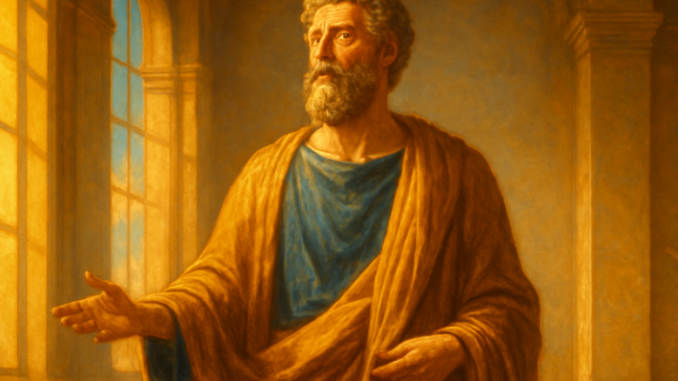
When you gaze up at the night sky, you may feel a fleeting sense of just how small you are within the vast expanse of existence. This very feeling lies at the heart of Book X of the Meditations by Marcus Aurelius. The Roman emperor-philosopher invites us to set our daily worries against the backdrop of an infinite universe — not to make us feel insignificant, but to help us see clearly what truly matters. In this summary, we explore the core ideas of this remarkable tenth book and how adopting a cosmic perspective can free us from petty concerns.
The Core of Book X: Looking Upward to Think Clearly
Throughout Book X of his Meditations, Marcus Aurelius returns again and again to a single central idea: human beings are a minuscule part of an immeasurably vast and eternally unfolding cosmic whole. This is not a pessimistic message about insignificance — it is a liberating invitation. By seeing yourself as a temporary manifestation within a larger fabric, the grip of daily frustration loosens. The emperor, who dealt with wars, political intrigue, and personal losses, found in this perspective an anchor for his inner peace.
The cosmic perspective functions as a mirror we hold up to ourselves. Not to dissolve into nothingness, but to discern more sharply what truly deserves our attention. Marcus Aurelius asks us to consider how brief a human life is compared to the age of mountains, rivers, and stars. From that vantage point, many of our worries suddenly become bearable — even trivial.
The Fabric of All Things
A recurring image in Book X is that of the universe as a single, interconnected fabric. Nothing exists in isolation; everything is interwoven with everything else. Marcus Aurelius uses this image to make clear that our actions, however small, resonate throughout the greater whole. At the same time, it reminds us that we are not the center of the universe. This realization is not humiliating — it is relieving. It removes the pressure to control everything, understand everything, and be everything.
The cosmic perspective is not an escape from reality, but a clearer view of what truly counts: character, virtue, and the quality of our actions.
In Freemasonry, we find a strikingly similar symbolism. The building of the temple, the work on the rough ashlar, the placing of oneself within a brotherhood that spans generations — these are all expressions of the same awareness. You are part of something greater. Not as a cog in a machine, but as a conscious contributor to a work that transcends your own lifespan.
Lessons from Book X: The Fleeting Nature of Fame and Possession
Marcus Aurelius illustrates his philosophy with vivid, concrete examples. He names great figures from the past — emperors, generals, philosophers. Where are they now? Forgotten, or reduced to a mere name in a history book. Their palaces are ruins, their battles footnotes. This is not a cynical observation but a call to sobriety. If even the most powerful people on earth were only temporary presences, why should we cling to fleeting rewards like fame, wealth, or power?
The image of the night sky returns time and again. Look upward, Marcus Aurelius writes, and realize that the same stars once shone above Alexander the Great, above Socrates, above generations we will never know. This perspective casts our own preoccupations in a different light. It invites a certain lightness — an ability to let go of what holds us back.
The Inner Citadel: Finding Stillness Amid the Cosmos
Despite the emphasis on the grand scheme of things, Marcus Aurelius never loses sight of the inner world. The cosmic perspective is no excuse for passivity or indifference. On the contrary: precisely because the external world is unpredictable and transient, we must guard our inner citadel. Our character, our virtue, our responses to what happens to us — that is what we truly hold in our own hands.
Stoic philosophy, of which Marcus Aurelius is one of the most important representatives, emphasizes this distinction between what lies within and what lies beyond our control. Book X applies this principle consistently. The universe is immeasurable, but our responsibility is close at hand: in every thought, every word, every action.
Symbolic Depth: The Square and Compasses as Cosmic Instruments
For the Freemason, Book X takes on a special resonance when we consider the symbols of the lodge. The compasses, which draw circles, point to the universal, the all-encompassing, the celestial sphere. The square, which forms right angles, represents the earth, the material, the concrete act. Together they form an image of the human being who moves between heaven and earth, between cosmic perspective and daily action.
Marcus Aurelius would have understood this image immediately. His philosophy is not an escape from the world, but a continual movement between contemplation and action. Look up at the stars, but do not forget to keep your feet firmly on the ground. Work on yourself — not despite the cosmic perspective, but precisely because of it.
What Book X Still Has to Tell Us Today
In an age of constant stimulation, news cycles, and social pressure, the cosmic perspective offers a welcome pause. It is an invitation to step back for a moment, to realize that not everything is urgent, that not every opinion demands a response, that not every event needs to shake our inner world. Marcus Aurelius wrote these words nearly nineteen hundred years ago, yet they feel more relevant than ever.
The tenth book of the Meditations is not an abstract treatise but a personal journal of someone who tried every single day to live according to his principles. That humanity is what makes it so accessible. We are not reading the words of a saint, but of a man who struggled, doubted, and yet chose clarity and virtue time and time again.
Book X of the Meditations reminds us that the grandeur of the cosmos need not diminish us — it can elevate us. By placing our lives within the vast sweep of time and space, we gain the freedom to focus on what truly matters: the quality of our character, the integrity of our actions, and our contribution to a work far greater than ourselves. For Freemasons and thoughtful seekers alike, this ancient wisdom offers a timeless guide: look upward to the stars, but never stop shaping the stone beneath your hands.
Copyright text & image: devrijmetselaar.nl
Texts are based on the ideas and content of the author of devrijmetselaar.nl, reviewed, corrected, and supplemented with the assistance of OpenAI. Images are created based on the ideas of the author of devrijmetselaar.nl using OpenAI/DALL-E.


Be the first to comment