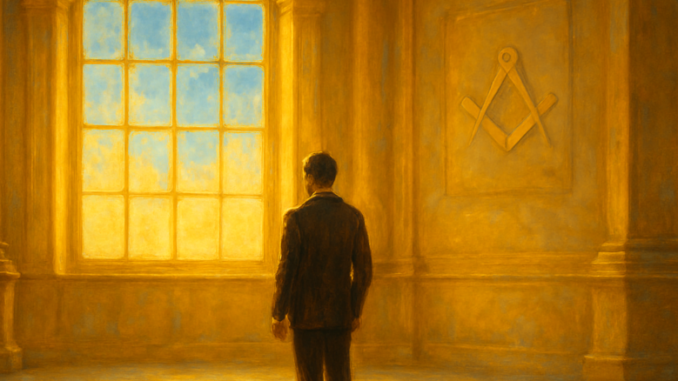
A compass resting on an altar. A pyramid crowned by a radiant eye. A secret vault buried deep beneath the Capitol. When Dan Brown published The Lost Symbol in 2009, he gave millions of readers what felt like a backstage pass to the world of Freemasonry. But looking at an actual piece of stonework and looking at a photograph of that same stonework are two very different experiences. How do the symbols Brown describes relate to actual Masonic practice? And where does the line fall between thriller fiction and craft truth?
The Square and Compasses: Tools and Metaphors
Let’s start with the most recognizable image: the square and compasses. In The Lost Symbol, these instruments appear repeatedly — as decorative motifs, keys to riddles, and visual clues pointing toward hidden knowledge. Brown uses them as plot devices, tension builders in a fast-paced narrative. But in actual Freemasonry, the square and compasses are not decoration. They are working tools inherited from the stonemason’s craft, the very trade from which Freemasonry draws its origin.
The square reminds a Freemason to measure his actions against standards of honesty and fairness. The compasses urge restraint — an awareness of limits in behavior and ambition. If you placed these objects on a desk, you would see two simple tools. But for a Freemason, they represent a daily exercise in self-examination. That is the essential difference from the novel: Brown turns the tools into puzzle pieces, while in the lodge they serve as mirrors.
The All-Seeing Eye: Not a Conspiracy, but an Ancient Belief
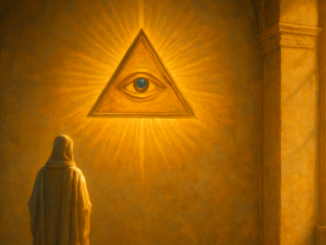
Few images have generated as many misunderstandings as the All-Seeing Eye — that radiant eye inside a triangle that also appears on the American dollar bill. In The Lost Symbol, this image is linked to secret power structures and hidden wisdom supposedly accessible only to initiates. It makes for a gripping plot point, but it diverges significantly from historical reality.
The All-Seeing Eye, also known as the Eye of Providence, is a centuries-old symbol found in many traditions. In Christian iconography, it represents divine omniscience. In Freemasonry, it refers to an awareness that human life unfolds under a higher moral order — however an individual Mason may personally define that order. Importantly, the symbol on the Great Seal of the United States was not designed by Freemasons, although some members of the design committee did have ties to the fraternity. Benjamin Franklin, himself a Mason, sat on that committee, but the final design was created by someone who was not a member. Brown implies a far more direct line between lodge and state than history supports.
The Pyramid and the Lost Knowledge
A central plot element in The Lost Symbol is a pyramid believed to contain a secret: the location of ancient, lost knowledge. The pyramid as a form does appear in Freemasonry, but not as a treasure chest or a reference to a physical location. The pyramid — specifically the unfinished pyramid — represents work that is never complete: the ongoing formation of one’s own character. Each stone laid represents a step in personal growth. The absent capstone symbolizes the understanding that perfection is a direction, not a destination.
This is a crucial point where fiction and reality part ways. Dan Brown places the secret outside the individual — somewhere in a vault, behind a code, beneath a monument. Freemasonry places the secret squarely within. The “Lost Word” that the novel references is, in the Masonic tradition, not a password or a magical formula. It is a reference to knowledge that humanity has lost through inattention or moral decline. It concerns inner rediscovery, not a treasure you can dig up.
Ritual: Theater or Inner Journey?
One of the most discussed passages in The Lost Symbol involves the description of an initiation ritual. Without delving into exactly what Brown depicts, we can observe that he uses elements that are partly recognizable to anyone familiar with Freemasonry, but he presents them as macabre spectacle. The novel has reinforced, for many readers, the impression that Masonic rituals are mysterious, almost occult performances.
In reality, Masonic rituals are more closely comparable to what the philosopher Aristotle called mimesis — an imitation of experience that invites the participant toward recognition and inner transformation. The ritual tells a story, often based on the legend of Hiram Abiff, the master builder from the tradition surrounding the Temple of Solomon. This story is about loyalty, integrity, and the confrontation with one’s own mortality. It is not a theatrical performance staged for entertainment but an experiential lesson — comparable, perhaps, to the way Michel de Montaigne used everyday life in his essays as a starting point for philosophical depth.
Where Dan Brown Gets It Right
It would be unfair to highlight only the inaccuracies. Dan Brown does get a number of things right in The Lost Symbol. The House of the Temple in Washington, D.C. — headquarters of the Scottish Rite — is a real building, and it is recognizably described in the novel. Freemasonry does indeed have historical ties to the founders of the American republic: George Washington was a Freemason, as were a significant number of signers of the Declaration of Independence. And it is true that the fraternity uses symbols as teaching tools, a tradition that stretches back to the operative stonemason guilds of the Middle Ages.
What Brown does, however — and what every skilled novelist does — is select, amplify, and reshape. He takes authentic elements and places them in a dramatic framework that serves the story. The danger lies not in the fiction itself, but in the assumption that fiction is a reliable guide to fact. The symbols Dan Brown describes in The Lost Symbol largely exist in reality. But their meaning within Freemasonry is not a secret code waiting to be cracked. They are mirrors — instruments for self-examination and moral growth.
The most important thing The Lost Symbol gets wrong is also the most understandable: it looks for the secret in the wrong place. The power of Masonic symbolism does not reside in hidden chambers or encrypted messages. It lives in the quiet, personal work of a Mason who picks up a familiar symbol — a square, a compass, an unfinished pyramid — and asks himself what it demands of him today. The symbols are real. The secret they guard is simply this: the never-ending task of becoming a better human being.
Copyright text & image: devrijmetselaar.nl
Texts are based on the ideas and content of the author of devrijmetselaar.nl, reviewed, corrected, and supplemented with the assistance of OpenAI. Images are created based on the ideas of the author of devrijmetselaar.nl using OpenAI/DALL-E.
Frequently Asked Questions
Are the Masonic symbols described in The Lost Symbol real?
Yes, symbols like the square and compasses are real and central to Freemasonry, but their meaning and use differ significantly from Dan Brown's fictional portrayal. In the novel, they function as plot devices and puzzle pieces, while in actual Masonic practice, they are working tools inherited from the stonemason's craft that serve as reminders for self-examination and moral standards.
What do the square and compasses actually represent in Freemasonry?
The square and compasses are not merely decorative symbols but working tools with deep meaning. The square reminds Freemasons to measure their actions against standards of honesty and fairness, while the compasses represent restraint and awareness of limits in behavior and ambition. Together, they serve as mirrors for daily self-reflection rather than as keys to hidden knowledge.
Is the All-Seeing Eye a Masonic conspiracy symbol?
No. While the All-Seeing Eye appears in Freemasonry and on the Great Seal of the United States, it is not a symbol of secret power or hidden wisdom accessible only to initiates. The symbol, also known as the Eye of Providence, is centuries-old and found in many traditions, including Christian iconography where it represents divine omniscience. In Freemasonry, it refers to awareness that human life unfolds under a higher moral order.

Be the first to comment