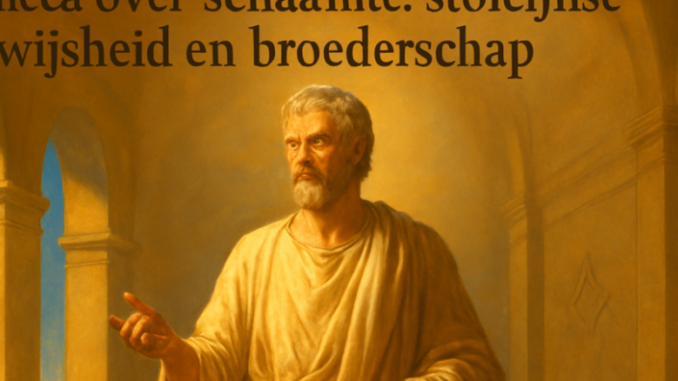
In 65 AD, Lucius Annaeus Seneca wrote a series of letters from his villa to his young friend Lucilius. The eleventh letter addresses a subject that remains strikingly relevant nearly two thousand years later: the role of shame in the formation of a noble character. For Freemasons, this ancient epistle offers a remarkably familiar perspective on the inner struggle between natural emotions and the conscious pursuit of self-improvement.
The Stoic View on Blushing
Seneca opens his eleventh letter with an observation that any public speaker will instantly recognize. He describes how even seasoned orators and philosophers blush when standing before a crowd. This blushing, he argues, is not a sign of weakness but a natural physical reaction that cannot be fully controlled by willpower alone. The Stoic philosopher draws a crucial distinction here: there are emotions we can train and master, and there are bodily reflexes that fall beyond our direct control.
This insight was revolutionary in the first century — and it remains so today. Seneca points out that Marcus Porcius Cato, the very embodiment of Roman virtue, was well known for his tendency to blush. Even Pompey, the great military commander, turned red during public appearances. The message is clear: shame in its physical form is not a moral failing but a hallmark of a sensitive and refined disposition.
Moral Nobility as an Inner Compass
Where Seneca’s letter truly gains depth is in his treatment of moral nobility. He distinguishes involuntary blushing from the conscious shame that arises from moral awareness. This second form of shame, he argues, is a sign of a developed conscience — an inner compass that warns us when we are in danger of straying from the right path. In the Stoic tradition, this conscience is not innate but shaped through education, philosophical reflection, and deliberate practice.
True shame is not the enemy of the wise, but an ally that reminds him of his highest self.
Seneca advises Lucilius to imagine a wise mentor who is always watching. Whether this figure is Cato, Laelius, or another virtuous person from history, this inner observer serves as a standard against which we measure our actions. When we behave as though a sage is watching, our choices naturally improve.
The Freemason and the Inner Witness
For Freemasons, this concept of an inner witness will feel immediately familiar. Within the lodge tradition, the idea of the Great Architect of the Universe plays a comparable role: an elevated principle that gives direction to our conduct without exercising coercion. The Freemason is not externally controlled but develops an inner moral awareness that guides him beyond the lodge walls as well.
The parallel extends further. Seneca speaks of the need for a living teacher — someone who instructs not merely through words but through the entirety of his being, setting an example by how he lives. In Freemasonry, we find this reflected in the mentorship between brethren, where experienced members guide newer ones not through prescriptions but through lived example. The rough ashlar is not refined by commandments, but by the daily example of brothers who continue to work on their own stone.
Shame as a Bridge to Human Connection
A surprising aspect of Seneca’s letter is how he connects shame to human bonding. He implies that anyone who never feels shame has effectively cut themselves off from community and its values. Shame presupposes that we care about the judgment of others — not out of vanity, but from an understanding that we are part of something greater than ourselves. The Stoic does not live in isolation but acknowledges his place within the human family.
This resonates powerfully with the Masonic ideal of brotherhood. The lodge is a community in which brethren mirror one another — not to pass judgment, but to grow together. The willingness to make yourself vulnerable, to feel shame when you fall short, is a sign of genuine commitment to the fraternity. Those who dismiss everything with indifference miss the very connection that lies at the heart of Masonic work.
The Square of Conscience
In Freemasonry, the square symbolizes right action — the measuring of our deeds against an objective moral standard. Seneca’s description of the inner witness functions in much the same way. The sage we keep in mind with every action is like an invisible square that helps us determine whether our conduct is true and upright.
The Stoic asks: Would my mentor approve of this? The Freemason asks: Can this withstand the test of the square? Both traditions emphasize self-reflection over external control.
The contrast with modern attitudes toward shame is striking. Where contemporary psychology often views shame as inherently destructive, both Seneca and the Masonic tradition see a constructive role for healthy shame. This is not about self-punishment or humiliation, but about cultivating a finely tuned moral awareness that drives us toward improvement.
From Rome to the Modern Lodge
The bridge from Seneca’s Stoicism to modern Freemasonry runs through the Renaissance, when humanists such as Petrarch and later Montaigne rediscovered classical wisdom. These thinkers shaped the intellectual climate in which organized Freemasonry would emerge in the eighteenth century. The emphasis on personal virtue, self-reflection, and character formation through deliberate practice is found in both traditions.
Seneca’s eleventh letter reminds us that moral development is not a one-time achievement but a daily labor. The Freemason who reflects on his day each evening is essentially performing the same exercise Seneca prescribed to his student: consulting the conscience, summoning the inner witness, and acknowledging one’s own shortcomings with a gaze that is gentle yet honest. Not to despair, but to build better tomorrow.
Nearly two millennia separate Seneca’s Roman villa from the modern Masonic lodge, yet the essential message endures. Healthy shame — the kind rooted in moral awareness rather than insecurity — remains one of the most powerful tools for self-improvement. It connects us to our highest ideals, to the brethren who walk beside us, and to the timeless pursuit of shaping the rough stone into something worthy. Whether we call it Stoic virtue or Masonic labor, the work is the same: to live each day as though a wise eye is watching, and to let that awareness make us not fearful, but better.
Copyright text & image: devrijmetselaar.nl
Texts are based on the ideas and content of the author of devrijmetselaar.nl, reviewed, corrected, and supplemented with the assistance of OpenAI. Images are created based on the ideas of the author of devrijmetselaar.nl using OpenAI/DALL-E.
Frequently Asked Questions
What is Seneca's main distinction between different types of shame?
Seneca distinguishes between involuntary physical blushing, which is a natural bodily reflex beyond our control, and conscious moral shame that arises from a developed conscience. While blushing is not a moral failing, the second form of shame is a valuable sign of moral awareness and an inner compass that guides us away from wrongdoing. He illustrates this by noting that even great figures like Cato and Pompey blushed publicly, demonstrating that this physical reaction is actually a hallmark of refined sensibility.
How does Seneca's concept of an inner witness relate to Freemasonry?
Seneca advises imagining a wise mentor or sage who is always observing your actions, serving as an inner standard for moral behavior. This concept parallels the Freemason tradition, where the idea of the Great Architect of the Universe functions similarly as an elevated inner witness. Both traditions use this concept of constant observation by a higher authority to encourage self-improvement and moral nobility.
Why is moral shame considered valuable in Seneca's philosophy?
According to Seneca, moral shame is not something to be eliminated but rather an ally to the wise person. It represents a developed conscience shaped through education, reflection, and deliberate practice. True shame reminds us of our highest self and warns us when we risk straying from the right path. Rather than being a weakness, it is evidence that we have cultivated an inner compass capable of guiding us toward virtue and nobility of character.



Be the first to comment