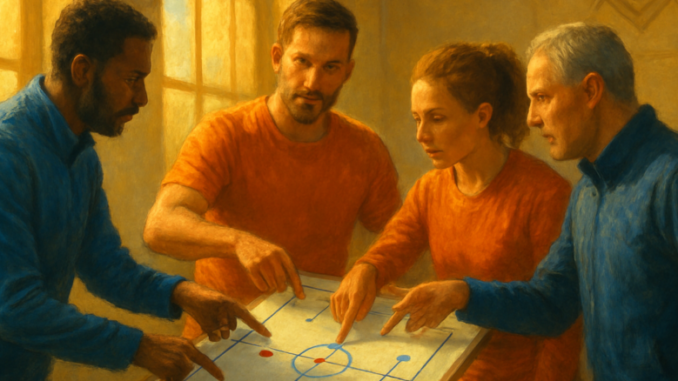
The recent announcement of a new coaching staff for the Dutch national football team — featuring names like Ruud van Nistelrooij, Moussa Ramzi, and a family member of the head coach — has sparked debate that reaches well beyond the pitch. How do you build an effective team where different backgrounds, skills, and personalities come together into a functioning whole? It is a question that has stood at the heart of Freemasonry for centuries, and one that remains profoundly relevant today.
The Historical Roots of Purposeful Collaboration
Looking back to the seventeenth and eighteenth centuries, we can observe how the operative stonemason guilds gradually transformed into speculative lodges. This transition marked a fundamental shift: the primary aim was no longer the construction of cathedrals and palaces, but the building of a better society through moral and intellectual development. The guilds operated on a refined system of collaboration in which masters, fellows, and apprentices each fulfilled their own role within a greater whole.
James Anderson, the compiler of the Constitutions of 1723, laid the groundwork for how brethren should interact with one another. His work emphasized that a lodge functions as an organism in which every member is indispensable. The Master may lead, but without the contributions of the fellows and the eagerness of the apprentices, no real progress is made. This principle of complementary collaboration has withstood the test of time and continues to offer guidance in modern contexts — including, perhaps surprisingly, the world of professional sports.
The Value of Diversity Within a Team
What stands out about the new Dutch coaching staff is the deliberate choice for diversity. The group includes former strikers, but also specialists in tactics, fitness, and mental coaching. This composition reflects an old insight that Masonic lodges have long cherished: a group made up only of like-minded individuals lacks the dynamic tension necessary for genuine growth.
Johann Wolfgang von Goethe, himself a Freemason, wrote extensively about the importance of opposites complementing each other. In his thinking about nature and the human spirit, he stressed that harmony does not arise from uniformity, but from the interplay of different forces. A coaching staff composed of people with diverse expertise follows exactly this pattern. The question is not whether team members always agree, but whether they are able to make their differences productive.
In a Masonic lodge, members come from all walks of life — doctors, builders, teachers, artists — and it is precisely this variety that enriches the collective experience. The same principle applies to any team striving for excellence: diversity of thought and background leads to richer solutions and more resilient decision-making.
Family Ties, Trust, and the Question of Nepotism
The inclusion of a family member of the head coach inevitably raises questions about nepotism versus natural trust. Throughout the history of human organizations, we see both extremes: dynasties that crumbled under cronyism, and family enterprises that achieved extraordinary results precisely because of the deep trust among their members.
Trust is the foundation upon which every successful collaboration rests, whether in a football coaching staff or in a Masonic lodge.
Within Freemasonry, brethren regard each other as family — not through blood, but through shared values and mutual respect. This chosen kinship creates a form of trust that can be every bit as strong as familial bonds. The crucial difference with nepotism lies in whether the chosen person is genuinely competent for the role. When trust is paired with ability, a powerful combination emerges. When it is not, the entire structure is weakened. This distinction is as important in a lodge as it is in any professional setting.
The Lesson of the Master Builder
In Freemasonry, the figure of Hiram Abiff — the legendary master builder of King Solomon’s Temple — occupies a central place. Hiram is not remembered as a solitary genius, but as someone who was able to coordinate and inspire thousands of craftsmen. His strength lay not only in his own skill, but in his ability to bring out the best in others.
A modern head coach faces a remarkably similar challenge. The point is not that he himself is the best footballer, but that he assembles a team around him that collectively achieves more than the sum of its parts. The selection of staff members is therefore an exercise in self-knowledge: knowing where your own limitations lie, and having the courage to bring in people who compensate for those shortcomings. Hiram’s legacy teaches us that true leadership is not about personal brilliance — it is about orchestrating the brilliance of others.
The Broader Relevance of Team Building
The discussions surrounding the new Dutch coaching staff mirror broader societal questions about leadership and collaboration. In an era where individualism is often glorified, a national football team offers a counterweight: here, everything revolves around the collective. Freemasonry has traditionally carried the same message. Benjamin Franklin, one of the most influential American Freemasons, consistently emphasized that individual virtue only gains true meaning when it is placed in service of the community.
The composition of a coaching staff is ultimately more than an organizational decision. It is a statement about which values one holds dear. Does one choose familiar faces or the best candidates? Does one dare to embrace diversity, or seek the safety of the known? These questions are universal and touch on the very core of how we wish to function as a society.
Four principles emerge that resonate across both the football pitch and the lodge room: complementary skills strengthen the whole; trust must be paired with competence; diversity of background leads to richer solutions; and true leadership means bringing out the best in others.
The formation of the new Dutch national team coaching staff offers a mirror in which we can examine our own beliefs about collaboration. Just as in a Masonic lodge, what matters in the end is not the individual star, but the harmony of the whole. When different talents, backgrounds, and perspectives come together around a shared goal, something emerges that is greater than what any individual could achieve alone. That is the timeless lesson the master builders have passed down through the ages — and it applies as much on the football pitch as it does within the walls of the lodge.
Copyright text & image: devrijmetselaar.nl
Texts are based on the ideas and content of the author of devrijmetselaar.nl, reviewed, corrected, and supplemented with the assistance of OpenAI. Images are created based on the ideas of the author of devrijmetselaar.nl using OpenAI/DALL-E.
Frequently Asked Questions
How does Freemasonry's approach to collaboration relate to modern team building in sports?
Freemasonry has practiced purposeful collaboration for centuries through its lodge system, where masters, fellows, and apprentices each play essential roles within a greater whole. This principle, formalized by James Anderson's Constitutions of 1723, emphasizes that every member is indispensable and that progress requires contributions from all levels. This model directly parallels modern coaching staff composition, where diverse expertise and roles must work together synergistically to achieve success.
Why is diversity important in building an effective team according to Masonic philosophy?
Masonic tradition values diversity because a group of only like-minded individuals lacks the dynamic tension necessary for genuine growth. Freemason Johann Wolfgang von Goethe emphasized that harmony arises not from uniformity, but from the interplay of different forces and perspectives. A diverse team with varied expertise in areas like tactics, fitness, and mental coaching creates the productive friction needed for innovation and better decision-making.
How did Freemasonry transition from being about construction to being about collaboration and moral development?
Between the seventeenth and eighteenth centuries, operative stonemason guilds gradually transformed into speculative lodges. This shift moved the primary purpose from constructing physical buildings like cathedrals and palaces to building a better society through moral and intellectual development. The refined system of collaboration that the guilds had developed—with clear roles for masters, fellows, and apprentices—remained the foundation for this new purpose.




Be the first to comment