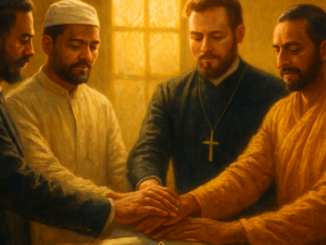
Freemasonry symbols representing unity and respect among world religions
Religion

Freemasonry and Religion: A Bridge of Connection and Respect

Freemasonry is an ancient fraternity built on universal values such as truth, brotherhood, and morality. While it is not a religion, it maintains a unique and fascinating relationship with religions around the world. How does Freemasonry position itself in relation to faith traditions, and what makes its spiritual vision so distinctive? Freemasonry: Not a Religion, But Deeply Spiritual One of the most common misconceptions about Freemasonry is that it is a religion. It is not. Freemasonry does not require its members to hold any specific religious belief. What it does ask is that members believe in a Supreme Being — often referred to as the “Grand Architect of the Universe” — a universal concept of a higher power that transcends any single faith tradition. This openness allows people from all religious backgrounds to participate and find common ground. The rituals and symbols used in Freemasonry are not religious in the traditional sense. Instead, they serve as tools for self-reflection and moral growth. This approach provides a shared foundation for members who may hold vastly different religious convictions, creating a space where spiritual exploration is encouraged without imposing any doctrine. How Freemasonry Relates to World Religions Respect for Diversity: Freemasonry recognizes […]

Islamic geometric patterns alongside Masonic symbols representing shared spirituality
Religion

Islam and Freemasonry in the Netherlands: Ritual & Spirit

The Netherlands is a mosaic of cultures and religions, and Islam plays a prominent role in this diverse landscape. With over one million Muslims, the faith is deeply woven into Dutch society. At the same time, Freemasonry offers a non-dogmatic space for spiritual growth and moral reflection. How do these two traditions complement each other, and what can they learn from one another? Islam: A Way of Life Rich in Ritual Islam is far more than a religion — it is a complete way of life. Built on the Five Pillars — the declaration of faith, prayer, charity, fasting, and pilgrimage — Islam provides its followers with structure, purpose, and direction. The daily prayers (salat) and the annual observance of Ramadan instill discipline and deep devotion to God. Mosques serve as centers of both community and worship, spaces where spirituality and human connection come together. They are often adorned with intricate geometric patterns and calligraphy that are not merely beautiful but carry profound symbolic meaning — pointing toward the infinite nature of the divine. Freemasonry: A Space for Universal Truths While Freemasonry is not a religion, it shares notable parallels with spiritual traditions like Islam. Freemasons use rituals and symbolism […]