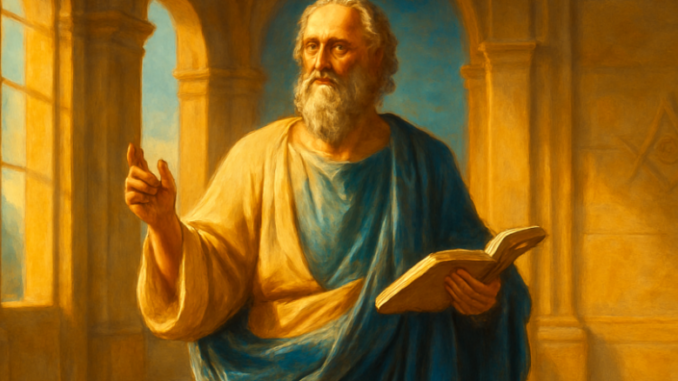
Can virtue be taught, or does every person already carry it within? This question, posed by Meno to Socrates in one of Plato’s most celebrated dialogues, touches on fundamental issues that still resonate today. The Meno offers not only a philosophical investigation into the nature of knowledge and morality but also opens a window into the intellectual world in which Plato wrote. For Freemasons, this dialogue strikes a particularly familiar chord: the quest for inner illumination, the role of symbols in unveiling hidden wisdom, and the conviction that true knowledge does not come from without but is awakened from within.
The World of Plato: Athens and the Sophists
To understand the Meno, we first need to step into the intellectual arena in which Plato operated. Fifth-century Athens was buzzing with philosophical activity. Sophists like Gorgias and Protagoras traveled the Greek world, teaching rhetoric, political skills, and what they called “virtue” to wealthy young men. Their approach was pragmatic: virtue, in their view, was a skill that could be learned, much like writing or arithmetic.
Socrates, Plato’s teacher, took a radically different stance. Where the Sophists confidently claimed to sell wisdom, Socrates began every conversation by acknowledging his own ignorance. This attitude, later known as the “Socratic method,” forms the beating heart of the Meno. In the dialogue, we meet Meno — an aristocratic young man who believes he knows precisely what virtue is, until Socrates, through carefully aimed questions, leads him into a state of productive confusion.
Pythagoras and the Doctrine of Recollection
One of the most fascinating aspects of the Meno is the introduction of the doctrine of recollection, or anamnesis. Plato has Socrates argue that learning is actually remembering: the soul, being immortal and having passed through many lives, already possesses all knowledge but has forgotten it at birth. The philosophical conversation serves to bring this dormant wisdom back to consciousness.
This idea is deeply rooted in the Pythagorean tradition. Pythagoras of Samos, who lived two centuries before Plato, combined mathematics, music, and mysticism into a philosophy of life. His followers believed in the transmigration of souls and saw the study of abstract truths — such as mathematical ratios — as a path to purifying the soul. Plato demonstrates this doctrine by having Socrates guide an uneducated enslaved person to “discover” geometric truths through targeted questions, without teaching him anything in the conventional sense.
True knowledge is not poured in from outside but awakened from within by asking the right questions of those who seek.
Parmenides and the Paradox of Inquiry
In the Meno, Meno raises a seemingly devastating objection, later known as “Meno’s Paradox”: how can you search for something if you don’t know what it is? And if you already know it, why would you still search? This paradox was not an original invention of Meno’s own making — it echoes the thinking of Parmenides, the early Greek philosopher who argued that change and becoming are impossible.
Plato’s answer, through the doctrine of recollection, is both elegant and profound. We are not searching for something entirely unknown, nor for something we fully know. We are searching for what we once knew but have forgotten. This philosophical insight places humanity between complete ignorance and divine omniscience — precisely in the position of the seeker.
The Symbolic Dimension: Freemasonry as a Path of Remembrance
Viewed through the lens of Freemasonry, Plato’s doctrine of recollection takes on a special resonance. The initiation rituals of the Masonic tradition do not work with dogmas or catechisms imposed from outside. Instead, they employ symbols, narratives, and experiences designed to awaken something within the candidate. The square, the compass, the rough ashlar — these do not teach by transmitting information but by stirring recognition.
This corresponds remarkably with what Socrates demonstrates in the Meno. The enslaved person does not “learn” geometry because Socrates tells him facts, but because the right questions compel him to look inward. Masonic ritual works in much the same way: it asks, it shows, it suggests — but the answer must be found by the seeker himself. The symbols are like the geometric figures drawn in the sand by Socrates: they make visible what the soul already knows but has not yet articulated.
Two Perspectives: The Sophist and the Seeker
Consider two fundamentally different approaches to virtue and knowledge. The Sophist sees himself as a supplier: he possesses wisdom and sells it to whoever pays. Education is a transaction; knowledge is a commodity. This vision has its modern equivalents in every approach that believes moral formation can be entirely programmed or codified.
The Socratic and the Masonic approaches share a very different vision. Here, the teacher is not a supplier but a catalyst. He does not possess more truth than the student, but he knows how to ask the right questions. The lodge becomes not a classroom but a space of remembrance, where symbols and rituals serve the same function as the geometric figures in the Meno.
The Sophist teaches from without; the philosopher awakens from within. The Sophist sells answers; the Freemason poses questions. The Sophist measures success by knowledge acquired; the seeker measures it by self-knowledge gained.
What Both Worlds Share
Despite their differences, the Sophist and the philosopher share a fundamental assumption: that human beings can grow, that virtue is not merely a matter of birth or chance. The question is not whether moral development is possible, but how it takes place. In this shared hope lies a bridge between the intellectual world of ancient Athens and the ritual practice of the modern lodge.
Both traditions acknowledge that the capacity for goodness exists within every person. The disagreement lies in methodology — whether wisdom is best delivered through instruction or drawn out through introspection. Freemasonry, like the Socratic tradition, clearly favors the latter. Its ceremonies are designed not to fill the mind with doctrine but to create the conditions under which personal insight can emerge.
Plato’s Meno remains, after more than two thousand years, a powerful invitation to self-reflection. Not because it provides definitive answers about virtue or knowledge, but because it reminds us that the most profound truths may already reside within us, waiting to be rediscovered. For Freemasons, this ancient dialogue affirms what the Craft has long practiced: that the path to wisdom is not a lecture to be absorbed but a journey inward — guided by symbols, shaped by questions, and completed only by the seeker himself. The rough ashlar, like the uneducated soul in Plato’s dialogue, contains the perfect form within it. Our task is simply to remember how to bring it to light.
Copyright text & image: devrijmetselaar.nl
Texts are based on the ideas and content of the author of devrijmetselaar.nl, reviewed, corrected, and supplemented with the assistance of OpenAI. Images are created based on the ideas of the author of devrijmetselaar.nl using OpenAI/DALL-E.
Frequently Asked Questions
What is the main philosophical question explored in Plato's Meno?
The central question of Plato's Meno is whether virtue can be taught or if every person already possesses it within themselves. This inquiry, posed by Meno to Socrates, explores fundamental issues about the nature of knowledge and morality that remain relevant to contemporary philosophical discussions.
How does the Socratic method differ from the Sophists' approach to teaching virtue?
The Sophists, such as Gorgias and Protagoras, taught virtue as a practical skill that could be learned like writing or arithmetic, and claimed to sell wisdom to wealthy young men. Socrates, by contrast, began every conversation by acknowledging his own ignorance and used the 'Socratic method' of carefully aimed questions to lead students into productive confusion, ultimately helping them discover truth themselves.
What is the doctrine of recollection (anamnesis) and how does it relate to Freemasonry?
The doctrine of recollection, introduced in the Meno, posits that learning is actually remembering—the soul, being immortal and having lived multiple lives, already possesses all knowledge but has forgotten it at birth. This idea resonates with Freemasonry's emphasis on inner illumination, the use of symbols to unveil hidden wisdom, and the belief that true knowledge is awakened from within rather than acquired from external sources.

Be the first to comment