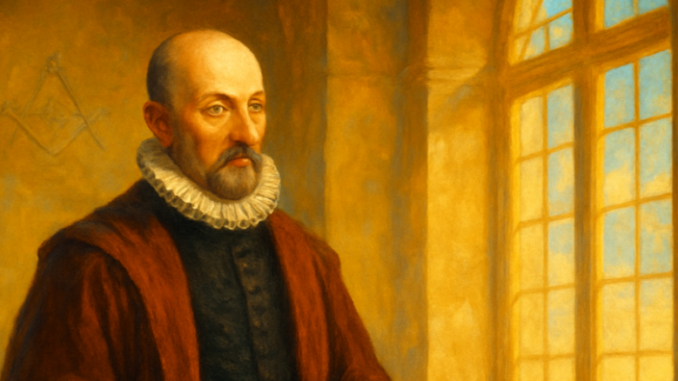
You’re about to make a major decision. Your stomach tightens, your thoughts race. Fear is a primal force that every human being knows intimately — whether you lived in sixteenth-century France or in the modern world today. Michel de Montaigne, the French thinker celebrated for his profoundly introspective essays, devoted an entire chapter to this very subject. His insights turn out to be remarkably relevant, especially for those committed to personal growth and brotherhood. So what can Freemasons learn from his reflections on fear?
How Fear Works According to Montaigne
In his essay “Of Fear,” Montaigne describes how anxiety influences our behavior in unpredictable ways. He recounts stories of soldiers who froze on the battlefield, of people who fled without knowing where they were going. Fear can paralyze us, but it can also drive us to reckless action. Montaigne observes that fear often causes more damage than the danger itself. It is not the threat that breaks us — it is our reaction to it.
This insight applies directly to everyday life. How many opportunities do we let slip away out of fear of rejection? How many conversations do we avoid because we dread conflict? Montaigne invites us to face our fears honestly — not to condemn them, but to understand them.
Self-Reflection as an Antidote
What Montaigne proposes aligns perfectly with what Freemasons practice in their rituals: honest self-reflection. Entering a lodge begins with a fundamental question — who am I, really? The rough ashlar, a central symbol in Freemasonry, represents the unfinished self. Through continuous inner work, we chip away at our rough edges. Fear is one of those rough edges. It is a part of ourselves that we need not deny, but that we can learn to understand and master.
He who learns to know his fear discovers a path to inner freedom.
Montaigne was not a Freemason — organized Freemasonry did not emerge until more than a century after his death. Yet his method and the method of the lodges share an essential starting point: only by looking at yourself honestly can you grow. This is not a theoretical ideal. It is a daily practice.
Brotherhood as a Safe Harbor
Fear isolates. It whispers that we are alone, that no one understands us. This is where the power of brotherhood reveals itself. In Freemasonry, people find a community where vulnerability is not weakness but a sign of courage. When brethren gather in lodge, a space is created where masks can fall away. This is precisely what Montaigne seems to suggest: fear loses its grip when we share it.
In practical terms, this means daring to name your insecurities in conversation. Ask a fellow brother how he deals with situations that frighten him. You will find that speaking fear aloud often diminishes it. The chain of union that Freemasons form during their rituals is more than symbolism — it is a living practice of support and trust.
Practical Steps for Dealing with Fear
Montaigne does not offer a step-by-step plan, but his method points us in the right direction. Here are several practical actions you can apply today:
Write down what frightens you. The act of naming your fears alone brings clarity.
Ask yourself: what is the worst that could happen? More often than not, the worst-case scenario is far less catastrophic than your imagination suggests.
Share your fear with someone you trust. This might be a fellow brother, a friend, or a family member.
Take one small action toward the thing you fear. Every step forward enlarges your courage.
Reflect at the end of each day: How did fear influence my choices today? What would I do differently tomorrow?
Seeking the Light Beyond Fear
In Freemasonry, light plays a central role. The candidate enters the lodge in darkness and gradually receives more light — a symbol of knowledge and insight. Fear thrives in the dark, in the unknown. By examining our fears, as Montaigne demonstrates, we bring light into our own shadow places. This is not a one-time act but a lifelong journey.
Montaigne does not conclude his essay with a triumphant victory over fear. He acknowledges that fear is part of being human. That may be his most important lesson: we do not need to be fearless. We only need to be brave enough to act, to speak, and to connect — despite the fear.
The words of Michel de Montaigne, written more than four hundred years ago, still strike a deep chord. His essay “Of Fear” reminds us that anxiety is universal but not all-powerful. Through self-reflection, through brotherly connection, and through small, courageous steps, we can learn to live with fear without being ruled by it. Whoever wishes to shape the rough ashlar must also dare to touch his fears. That is where real growth begins.
Copyright text & image: devrijmetselaar.nl
Texts are based on the ideas and content of the author of devrijmetselaar.nl, reviewed, corrected, and supplemented with the assistance of OpenAI. Images are created based on the ideas of the author of devrijmetselaar.nl using OpenAI/DALL-E.
Frequently Asked Questions
What was Michel de Montaigne's main insight about fear?
Montaigne observed that fear often causes more damage than the actual danger itself. He noted that fear can paralyze us or drive us to reckless action, and that it is not the threat that breaks us, but our reaction to it. He advocated for facing our fears honestly to understand them rather than condemning them.
How does Montaigne's philosophy on fear relate to Freemasonry?
Both Montaigne's philosophy and Freemasonry practice emphasize honest self-reflection as a path to personal growth. The Masonic symbol of the rough ashlar represents the unfinished self that must be continuously refined. By understanding and mastering fear through inner work, Freemasons can achieve inner freedom, much like Montaigne's approach of looking at oneself honestly to grow.
How does brotherhood help Freemasons overcome fear?
According to the article, fear isolates individuals by suggesting they are alone. Brotherhood in Freemasonry creates a safe community where vulnerability is viewed as courage rather than weakness. In lodge, brethren can remove their masks and connect authentically, providing mutual support that counteracts the isolating nature of fear.


Be the first to comment