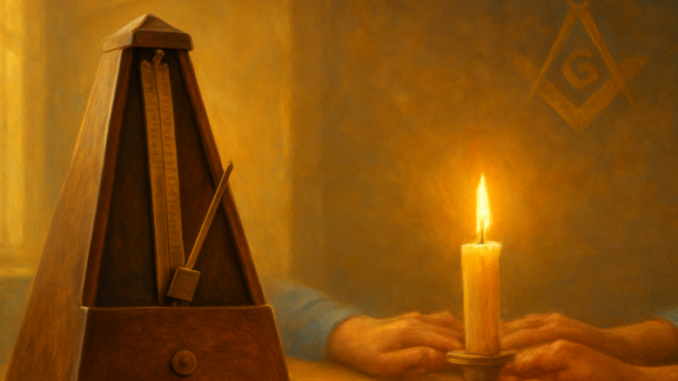
Somewhere in a lodge in the Netherlands, a brother sits quietly at the festive board after the ritual work is done. He’s a business owner, and earlier that afternoon he was told his company isn’t showing enough “growth.” The numbers don’t add up, they said. But here, among his brethren, he feels something no spreadsheet can measure: recognition for who he is, not for what he produces. This tension between measurable value and human dignity touches on something that’s currently rippling through the world of the arts — and something Freemasonry has been teaching for centuries.
The Tyranny of the Number
Recently, a well-known contemporary musician spoke out against the obsession with streaming numbers in the music industry. He called it “depressing” that artists are reduced to statistics — figures on a screen that determine whether you’re considered successful or not. His words struck a nerve, not just in the entertainment world, but across a society that seems increasingly obsessed with quantification.
We live in an era where everything must be measurable. Likes, followers, streaming counts, watch minutes, revenue, return on investment. People are judged more and more on the basis of data rather than character or contribution to community. This development stands in stark contrast to one of the core values Freemasonry has cherished since the eighteenth century: the intrinsic worth of every human being, regardless of worldly achievement.
Brotherhood as an Antidote
In a Masonic lodge, there is no hierarchy based on wealth, fame, or social success. The banker sits beside the carpenter; the doctor beside the postal worker. James Anderson, who penned the first constitution of modern Freemasonry in 1723, emphasized that brethren should judge one another on moral qualities, not external status. This principle forms the very foundation of what we call brotherhood.
True brotherhood does not measure a person by his achievements, but by his sincerity in striving to improve himself and the world around him.
This brotherhood is not a casual friendship. It is a deliberate choice to see the other as a fellow traveler on the same journey of self-improvement. In a world increasingly dominated by algorithms and metric-driven evaluations, the lodge offers a sanctuary where different values prevail.
What Aristotle Teaches Us About True Appreciation
The Greek philosopher Aristotle distinguished between different kinds of friendship as far back as the fourth century BCE. He described friendships based on utility, on pleasure, and on virtue. Only the last category did he consider genuine friendship, because it is grounded in who the other person truly is — not in what they can offer or produce.
The modern obsession with numbers creates relationships that fall squarely into the first category: relationships of utility. An artist is valuable as long as the numbers look good. An employee is valuable as long as targets are met. A friend is valuable as long as they add something to your network. This impoverishment of human connection is precisely what that contemporary musician called “depressing.”
The Lodge as a Place of Practice
Freemasons gather regularly in their lodges — not to close business deals or build professional networks, but to work together on their inner development. The ritual they employ reminds the brethren that certain values exist which cannot be expressed in numbers: wisdom, strength, beauty, brotherly love, sincerity, and charity.
Wisdom to discern between appearance and substance.
Strength to push back against the current of metric-driven thinking.
Beauty in recognizing the intrinsic worth of every human being.
Johann Wolfgang von Goethe, the great German poet and Freemason, wrote that a person can only truly know himself in relation to others — not by measuring himself against them, but by recognizing in them the shared humanity that mirrors his own. This insight lies at the heart of Masonic philosophy about brotherhood.
From Streaming Numbers to a Listening Ear
That musician’s remark about the depressing effect of number obsession is more than a complaint about the music industry. It is a signal that we, as a society, risk losing something fundamental: the ability to value what cannot be measured. A meaningful conversation. A helping hand. Presence without an agenda.
Freemasonry does not offer a ready-made solution to the metric tyranny of our time. What it does offer is a space where different rules apply. A space where a brother is not asked how much he has achieved, but how he is growing as a person. Where success is not measured by external recognition, but by inner development and contribution to the community.
An Invitation to Reflect
Perhaps the discontent now bubbling up in the arts is an invitation for all of us — an invitation to reconsider how we value ourselves and others. To ask whether we want friendships and relationships that depend on performance, or connections rooted in something deeper.
The Freemason learns that true brotherhood begins with acknowledging the immeasurable worth of the other person. Not in spite of, but entirely apart from, what that person achieves or produces. In a world that cries ever louder for numbers, this is a quiet but powerful form of resistance.
The depressing effect of number obsession currently being discussed in the arts world is recognizable to anyone who has ever been reduced to a statistic. Freemasonry teaches us that there is another way. In the brotherhood of the lodge, what matters is not what you have achieved, but who you are and who you are striving to become. That is not an escape from reality — it is a reminder of what truly holds value. And perhaps that is exactly the message our number-obsessed age needs to hear.
Copyright text & image: devrijmetselaar.nl
Texts are based on the ideas and content of the author of devrijmetselaar.nl, reviewed, corrected, and supplemented with the assistance of OpenAI. Images are created based on the ideas of the author of devrijmetselaar.nl using OpenAI/DALL-E.
Frequently Asked Questions
What is the main message of the article about Freemasonry and numbers?
The article argues that modern society's obsession with measurable metrics (likes, followers, revenue) undermines human dignity and true brotherhood. Freemasonry, since the eighteenth century, has taught that every person has intrinsic worth regardless of worldly achievements or statistics, offering a sanctuary from metric-driven evaluations.
How does Freemasonry define brotherhood differently from casual friendship?
In Freemasonry, brotherhood is a deliberate choice to see others as fellow travelers on a journey of self-improvement, judged by moral qualities rather than external status or achievements. It is a bond where a banker sits beside a carpenter and a doctor beside a postal worker, all valued equally.
What did James Anderson establish about how Masonic brethren should be judged?
James Anderson, who wrote the first constitution of modern Freemasonry in 1723, emphasized that brethren should judge one another based on moral qualities, not external status such as wealth, fame, or social success. This principle forms the foundation of Masonic brotherhood.


Be the first to comment