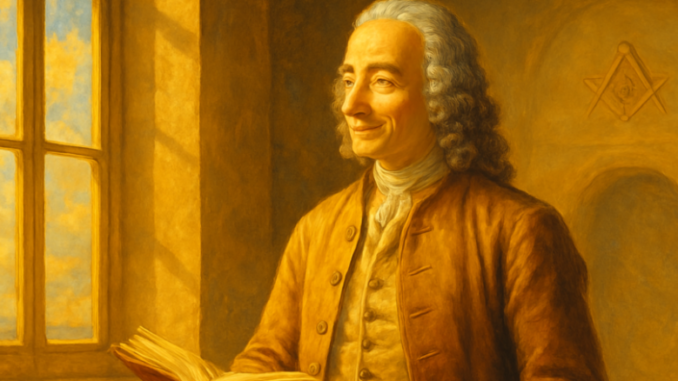
When Voltaire published his satirical masterpiece Candide in 1759, he set off a philosophical earthquake. The work confronts the reader relentlessly with human suffering, yet refuses to abandon hope entirely. How can a thinker who depicts misery with such razor-sharp clarity still leave a path open toward meaning? The answers lie in a rich intellectual heritage stretching from the Stoic philosophers to the Enlightenment salons of Paris — and they connect in surprising ways to the ideals cherished by Freemasonry.
Two Perspectives on Evil
To understand Voltaire’s treatment of suffering, we need to set two fundamentally different worldviews side by side. On one hand stands the optimism of Gottfried Wilhelm Leibniz, the German philosopher who claimed that we live in the best of all possible worlds. According to Leibniz, God — as a perfect being — necessarily created the most harmonious universe. Every evil serves a higher purpose; every instance of suffering fits neatly into a grand cosmic plan.
On the other hand stands Voltaire himself, who dissected this optimism with biting irony. After the devastating Lisbon earthquake of 1755, which killed tens of thousands of people, he could no longer accept the notion that all suffering has divine justification. In Candide, the naïve protagonist is hurled from one disaster to the next — precisely to show how hollow Leibnizian optimism sounds when measured against real human catastrophe.
The Stoic Heritage
Yet Voltaire is no nihilist. His critique of blind optimism draws from a far older tradition: Stoicism. Thinkers like Seneca and Marcus Aurelius taught that while the universe inevitably contains suffering, human beings possess an inner freedom in how they respond. It is not events themselves that determine our fate, but our attitude toward those events. This idea resonates throughout Candide.
Where Leibniz rationalizes evil as part of a perfect plan, the Stoic accepts evil as a given and seeks strength in personal response. Voltaire adopts this approach but adds something essential: the necessity of practical action. It is not enough to fortify yourself inwardly — you must also get your hands dirty in the world.
The Garden as a Symbol of Hope
The famous conclusion of Candide, in which the hero decides that one must cultivate one’s garden, is not a rejection of hope but a redefinition of it. Rather than waiting for cosmic justice or divine intervention, Voltaire chooses human action as the source of meaning. The garden symbolizes the modest but genuine work we can accomplish within our own sphere of influence.
In Voltaire’s vision, hope is not a passive waiting for salvation but the active cultivation of humanity within the boundaries of our own reach. This perspective aligns remarkably well with Masonic ideals, where the working of the rough stone — the ashlar — serves as a central metaphor. Just as the Mason works on his own character, Candide works on his garden. Both traditions refuse to succumb to cynicism or fatalism, choosing instead constructive action as an answer to an imperfect world.
Enlightenment Thinking and Brotherhood
Voltaire wrote Candide during a period when the Enlightenment was transforming Europe. Thinkers like John Locke and Pierre Bayle had paved the way for religious tolerance and critical inquiry. The salons of Paris hummed with conversations about reason, progress, and human perfectibility. At the same time, Masonic lodges were springing up across Europe, putting these Enlightenment values into practice by bringing together men of different backgrounds in a spirit of brotherhood.
The kinship between Voltaire’s philosophy and Freemasonry is no coincidence. Both emphasize the importance of personal responsibility over dogmatic belief, the value of practical engagement with the world, the possibility of improvement through self-reflection and labor, and tolerance as the foundation of a humane society. These shared principles reveal a deep philosophical current running through both the literary and fraternal traditions of the eighteenth century.
Skepticism Without Despair
A final philosophical current that permeates Candide is the skepticism Voltaire inherited from Michel de Montaigne. Montaigne, whose essays were the first to place the question of what a person can truly know at center stage, taught his readers to be humble about their own convictions. Voltaire applies this lesson by undermining both religious optimism and philosophical pessimism in equal measure.
The result is a remarkable combination: a writer who criticizes all grand systems but refuses to give up. Voltaire mocks metaphysical pretensions yet holds firm to the possibility of human dignity and improvement. His skepticism destroys false certainties, but it creates space for a more modest and more honest form of hope.
What Both Perspectives Share
When we place Leibniz’s optimism alongside Voltaire’s satirical critique, something surprising emerges: both are searching for a way to give meaning to a world full of suffering. Leibniz finds that meaning in a cosmic plan; Voltaire finds it in human action. The question of theodicy — how a benevolent God can permit evil — drives both thinkers, even though they arrive at opposite answers.
For today’s reader, and especially for those drawn to Freemasonry, the lesson may lie in this shared search itself. We need not choose between naïve optimism and cynical pessimism. The path Voltaire points to is that of the working individual: someone who acknowledges suffering but refuses to drown in it, and who bases hope not on heavenly promises but on earthly effort.
Voltaire’s Candide stands at a crossroads of philosophical traditions — from Leibniz’s optimism to Stoic resilience, from Montaigne’s skepticism to the practical ideals of the Enlightenment. For Freemasons, the work offers a powerful mirror: it reminds us that meaning is not something bestowed from above, but something we build with our own hands. The rough stone does not shape itself. The garden does not tend itself. It is in the daily discipline of constructive action — modest, honest, and persistent — that both the Mason and the philosopher find their answer to a world that is far from perfect, but never beyond hope.
Copyright text & image: devrijmetselaar.nl
Texts are based on the ideas and content of the author of devrijmetselaar.nl, reviewed, corrected, and supplemented with the assistance of OpenAI. Images are created based on the ideas of the author of devrijmetselaar.nl using OpenAI/DALL-E.
Frequently Asked Questions
What is the main difference between Leibniz's and Voltaire's views on suffering?
Leibniz believed we live in the best of all possible worlds where God, being perfect, created the most harmonious universe and every evil serves a higher purpose. Voltaire rejected this optimism, particularly after the Lisbon earthquake of 1755, and argued through Candide that such reasoning is hollow when confronted with real human catastrophe and suffering.
How does Stoicism influence Voltaire's philosophy in Candide?
Voltaire draws from Stoic philosophy, which teaches that while suffering is inevitable in the universe, humans possess inner freedom in how they respond to it. However, Voltaire adds a crucial element absent from classical Stoicism: the necessity of practical action in the world, not just inner fortitude.
What does the garden symbolize at the end of Candide?
The garden represents a redefinition of hope through human action rather than reliance on cosmic justice or divine intervention. By cultivating one's garden, Voltaire suggests that meaning and purpose come from practical engagement with the world and tangible human effort, not from passive acceptance of a predetermined cosmic plan.

Be the first to comment