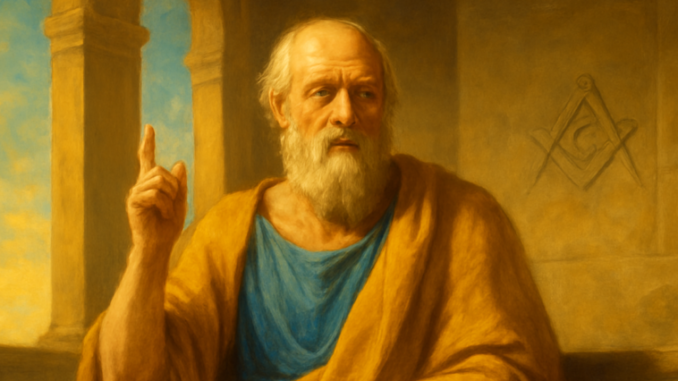
What happens to the soul when the body dies? Is death the final chapter, or does it mark a transition to something greater? These questions are not merely philosophical curiosities — they touch the very core of human existence. In the Phaedo, one of his most profound dialogues, Plato invites us into the final hours of Socrates, who is about to drink the hemlock. What follows is not a eulogy steeped in sorrow, but a lucid argument for the immortality of the soul.
Why Did Plato Write This Dialogue?
The Phaedo is far from an abstract treatise detached from real life. On the contrary, Plato situates his most profound reflections on the soul precisely within the context of his master Socrates’ death. This deeply personal setting lends the question of immortality an emotional urgency that no theoretical exercise could achieve. Socrates’ friends are gathered in his cell, torn between grief and an almost desperate curiosity. They want to know: is this truly the end?
Plato uses this dramatic setting to weave philosophy together with existential reality. The dialogue demonstrates that wisdom is not an escape from life, but rather a way of confronting death head-on. Socrates does not speak as a man gripped by fear; he speaks as someone who has spent his entire life contemplating what is truly valuable.
What Is the Central Idea of the Phaedo?
The core question is straightforward yet immense: does the soul continue to exist after the death of the body? Socrates argues through multiple lines of reasoning that it does. In his view, the soul is not merely a byproduct of the body — it is an independent, immaterial being held captive within the physical form. Death, then, is not annihilation but liberation.
The soul is imprisoned in the body as in a dungeon; death opens the door to true knowledge and purity.
This idea of the soul as something that exists independently of the body laid the groundwork for later Western conceptions of immortality. It also resonates powerfully with Freemasonry, where the theme of death and rebirth stands at the heart of ritual practice. Just as the candidate symbolically dies and is reborn during initiation, Socrates suggests that physical death is merely one phase in a greater, eternal process.
What Arguments Does Socrates Present?
Socrates offers several distinct arguments to make the case for the soul’s immortality. Each illuminates a different facet of his conviction.
The Argument from Opposites
Everything in nature arises from its opposite: heat from cold, waking from sleep. If life comes from death, then death must in turn lead back to life. This cyclical argument suggests that the soul does not vanish — it returns.
The Argument from Recollection
We recognize abstract concepts such as equality and beauty, even though no one has ever presented us with a perfect example in the physical world. According to Socrates, this is evidence that the soul existed before our birth and possessed knowledge of the pure Forms. The body forgets, but the soul remembers.
The Argument from Indivisibility
Whatever is composite can be broken apart. The body is composite, and therefore it decays. The soul, however, is immaterial and simple — it cannot be divided into parts and is therefore impervious to destruction.
The Rich Symbolism of the Phaedo
The Phaedo is laden with powerful imagery that reaches beyond words alone. The body is described as a prison, death as a release. The philosopher is portrayed as someone who practices dying throughout his entire life — not out of morbidity, but out of a yearning for the pure truth that only the liberated soul can attain.
This image of the body as a dungeon and the soul as its prisoner bears a striking resemblance to Masonic symbolism. The rough ashlar that must be shaped, the journey from darkness into light, the symbolic death in the Third Degree ritual — all of these images reflect the idea that human beings must grow beyond their physical limitations. Plato’s imagery and the Craft’s allegories share a common language: the conviction that what is most real and most valuable lies beyond the material world.
How Does the Dialogue End?
After presenting his arguments, Socrates calmly bids farewell to his friends. He drinks the hemlock without hesitation or complaint. His final words form one of the most famous passages in all of philosophy: he asks Crito to sacrifice a rooster to Asclepius, the god of healing. The implication is extraordinary — Socrates suggests that death is itself a cure, a liberation from the illness that is earthly life.
This serene departure stands in stark contrast to the grief of those around him. Socrates demonstrates that whoever truly believes in the immortality of the soul need not fear death. It is a lesson in dignity and trust — an attitude that Freemasonry also encourages: not to deny death, but to give it its rightful place within the larger narrative of human growth and transformation.
What Does the Phaedo Mean for Us Today?
The questions Plato raises are timeless. Whether or not one believes in a literal immortality, the Phaedo invites deep reflection. What gives life meaning if it is finite? How do we live when we know we will die? And what remains of who we are when the body is no more?
For Freemasons, this dialogue offers a philosophical foundation for themes that are lived and experienced within the Lodge. The symbolic death, the search for light, the pursuit of self-improvement — all of these elements find their echo in Plato’s words. The Phaedo is not merely a text to be read; it is an invitation to live with an awareness of what lies beyond the visible world.
More than two thousand years after it was written, the Phaedo remains one of the most penetrating texts ever composed about the human soul. Plato’s portrait of Socrates on the threshold of death is at once a philosophical argument and a spiritual lesson. The dialogue teaches us that those who understand death as a transition rather than an ending can live with greater freedom and clarity. For anyone seeking deeper meaning — whether through philosophy, through the Craft, or through the quiet contemplation of life’s greatest mysteries — the Phaedo offers a timeless source of wisdom and inspiration.
Copyright text & image: devrijmetselaar.nl
Texts are based on the ideas and content of the author of devrijmetselaar.nl, reviewed, corrected, and supplemented with the assistance of OpenAI. Images are created based on the ideas of the author of devrijmetselaar.nl using OpenAI/DALL-E.
Frequently Asked Questions
What is the main argument Plato makes about the soul in the Phaedo?
Plato argues through Socrates that the soul is an independent, immaterial being that exists separately from the body. Rather than being a byproduct of the physical form, the soul continues to exist after the body dies. Socrates describes the soul as imprisoned in the body like a prisoner in a dungeon, and death represents liberation rather than annihilation.
Why did Plato choose to write about the soul's immortality in the context of Socrates' death?
By situating his profound reflections on the soul within the dramatic setting of Socrates' final hours before drinking hemlock, Plato weaves philosophy together with existential reality. This deeply personal context lends emotional urgency to the question of immortality and demonstrates that wisdom is not an escape from life, but a way of confronting death head-on with courage and conviction.
How does Plato's concept of the soul relate to Freemasonry?
The theme of death and rebirth in the Phaedo resonates powerfully with Freemasonry. Just as Socrates suggests that physical death is merely one phase in a greater, eternal process, candidates in Freemasonry symbolically experience death and rebirth during initiation rituals, reflecting the same spiritual principles about transformation and renewal.


Be the first to comment