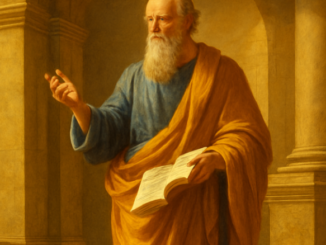
Ancient Greek philosopher in contemplation symbolizing Freemasonry and Plato
Plato – Freemasonry & Connection

Plato’s Phaedo and Freemasonry: A Shared Quest for Light

Imagine sitting in a room with your closest friends, knowing this conversation will be your last. What would you want to talk about? For Socrates, in the final hours before his death, the answer was clear: the immortality of the soul and the meaning of a life well lived. In Plato’s dialogue Phaedo, we find not only a philosophical masterpiece on life and death, but also a wellspring of insights that resonate remarkably with the core principles of Freemasonry. The Setting of a Final Farewell The Phaedo unfolds in Socrates’ prison cell on the day of his execution. His students — Phaedo, Simmias, Cebes, and others — gather around their teacher for one last conversation. What follows is neither a lament nor a bitter goodbye, but a calm, profound exploration of what it means to live and die as a philosopher. Socrates faces his own death with a serenity that both astonishes and inspires his companions. This composure is not indifference or denial. It is the fruit of a life devoted to self-reflection and the pursuit of truth. Socrates spent his entire existence examining the human condition, asking difficult questions, and challenging false certainties. Now, at the end, he reaps […]
Ancient Greek cup symbolizing Socrates' hemlock and the immortality of the soul
Plato – Philosophical Background

Plato’s Phaedo: Philosophical Roots of Immortality

A cup. Simple earthenware, filled with a liquid that ends a life. Yet it is precisely this ordinary object that becomes the stage for one of the most profound philosophical conversations in the Western tradition. As Socrates approaches the hemlock, a dialogue unfolds that asks what remains of us when the body dies. The cup becomes a threshold — a passage from the visible to the invisible. To understand why Plato wrote this dialogue the way he did, we must descend into the philosophical sources that nourished his thought. The Orphic Mysteries and the Soul as Prisoner Plato’s conviction that the soul is immortal and the body merely a temporary dwelling is deeply rooted in the Orphic tradition. This mystery school, named after the mythical singer Orpheus, taught that the soul is divine in origin but became trapped in the body through a primordial transgression. The Greek word soma (body) was linked by the Orphics to sema (tomb) — the body as the soul’s burial chamber. We recognize this idea in the Phaedo when Socrates describes the body as an obstacle preventing the soul from attaining true knowledge. The senses deceive us; desires cloud our judgment. Only in death, when […]

Ancient Greek philosopher Socrates discussing the immortality of the soul
Plato – Content & Summary

Plato’s Phaedo: The Soul and Its Immortality Explained

What happens to the soul when the body dies? Is death the final chapter, or does it mark a transition to something greater? These questions are not merely philosophical curiosities — they touch the very core of human existence. In the Phaedo, one of his most profound dialogues, Plato invites us into the final hours of Socrates, who is about to drink the hemlock. What follows is not a eulogy steeped in sorrow, but a lucid argument for the immortality of the soul. Why Did Plato Write This Dialogue? The Phaedo is far from an abstract treatise detached from real life. On the contrary, Plato situates his most profound reflections on the soul precisely within the context of his master Socrates’ death. This deeply personal setting lends the question of immortality an emotional urgency that no theoretical exercise could achieve. Socrates’ friends are gathered in his cell, torn between grief and an almost desperate curiosity. They want to know: is this truly the end? Plato uses this dramatic setting to weave philosophy together with existential reality. The dialogue demonstrates that wisdom is not an escape from life, but rather a way of confronting death head-on. Socrates does not speak as […]